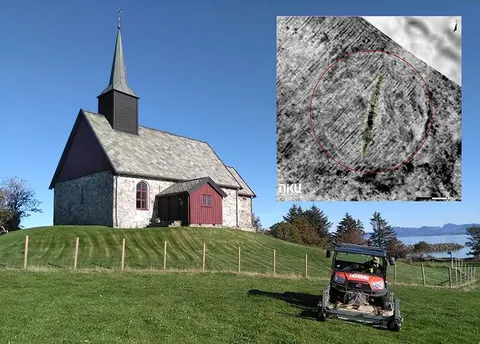
Eday Church: Eday's Viking Graves
The arrival of Scandinavian settlers transformed Orkney.
From the late first millennium AD, Norse language, political institutions, settlement patterns, religious traditions, and burial practices became deeply embedded within the islands.
The area around Eday Church preserves evidence connected with this Viking and Norse presence.
Burials are especially valuable because they provide direct archaeological evidence for individuals rather than merely buildings or artifacts.
Vikings in Orkney
Scandinavian activity in Orkney began before permanent settlement.
Viking raiders used the Northern Isles strategically because of their position along maritime routes between Scandinavia, Britain, Ireland, and the North Atlantic.
Eventually, Norse settlement became substantial.
Orkney became part of the Norse political world and later the earldom of Orkney.
Viking Burial Practices
Norse burial traditions varied.
Some individuals were buried in:
Simple graves
Stone-lined graves
Cists
Boat burials
Burial mounds
Grave goods could include weapons, jewelry, tools, dress accessories, and personal possessions.
However, the presence or absence of grave goods does not automatically determine whether an individual was "Viking."
Burial practices changed through time and were influenced by Christianity.
Christianity Changes Burial
One of the most important transformations in Norse Orkney was Christianization.
Earlier pagan traditions could involve grave goods and burial monuments.
Christian burial increasingly emphasized churchyards and inhumation without the extensive object assemblages characteristic of some earlier graves.
This makes sites around medieval churches particularly interesting because they can represent a transition between religious traditions.
What Graves Can Tell Us
Modern archaeology can extract far more information from graves than nineteenth-century excavators could.
Human remains can provide evidence concerning:
Age
Biological sex
Trauma
Disease
Diet
Childhood stress
Mobility
Physical activity
Isotopic analysis can sometimes identify whether individuals grew up locally or elsewhere.
Ancient DNA can also provide information about biological relationships and population movement when preservation permits.
Eday's Strategic Position
Eday's position in northern Orkney placed it within maritime networks connecting the islands.
Its archaeological record demonstrates that Norse settlement was not confined to Mainland Orkney.
Farmsteads, churches, graves, place names, and landscape features collectively demonstrate the depth of Scandinavian influence.
Beyond the Warrior Stereotype
The archaeological evidence also challenges the popular image of every Viking burial belonging to a warrior.
Most Norse settlers were farmers, craftspeople, traders, fishers, and household members.
A grave therefore provides evidence about a community rather than simply about warfare.
The Viking presence on Eday was part of a broader transformation in which Scandinavian settlers became permanent participants in Orcadian society.