The murals were painted on limestone canyon walls, in the same style, over the span of four millennia
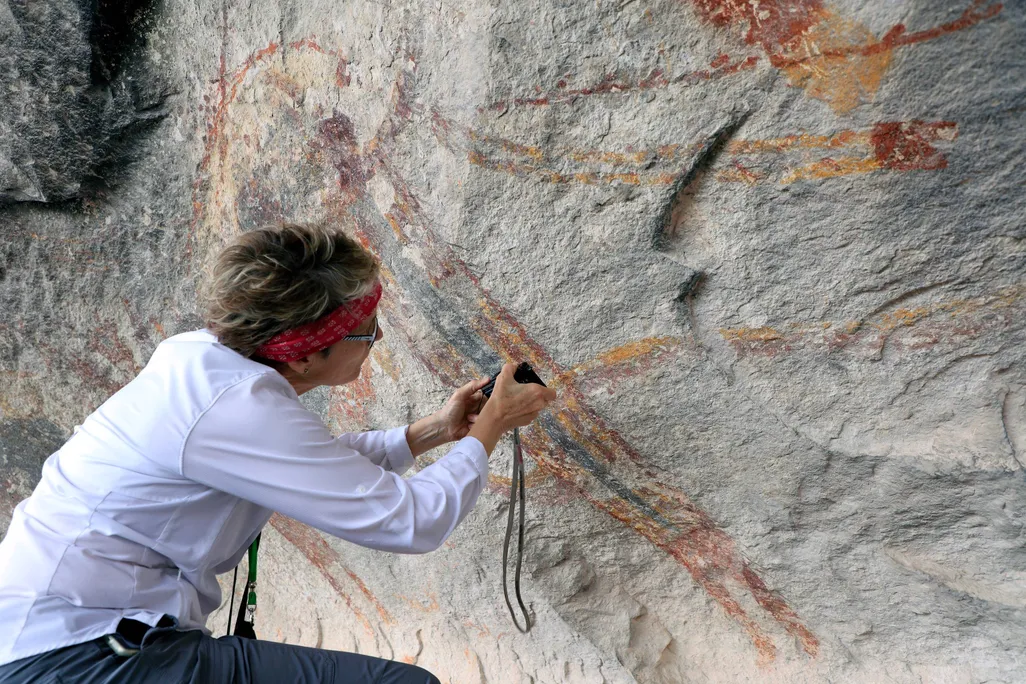
Researcher Carolyn Boyd examines a Pecos River style pictograph in Seminole Canyon State Park and Historic Site.
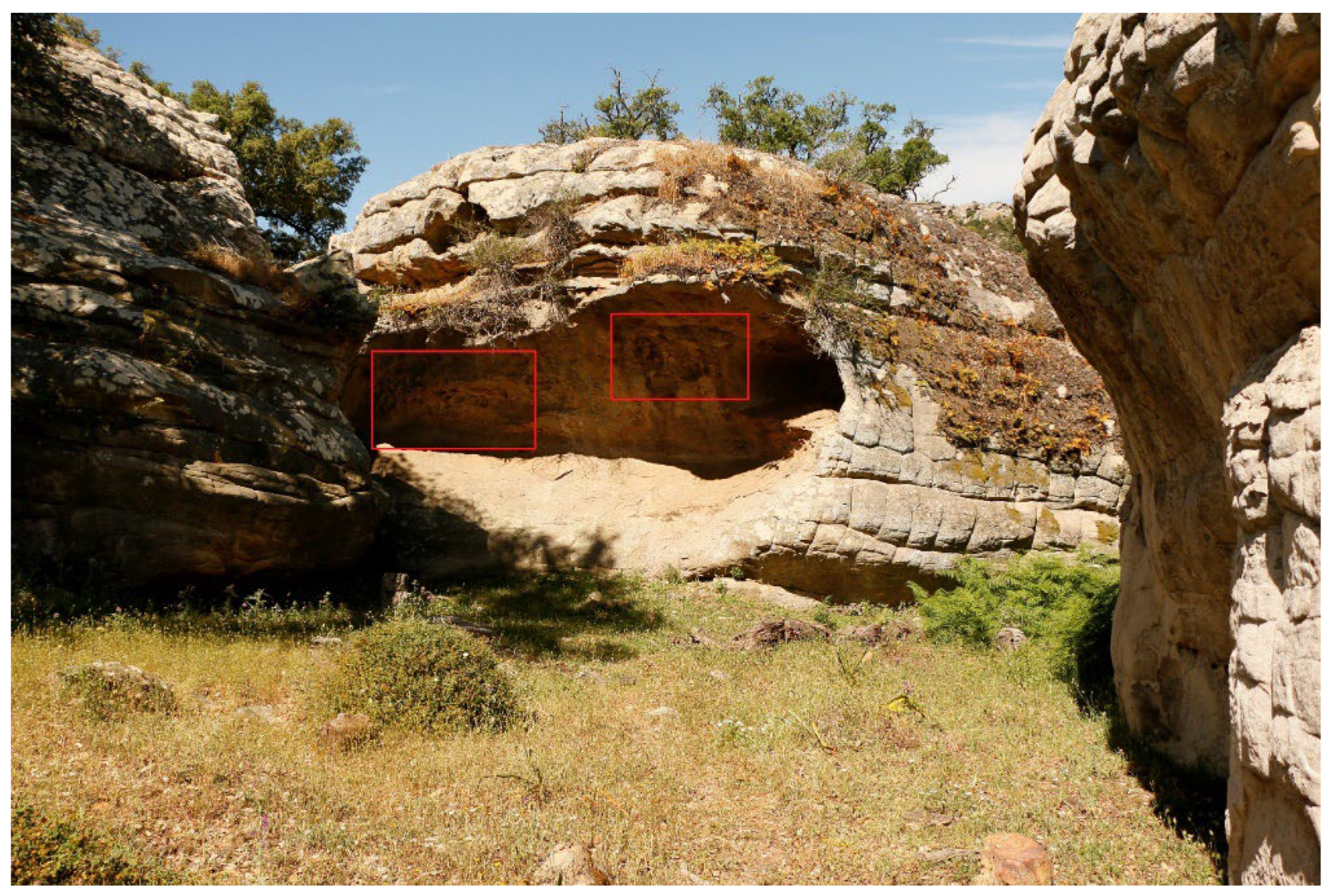
The limestone canyons bordering the Pecos River in southwest Texas are covered with ancient rock art. Created by Indigenous peoples whose identities remain unknown, these Pecos River style murals extend into northern Mexico and have long puzzled archaeologists, largely because their age was impossible to pin down.
That mystery has now been solved. Using radiocarbon analysis of pigments and mineral crusts, researchers were able to date portions of the artwork. Their findings, published in Science Advances, show that people living in the Pecos River valley painted in this same distinctive, cosmic style for an astonishing span of time — from about 3700 B.C.E. to 900 C.E.
“We were honestly shocked to learn that these murals were produced for more than 4,000 years, and that the carefully structured painting sequence stayed consistent the whole time,” says study coauthor Carolyn Boyd, an archaeologist at Texas State University, in an interview with Live Science’s Aristos Georgiou. She compares the canyons to an “ancient library filled with hundreds of books written by 175 generations of artists.” And, she adds, “the stories they tell are still alive today.”
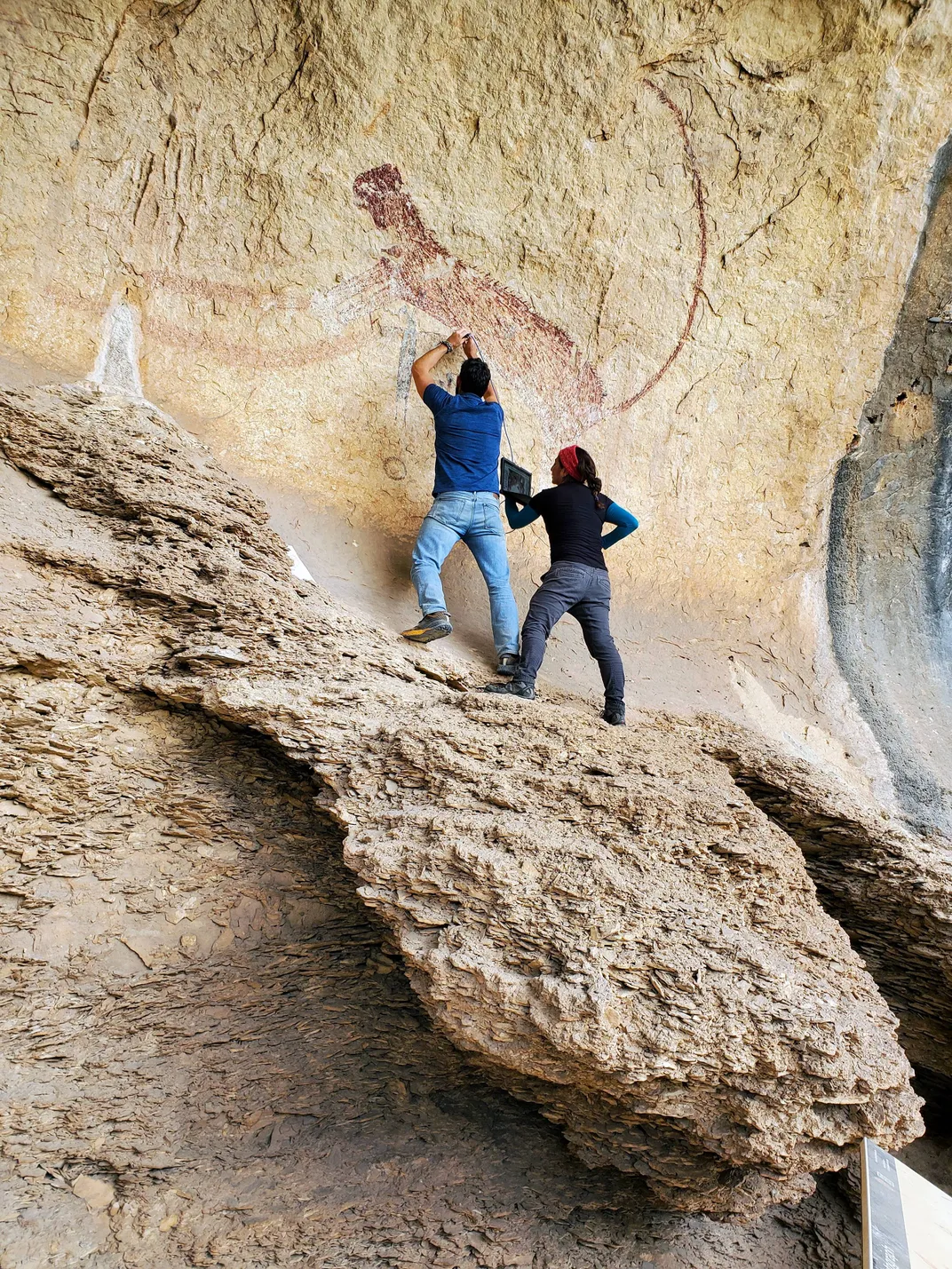
Researchers Tim Murphy and Diana Radillo Rolon capture microscopic images of a 10-foot feline pictograph in Panther Cave.
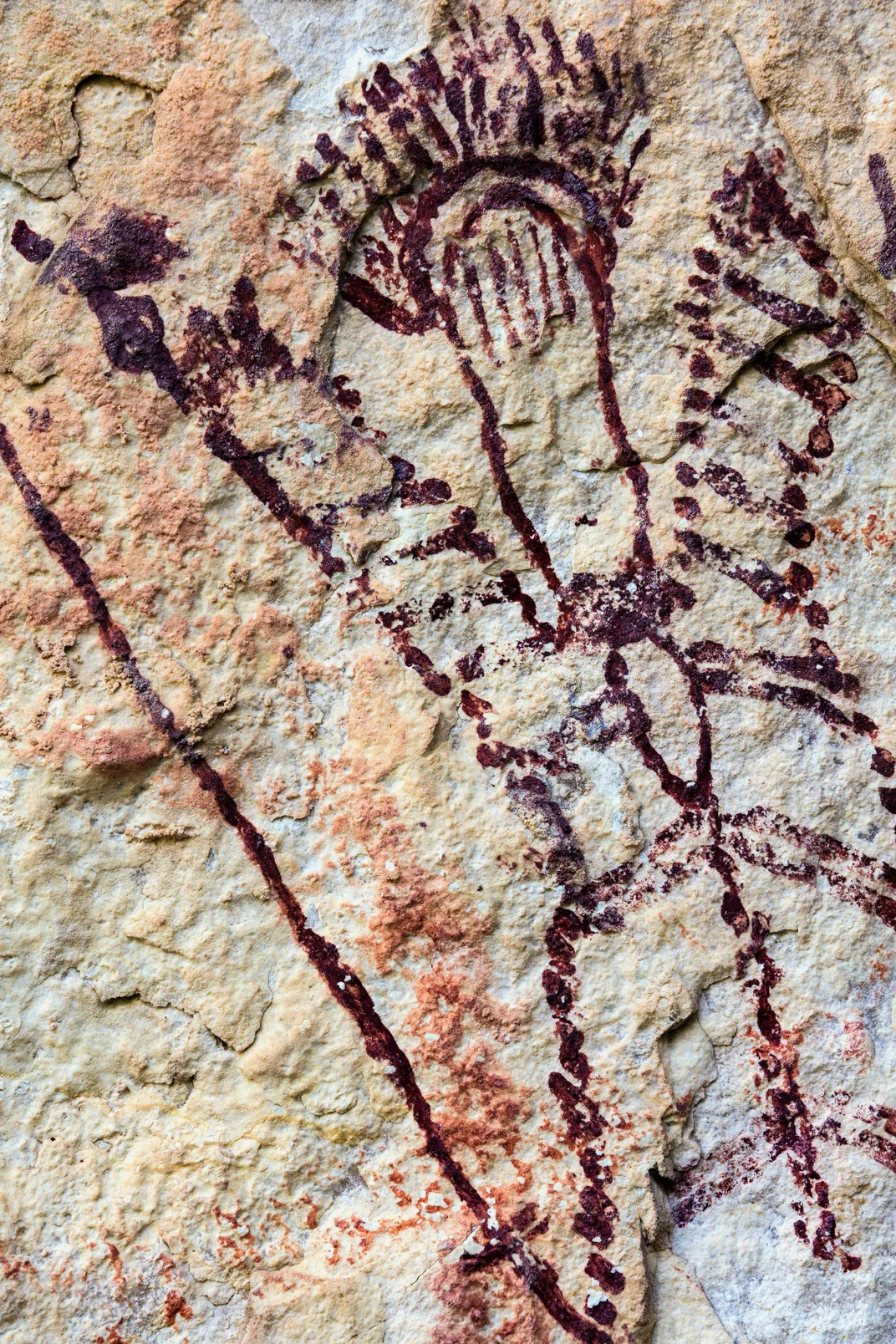
The murals were painted in pigments binded with yucca or bone marrow.
Many Pecos River murals scattered across numerous canyon rock shelters share recurring imagery. As the researchers began their analysis, they first cataloged motifs that appeared repeatedly. They identified 134 murals that featured at least one symbol from a distinctive set, which includes rabbit-ear headdresses, stylized dart points, antlered winged figures, power bundles, and “speech breath.” Power bundles were especially common, appearing in more than 60 percent of the artworks. These bundles resemble plant-, animal-, or human-like forms positioned at the tips of two long lines extending from a figure’s hand.
“Many of the more than 200 murals in the region are massive,” Boyd tells Live Science. “Some stretch over 100 feet in length and reach 20 feet high, packed with hundreds of finely painted images.”
Little is known about the artists themselves, except that they were nomadic hunter-gatherers. Archaeological evidence shows that hunter-gatherer groups occupied the region for more than 12,500 years. Southern Texas’ dry climate helped preserve the paintings, but determining their age remained a major challenge.
To overcome this, researchers concentrated on 12 murals that displayed similar imagery. According to the study, they applied two independent dating methods. The first measured organic carbon in the paint’s binding materials—likely yucca fiber and deer bone marrow. The second analyzed carbon within calcium oxalate mineral crusts that had formed both beneath and on top of the paintings, allowing the team to estimate the murals’ minimum and maximum ages.
“It’s crucial to collect a control sample from unpainted rock to check for any organic contamination on the surface,” says study coauthor Karen Steelman, science director at the Shumla Archaeological Research and Education Center, in an interview with Artnet News. “If no contamination is detected as was the case here then we can be confident that the organic material being dated comes solely from the paint itself.”
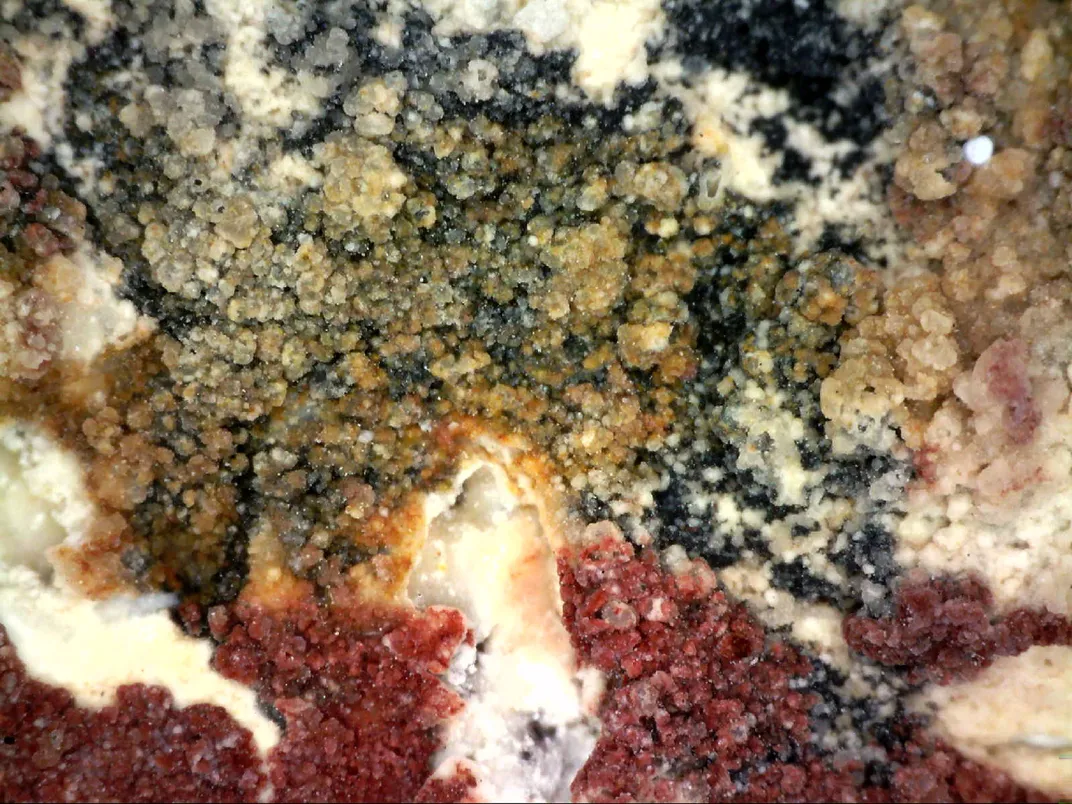
This photomicrograph shows layers of yellow, red and black paint.
Anthropologists once believed that Pecos River murals were built up slowly, with different artists adding small elements over long stretches of time. However, new radiocarbon analysis shows that the pictographs on each mural were created so close together in time that they are statistically indistinguishable indicating that each mural was likely painted in a single event.
Analysis of paint layers and recurring imagery across twelve murals reveals that eight of them follow the same artistic rules and symbolic traditions, even though they were created as much as 4,000 years apart. This consistency suggests a unified system of messaging that endured despite major changes in climate, land use, and material culture.
Researchers propose that the Pecos River style conveyed a complex system of metaphysical ideas concepts related to existence, time, space, and the origins of life. This long-standing “cosmovision” may have shaped the belief systems of later Mesoamerican societies, including the Olmec, Maya, and Aztec.
Indigenous communities today interpret the murals as living, conscious ancestral beings that continue to participate in creation and cosmic order.
The Huichol people of western Mexico recognize one of the recurring motifs in the Pecos imagery a crenellated arch beneath a portal through which figures pass. According to their traditional understanding, the arch represents the sacred mountain, and the wave-like lines along its sides form a ladder the sun uses to rise from the underworld each morning and to descend again each night.