
Introduction
Salt has played a significant role in human history as a food preservative, dietary resource, commodity, and economic product. Salt production was particularly important in regions where coastal environments, saline lakes, mineral-rich waters, and evaporative conditions made extraction possible.
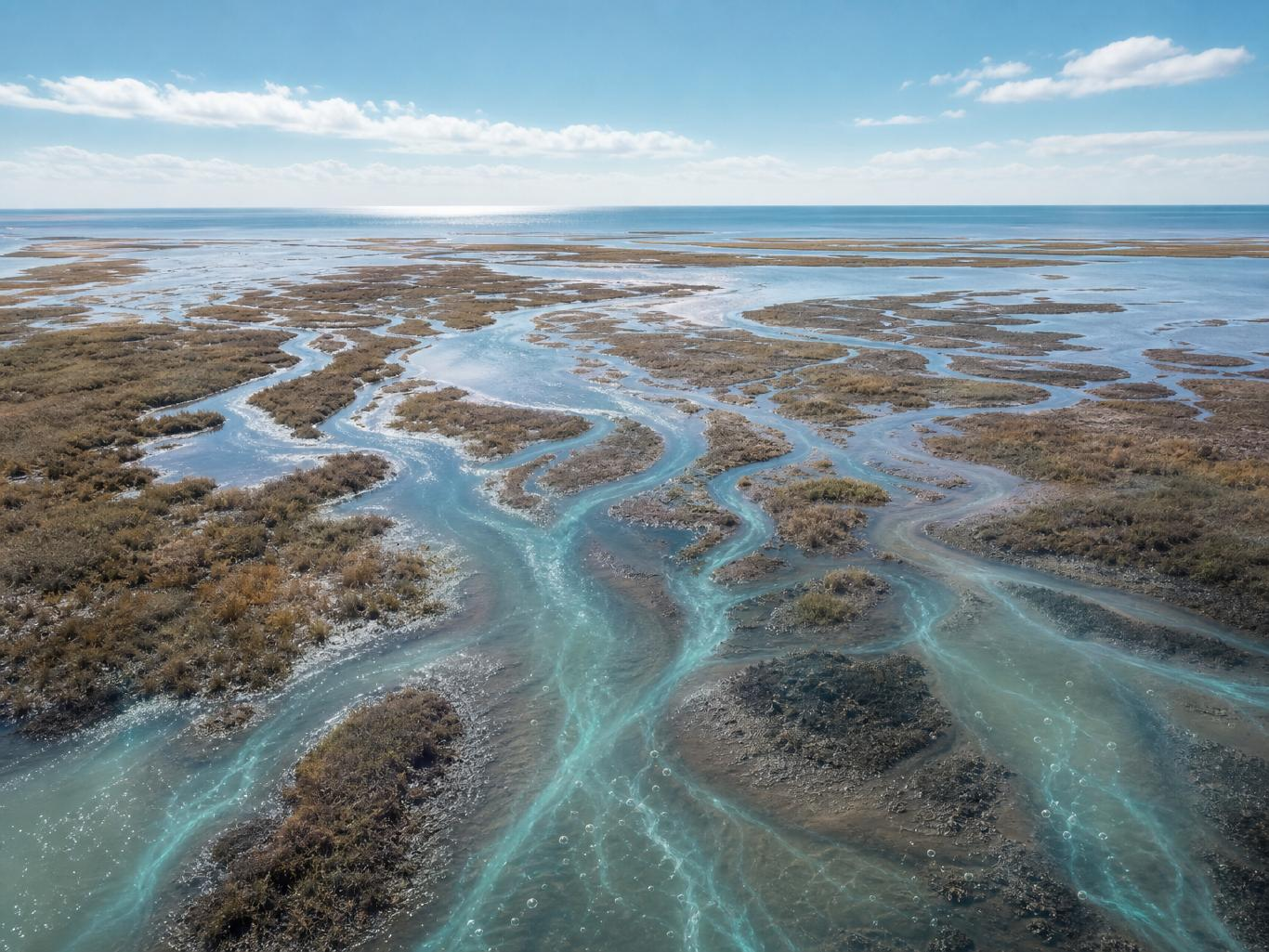
The Yellow River Delta in northern China is an environmentally dynamic region characterized by sediment deposition, shifting channels, wetlands, coastal plains, and changing shorelines. Its geography provides a compelling setting for investigating historical salt production.
The specific salterns referred to in this title are not independently verified archaeological sites. Nevertheless, the archaeological investigation of lost salt-production landscapes in the Yellow River Delta offers an important research theme involving industrial archaeology, environmental reconstruction, and economic history.
Salt Production and Coastal Environments
Salt can be produced through several methods, depending on the available resources and environmental conditions.
Coastal salt production frequently involves the evaporation of seawater. Water is collected and transferred through a system of channels, ponds, or shallow basins. As evaporation increases the concentration of dissolved salts, salt crystals may eventually form and be collected.
In some regions, salt production may also involve saline groundwater or naturally occurring brine.
The efficiency of salt production depends on factors such as temperature, rainfall, humidity, wind, water availability, and the chemical composition of the source.
The Yellow River Delta's coastal environment may have offered opportunities for salt production, although the precise location, date, and archaeological characteristics of any particular saltern would require investigation.
Archaeological Evidence of Salterns
Ancient salt production can leave distinctive archaeological traces.
Researchers may identify:
Evaporation ponds.
Saltwater channels.
Brine storage features.
Heating installations.
Ceramic vessels used in processing.
Concentrated ash deposits.
Burnt clay structures.
Salt-processing tools.
Production waste.
Settlement remains associated with workers.
The interpretation of these remains is not always straightforward. Similar structures may have been used for pottery production, food processing, water management, or other activities.
A saltern identification therefore requires a combination of architectural evidence, environmental context, chemical analysis, and associated artifacts.
The Yellow River and Landscape Change
The Yellow River is well known for its substantial sediment load and changing channels. Its lower course and delta have been reshaped by sediment deposition, river migration, flooding, and coastal processes.
These changes can have significant archaeological consequences.
Salt-production sites may be buried beneath new sediment deposits, eroded by changing waterways, or separated from the modern shoreline. A former coastal production area may now appear inland, while other remains may have been destroyed or submerged.
The reconstruction of historic salt landscapes therefore requires an understanding of both human activity and the changing river-delta environment.
Researchers could examine historical maps, sediment cores, aerial imagery, geomorphological data, and archaeological survey records to identify potential production areas.
Salt, Trade, and Regional Economies
Salt was often an economically important commodity because it could be used to preserve food, support livestock, and facilitate long-distance exchange.
A salt-production center could contribute to the development of regional markets and transportation networks.
The movement of salt may have connected coastal production areas with inland settlements, agricultural communities, military centers, and commercial hubs.
Archaeological research could investigate how salt was transported, packaged, stored, taxed, exchanged, or distributed.
Production facilities may also provide information about labor organization. Large-scale salt production could involve specialized workers, seasonal labor, administrative oversight, and coordinated infrastructure.
Environmental Archaeology and Industrial Reconstruction
The study of lost salterns would benefit from environmental archaeology.
Sediment analysis could identify changes in water salinity, shoreline position, and depositional conditions. Chemical analysis may help distinguish deposits associated with salt processing from ordinary environmental sediments.
Pollen, phytoliths, and other biological remains could reveal vegetation changes around production areas.
Archaeologists could also investigate whether salt production altered local environments through the construction of ponds, channels, embankments, or heating installations.
The relationship between salt production and environmental modification would be particularly important in a delta where natural processes and human activity constantly interact.
Conclusion
Lost salterns in the Yellow River Delta could provide valuable evidence for ancient coastal industries, trade, environmental adaptation, and economic organization. Their investigation would require archaeological fieldwork combined with sediment analysis, historical research, and landscape reconstruction.
The study of salt production illustrates how an apparently ordinary commodity could shape settlement patterns, regional economies, and the transformation of coastal environments.





