Introduction
Situated in An Giang Province in the lower Mekong Delta of southern Vietnam, Óc Eo was the principal entrepôt and major maritime port city of the Funan Empire—one of mainland Southeast Asia's earliest Indianized urban civilizations, flourishing between the 1st and 7th centuries CE.
Strategically positioned along the primary maritime trade route connecting China, India, the Persian Gulf, and the Roman Mediterranean, Óc Eo was a bustling, cosmopolitan metropolis where international merchants, religious scholars, and local artisans exchanged goods, ideas, and technologies.
Urban Layout, Hydraulic Engineering, and Global Trade
Archaeological survey, satellite imagery, and aerial photography reveal that Óc Eo was an expertly engineered hydraulic city:
Canal Systems & Grid Infrastructure: The port was crisscrossed by a vast network of broad, hand-dug canals that served as transportation arteries, urban drainage channels, and agricultural irrigation feeds. Canal 1, a main arterial waterway, connected Óc Eo directly to the inland Funan capital at Angkor Borei (in modern Cambodia) and outward to the Gulf of Thailand.
Stilt House Urbanism: Buildings were constructed on massive timber piles and wooden foundations raised above the seasonal swamp waters of the delta, anchored by brick-and-stone temple foundations (kalan) dedicated to Hindu deities (Vishnu and Shiva) and early Theravada/Mahayana Buddhism.
Excavations at Óc Eo have yielded one of the most international assemblages of trade goods ever found in Southeast Asia:
Western Mediterranean Objects: Roman gold medallions dating to the reigns of Emperors Antoninus Pius and Marcus Aurelius (2nd century CE), alongside Mediterranean glass beads, intaglio ring stones carved with Roman figures, and Sasanian Persian seals.
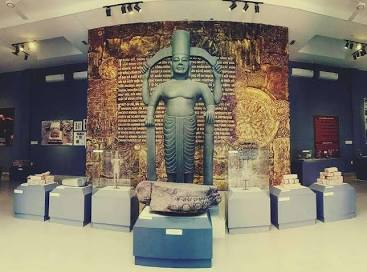
Indian Material Culture: Inscribed gold leaf plaques written in early Grantha and Brahmi Sanskrit scripts, carnelian and agate intaglios depicting Hindu deities, and high-tin bronze statues of Vishnu and Buddha.
Chinese Artifacts: Han Dynasty bronze mirrors, celadon ceramics, and iron tools.
Local artisans at Óc Eo processed raw materials imported through these trade networks, operating large-scale workshops that produced fine gold jewelry, tin amulets, glass beads, and high-fired earthenware pottery stamped with sacred motifs.
Conclusion
Óc Eo stands as a monumental landmark in the history of global trade and early state formation in Southeast Asia. As the maritime gateway of the Funan Empire, this hydraulic port city connected distant civilizations across Afro-Eurasia, playing a transformative role in the cultural, economic, and religious development of the ancient Mekong Delta.