
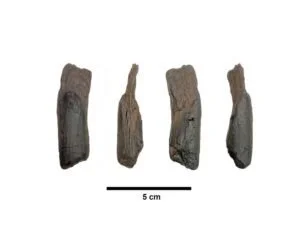
Investigating how mineral deposits can preserve traces of wooden tools and what their survival reveals about ancient work in coastal environments.
Introduction: Wood Preserved by Mineral Processes
Wooden tools were essential to many ancient activities. People used wooden handles, wedges, digging implements, fishing equipment, construction components, and tools for processing food and other materials. Yet wood usually decomposes unless environmental conditions slow the biological and chemical processes responsible for its breakdown.
Tidal environments create particularly complex preservation conditions. Alternating exposure to air and water, sediment movement, changing salinity, and the presence of marine organisms can accelerate deterioration. In some settings, however, mineral deposits may form on or within wood, creating a protective coating or preserving impressions of the original object.
The term “calcified wooden tools” can describe objects affected by mineral deposition, but the process needs precise identification. Calcium carbonate may precipitate around wood, while other mineral substances can enter pores or replace some of the original material. These processes are not identical, and not every mineral-coated wooden object is truly fossilized or calcified throughout its structure.
Archaeologists must therefore establish what material survives, how it formed, and whether the object was genuinely a tool rather than an architectural fragment or naturally occurring piece of wood.
How Mineralization and Calcification Occur
Wood consists largely of cellulose, hemicellulose, and lignin, all of which can degrade under biological and chemical conditions. In some environments, mineral-rich water moves through wood or deposits minerals on its surface.
Calcium carbonate can precipitate when water chemistry changes, particularly where dissolved carbon dioxide and mineral saturation conditions favor deposition. Microorganisms may also influence mineral formation by changing the chemistry immediately around a surface.
The result can be a coating, mineral-filled pores, or a more complex structure in which some original organic material survives alongside mineral deposits. Researchers distinguish these processes through microscopy and chemical analysis.
Scanning electron microscopy can reveal the relationship between wood anatomy and mineral material. X-ray diffraction and elemental analysis may help identify the minerals present, while thin sections can show whether minerals formed inside the wood or accumulated externally.
The distinction matters because mineral coatings may preserve an object's shape without preserving its original strength or composition. A tool may appear intact even when most of the wood has disappeared.
Tidal Environments and Preservation Conditions
Tidal settings are dynamic environments. Water levels rise and fall, exposing objects to oxygen during some periods and submerging them during others. Currents may move sediment, while changes in salinity influence the organisms and chemical processes affecting buried wood.
Rapid burial can protect wood by reducing exposure to oxygen and limiting some forms of biological decay. Conversely, repeated exposure may accelerate deterioration, particularly when sediment is disturbed or when a site is uncovered by erosion.
Mineral deposition depends on local water chemistry and cannot be assumed to occur in every tidal environment. A site with extensive calcification may have experienced conditions different from those at a nearby location, even if both are exposed to similar tides.
Researchers investigate these differences through sediment cores, water chemistry where modern conditions are relevant, and comparisons with other preserved materials from the same archaeological context. Modern environmental measurements can help explain possible processes, but they do not automatically reproduce the conditions that existed centuries or millennia ago.
Identifying the Original Tool
Once mineral deposits are identified, archaeologists must determine whether the object was used as a tool. Shape can provide clues, but erosion and mineral growth may obscure important details.
Researchers look for evidence such as worked edges, repeated impact damage, cutting marks, polished surfaces, handles, joints, and patterns of wear. Wood anatomy may help identify the tree species, while tool marks can indicate how the object was shaped.
Use-wear analysis can be particularly valuable. Microscopic striations, polish, and localized damage may reveal repeated contact with particular materials. However, weathering, sediment abrasion, and the movement of an object within tidal deposits can create similar marks.
The strongest identification combines manufacturing evidence, functional wear, archaeological context, and comparison with known tool forms. If the object is too damaged to support a secure interpretation, it is better described as worked wood of uncertain function.
Reconstructing Coastal Work and Technology
Wooden tools could have supported many activities in coastal environments, including fishing, boat maintenance, shellfish collection, salt production, construction, and the management of tidal wetlands.
The interpretation depends on the tool's form and context. A pointed wooden implement found near a wetland settlement might have been used for digging or planting, while a shaped component associated with a boat may have served a maritime function. Neither conclusion should be based solely on proximity to water.
Archaeologists compare the object with other artifacts from the site, examine nearby structures, and reconstruct the activities that could have taken place in the surrounding environment. Botanical identification can also reveal whether the wood came from a locally available tree or a species transported from elsewhere.
Where several tools are found together, their relationships may reveal a specialized activity area. Yet a concentration of objects can also result from water movement or later redeposition, so the original depositional context remains critical.
Dating and Conservation Challenges
Dating mineral-coated wood can be difficult because the mineral layer may have formed long after the object was made. Radiocarbon dating of surviving wood can estimate when the tree tissue formed, but the age of the tree ring may precede the manufacture of the tool.
Mineral deposits may also contain carbon from environmental sources that complicate dating. Researchers must choose samples carefully and understand the material being measured before interpreting a date.
Conservation poses additional challenges. Removing mineral crusts may damage fragile wood, while leaving deposits in place can obscure tool marks or interfere with analysis. Treatment decisions should be based on the research goals, the condition of the object, and the need to preserve evidence for future study.
Documentation before treatment is essential. Three-dimensional scanning, photography, radiography, and detailed recording can preserve information that might otherwise be lost during cleaning or stabilization.
Conclusion: The Survival of Wooden Technology
Calcified or mineral-coated wooden tools offer an opportunity to study technologies that are often missing from the archaeological record. Their survival can reveal aspects of woodworking, coastal activity, and the relationship between human objects and dynamic tidal environments.
However, mineralization must be distinguished from other preservation processes, and a surviving shape does not automatically establish the original function of an object. Researchers need to examine wood anatomy, mineral composition, use-wear, and depositional context together.
When these methods are combined, mineralized wood can contribute to a more complete understanding of ancient technology. It reminds us that the archaeological record is shaped not only by what people made and used, but also by the environmental processes that determine which objects survive.




