
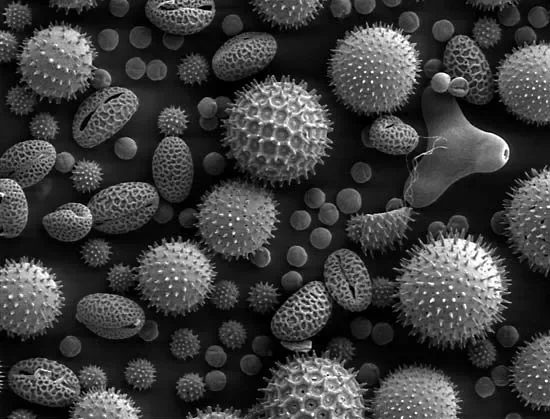
How plant remains can reveal the organization of household gardens, the cultivation of useful species, and the relationship between domestic life and the surrounding environment.
Introduction: Gardens Beyond the Written Record
Gardens occupy an unusual place in archaeology. Unlike large buildings or monumental irrigation systems, small household plots may leave few visible traces after centuries of abandonment. Yet these spaces could have supplied vegetables, herbs, fruits, medicinal plants, flowers, and materials used in everyday household activities.
Gardens also reflect choices about space and labor. Families may have cultivated plants close to their homes for convenience, while larger or specialized gardens could have served markets, religious institutions, or elite households.
Paleobotany—the study of ancient plant remains—offers ways to investigate these activities. Seeds, pollen, wood charcoal, fruit stones, and other botanical evidence can help researchers reconstruct which plants grew near settlements and how people used them.
However, identifying a garden is more difficult than finding a collection of plant remains. Seeds may arrive through trade, animal activity, natural vegetation, or household waste. Researchers must establish whether the evidence reflects deliberate cultivation and whether the plants grew at the location where they were recovered.
Seeds as Evidence of Cultivation
Seeds can survive in archaeological deposits through charring, waterlogging, mineralization, or other preservation processes. Their shape and surface characteristics may allow identification to a species or broader plant group.
A concentration of seeds from edible or useful plants may suggest storage, processing, or cultivation. Yet the same pattern can occur in a rubbish pit or a food-processing area. Context is essential for distinguishing a garden from a place where harvested plants were cleaned, cooked, or discarded.
Researchers examine the variety and quantity of seeds, their condition, and their relationship to soil layers and architectural features. Seeds recovered from a household courtyard may be more consistent with nearby cultivation than those found in a distant commercial dump, but neither context is conclusive by itself.
The presence of cultivated species also requires careful interpretation. A plant may have been imported as food or medicine rather than grown locally. Evidence for local cultivation becomes stronger when seed remains occur alongside other indicators of horticulture, such as planting features, irrigation traces, or a consistent botanical assemblage.
Pollen and the Reconstruction of Plant Communities
Pollen grains are produced by plants and can become preserved in sediments, waterlogged deposits, and other suitable environments. Their microscopic structures allow researchers to identify many plant groups, making pollen analysis valuable for reconstructing past vegetation.
A pollen assemblage can reveal changes in the surrounding landscape. An increase in pollen from cultivated plants, fruit trees, or other useful species may suggest human management, although the interpretation depends on the plants involved and the distance pollen can travel.
Some plants produce abundant pollen that disperses over long distances, while others release relatively little. A pollen grain found within a settlement does not necessarily originate from a plant growing directly beside the house.
Researchers therefore compare pollen with seeds, plant tissues, soil chemistry, and the broader environmental record. A garden interpretation is more persuasive when several lines of evidence point to cultivation within a defined area.
Pollen preservation also varies. Oxidation, soil acidity, water movement, and human disturbance can affect the assemblage, so the absence of a particular plant is not proof that it was never grown.
Household Space and Garden Layout
Gardens can occupy small spaces beside houses, courtyards, walls, water sources, and paths. Archaeologists investigate these possibilities through excavation and spatial analysis, looking for planting pits, soil modification, irrigation channels, boundary features, and repeated concentrations of botanical remains.
The arrangement of buildings can help establish where cultivation was practical. A courtyard with access to water and sunlight may have been suitable for a garden, while a heavily paved space might have served other purposes unless planting containers or soil beds were present.
Geophysical survey and soil analysis can sometimes identify features that are not visible at the surface. Differences in soil composition, organic matter, and phosphate concentration may indicate repeated cultivation or the accumulation of plant waste, but these signals are not unique to gardens.
Reconstructing a garden's layout is especially difficult when later construction has destroyed its boundaries. Researchers may need to combine fragmentary evidence from several locations to develop a plausible model of the original domestic landscape.
Plants, Household Economy, and Social Difference
Household gardens could contribute to food security by providing fresh ingredients and reducing dependence on distant markets. Their importance varied according to household size, climate, access to land, and the availability of other food sources.
Different households may have cultivated different combinations of plants. Some may have prioritized food crops, while others maintained medicinal plants, ornamental species, or crops intended for exchange.
These differences can provide clues about household practices, but plant remains do not directly reveal the social status of the people who grew them. A rich botanical assemblage might represent a garden, a processing area, or a commercial deposit rather than a wealthy household.
Researchers can compare botanical remains across neighborhoods to investigate differences in access to useful plants. Such comparisons must account for preservation, excavation methods, and the possibility that some plants were obtained through trade rather than cultivation.
Gardens, Medicine, and Cultural Knowledge
Gardens could serve as spaces where knowledge about plants was maintained and transmitted. Household members might learn which plants were edible, how to prepare them, when to harvest them, and how to use certain species for medicinal or practical purposes.
Archaeology rarely preserves this knowledge directly. Instead, researchers infer plant use from repeated associations, residues, historical descriptions, and the known properties of identified species.
The medicinal interpretation of a plant requires particular caution. A species known for medicinal use today may have been grown for food, fragrance, dye, or another purpose in antiquity. Its presence in a garden does not establish how people understood or used it.
Written medical texts can provide useful context in regions and periods where they survive, but they should not automatically be treated as descriptions of every household's practices. Archaeological evidence remains necessary to establish which plants were present at a particular site.
Conclusion: Reconstructing Domestic Landscapes from Plants
The paleobotany of ancient gardens helps researchers recover aspects of household life that may be invisible in the surviving architecture. Seeds, pollen, and other plant remains can reveal the cultivation, use, and movement of species within and around settlements.
Yet a botanical assemblage does not automatically represent a garden. Researchers must distinguish local cultivation from imported foods, natural vegetation, and waste from processing activities.
By combining plant identification with soil analysis, spatial reconstruction, and historical evidence, archaeologists can investigate how households used their available land and maintained relationships with the natural world. Ancient gardens emerge as more than decorative spaces: they may have been important settings for subsistence, experimentation, household knowledge, and the daily management of useful plants.




