
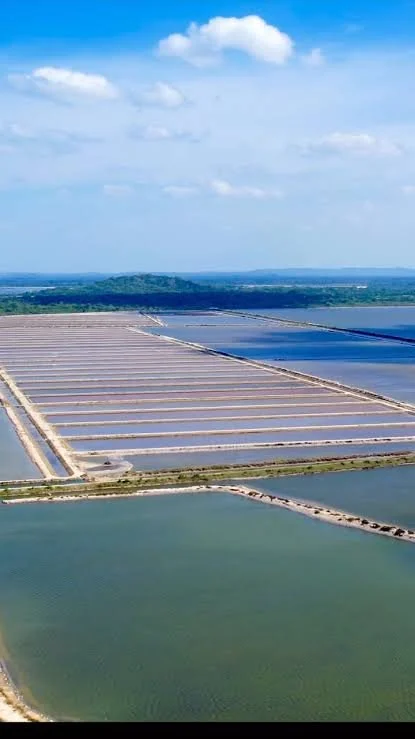
Investigating how coastal salt production may have supported trade, taxation, labor organization, and the development of early political institutions.
Introduction: A Common Mineral with Economic Power
Salt is essential to human and animal biology, but its historical significance extends far beyond diet. It has been used in food preservation, animal husbandry, craft production, and a variety of technical and domestic activities. Because salt deposits are unevenly distributed, communities in some regions depended on exchange to obtain it.
Coastal salterns are installations or landscapes used to produce salt from seawater or saline water. Their operation can involve evaporation, heating, concentration, and the collection of crystallized salt. The exact methods depend on climate, water chemistry, fuel availability, and the technology used.
Archaeologists study coastal salterns to understand how salt production was organized and how it related to the growth of political institutions. Large or repeated production activities could generate goods suitable for exchange and taxation, potentially linking coastal producers to inland settlements and emerging states.
However, the presence of a saltern does not automatically demonstrate centralized control. Salt production could be organized by households, communities, private enterprises, religious institutions, or political authorities. The social and economic organization must be established through evidence from each region and period.
The Technology of Coastal Salt Production
Seawater contains dissolved salts, but extracting usable quantities requires concentrating the brine and allowing salt crystals to form. In warm, dry environments, solar evaporation can reduce water content. In cooler or wetter climates, heating and controlled evaporation may be more practical.
Archaeological evidence for salt production can include evaporation basins, heating installations, fuel residues, specialized ceramics, storage facilities, and concentrations of production waste. Some methods leave substantial remains, while others may use shallow basins or temporary installations that are difficult to identify.
Researchers examine the materials used in production. Ceramic fragments may show signs of repeated heating, while ash and charcoal can reveal the use of fuel. Sediment chemistry may identify unusually saline deposits, although natural salt accumulation can create similar patterns.
The interpretation depends on context. A concentration of fired pottery might represent domestic cooking or another craft rather than salt production. A convincing identification requires a combination of technological evidence, production waste, and an appropriate environmental setting.
From Production Sites to Exchange Networks
Salt production becomes economically significant when the quantity produced exceeds immediate local requirements or when communities depend on it for essential activities. Coastal salt could move inland through rivers, roads, pack-animal routes, or maritime shipping.
Archaeologists investigate these connections by examining the distribution of salt-related materials, transport containers, settlements, and associated infrastructure. Yet salt itself is often difficult to identify in the archaeological record because it dissolves readily and leaves no durable form comparable to metal or stone.
As a result, researchers may need to reconstruct trade indirectly. Production sites can be compared with the needs of nearby settlements, while historical records or distinctive containers may provide additional clues about exchange.
The presence of imported goods at a coastal settlement can demonstrate participation in trade, but it does not necessarily prove that salt was the commodity exchanged. A broader economic reconstruction is needed to connect the saltern with particular markets.
Salt and the Development of Political Authority
Salt production can attract political interest because it creates a resource that may be measured, stored, and exchanged. Authorities might regulate access to production sites, collect taxes, require labor, or oversee distribution. In some historical contexts, control over salt production became an important source of revenue.
These possibilities must not be projected automatically onto every early state. The political significance of salt varied according to ecology, population, available substitutes, transport costs, and the organization of local economies.
Archaeologists look for evidence of administration and control, such as standardized production facilities, storage complexes, restricted access, administrative buildings, or patterns of settlement organization consistent with centralized oversight. Written records, where available, can clarify how production and taxation operated.
Even large-scale production does not necessarily imply state ownership. A community might coordinate labor collectively, while merchants or private producers could operate under different arrangements. The scale of production and the structure of authority are related questions, but they are not identical.
Labor, Fuel, and Environmental Costs
Salt production required labor and energy. Depending on the method, workers might collect seawater, maintain basins, manage heating installations, gather fuel, remove crystallized salt, and prepare the product for storage or transport.
These activities could affect local environments. Fuel-intensive methods might place pressure on nearby woodlands, while repeated extraction and drainage could alter coastal wetlands or local water conditions.
Researchers can investigate such effects through charcoal analysis, pollen records, sediment cores, and changes in vegetation around production sites. However, environmental changes may also result from agriculture, settlement expansion, and natural coastal processes.
Labor organization is equally important. Production could be seasonal or continuous, household-based or specialized, and performed by different social groups. The archaeological evidence may reveal the scale and technical demands of production more clearly than the social status of the workers themselves.
Salt Production and the Formation of Early States
The relationship between salt production and state formation is best understood as a possible contribution to broader economic and political change rather than a single cause.
A reliable supply of salt could support livestock management, food preservation, and specialized exchange. Production and distribution might encourage the development of routes, storage facilities, market relationships, and systems for measuring or taxing goods.
These processes could reinforce political authority where institutions already existed or were developing. Yet states also emerged through many other mechanisms, including agricultural surplus, warfare, population growth, trade, and control over land and labor.
To investigate the role of salt, researchers should establish the chronology of production and compare it with evidence for political centralization. If production expanded before or during the development of administrative institutions, the relationship may be worth exploring. Chronological overlap alone, however, does not establish causation.
Conclusion: Salt, Exchange, and Political Organization
Coastal salterns offer an important perspective on how ordinary resources could contribute to complex economies. Their technology, scale, labor requirements, and distribution networks may reveal how salt connected coastal communities with inland consumers and political institutions.
The existence of a saltern does not prove that a state controlled it or that salt revenue drove political centralization. Such conclusions require evidence of administrative structures, chronology, and the organization of exchange.
When integrated with environmental science, settlement archaeology, and historical documentation, salt-production research can illuminate the relationships among technology, labor, trade, and political authority. It shows how the development of early economies often depended not only on luxury goods but also on the production and movement of essential materials.




