
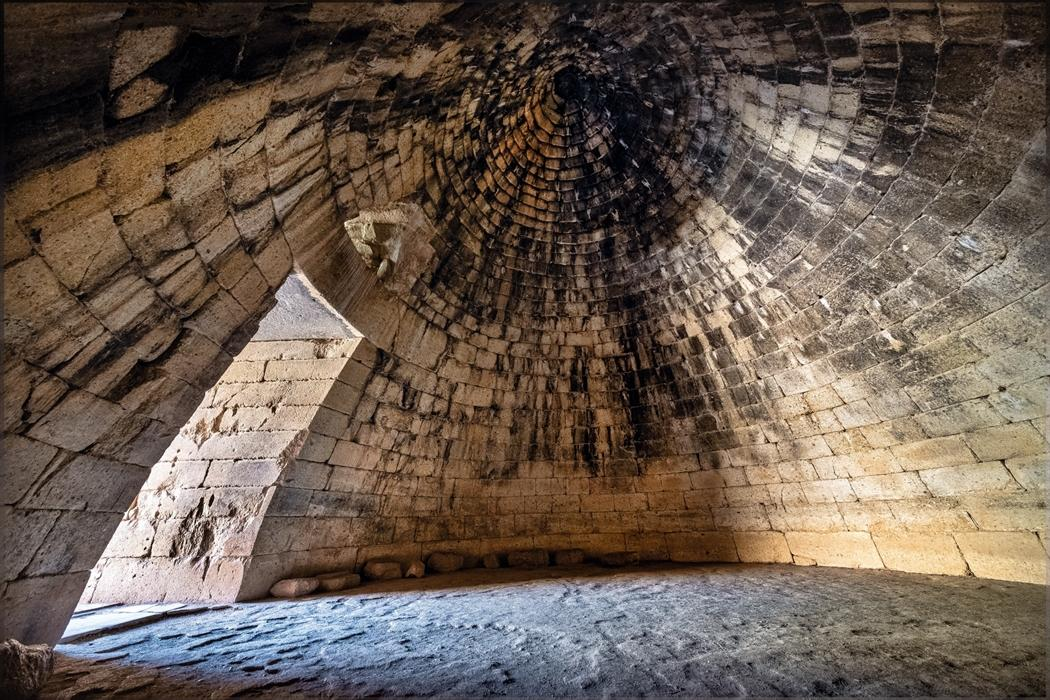
Digital Documentation of Mycenaean Funerary Architecture
Three-dimensional scanning has become an increasingly valuable tool for documenting ancient tombs, especially structures whose fragile walls, irregular stone surfaces, and limited accessibility make traditional recording difficult. A hypothetical Mycenaean tomb near Dimitsana in the mountainous Arcadian region of the Peloponnese would provide an interesting example of how digital technology could improve the study of prehistoric funerary architecture.
Mycenaean burial traditions developed during the Late Bronze Age, approximately 1600–1100 BCE. Tombs varied in construction and social significance, ranging from simple chamber burials to monumental tholos tombs characterized by circular chambers, corbelled roofs, and carefully constructed entrances. These structures reflected the importance of ancestry, family identity, social hierarchy, and ritual practices.
Dimitsana's surrounding landscape, characterized by mountain slopes, valleys, forests, and rugged terrain, provides a setting where archaeological remains may be difficult to survey systematically. Although the presence of a specific Mycenaean tomb with an existing 3D scan in Dimitsana is not established here, digital documentation could provide an effective approach to recording a discovered or previously investigated tomb.
The Process of Three-Dimensional Tomb Scanning
Digital scanning involves capturing the physical dimensions and surface details of an archaeological structure. Depending on the project, researchers may employ terrestrial laser scanning, structured-light scanning, photogrammetry, or combinations of these techniques.
Photogrammetry uses overlapping photographs taken from multiple angles to reconstruct a three-dimensional representation. Laser scanning records spatial measurements using laser beams, producing highly detailed point clouds that can be converted into architectural models.
For a Mycenaean tomb, a digital survey could record:
The dimensions and orientation of the entrance.
Wall curvature and masonry arrangement.
Ceiling or roof construction.
Surface erosion and cracks.
Burial chamber proportions.
Evidence of ancient modifications.
Modern damage, vegetation, or disturbances.
The resulting model would preserve the tomb's physical appearance at the time of documentation.
Understanding Tomb Construction and Structural Changes
A three-dimensional model would allow archaeologists to study construction techniques more closely. Mycenaean tombs frequently incorporated carefully arranged stone blocks, rubble masonry, and architectural features that reflected regional traditions and available materials.
Digital measurements could help determine whether the tomb's walls were originally symmetrical, whether the entrance was modified, or whether the chamber experienced structural collapse. Researchers could also compare the scanned architecture with documented tombs from other regions of the Peloponnese.
The model would be especially useful for examining spaces that are difficult to access physically. Instead of repeatedly entering a fragile tomb, researchers could conduct measurements and architectural analysis using the digital representation.
Preservation and Monitoring
Three-dimensional documentation is not only useful for research but also for conservation. A scan can serve as a baseline record against which future surveys are compared.
Repeated scanning may reveal:
Progressive wall deformation.
Rock displacement.
Cracks that expand over time.
Loss of surface material.
Effects of moisture infiltration.
Damage caused by visitors or environmental conditions.
These changes can be measured digitally, helping conservation specialists determine whether intervention is necessary.
Archaeological Interpretation and Digital Access
A digital tomb model could also support education and public interpretation. Students, researchers, and museum visitors could explore the burial chamber virtually without physically entering the archaeological site.
Interactive models may include annotations identifying masonry types, architectural features, burial arrangements, and historical phases. Virtual tours could provide a clearer understanding of the tomb's interior than photographs alone.
However, digital models should not replace archaeological interpretation. A scan records visible surfaces but cannot independently establish the tomb's age, function, ownership, or burial history. These conclusions require archaeological context, excavation evidence, comparative analysis, and scientific dating where available.
Conclusion
Three-dimensional scanning of a Mycenaean tomb in the Dimitsana region would represent a valuable combination of archaeological recording and digital preservation. Although the specific project named in the title remains unverified, the technology offers substantial potential for architectural analysis, conservation monitoring, research collaboration, and public engagement with prehistoric heritage.





