
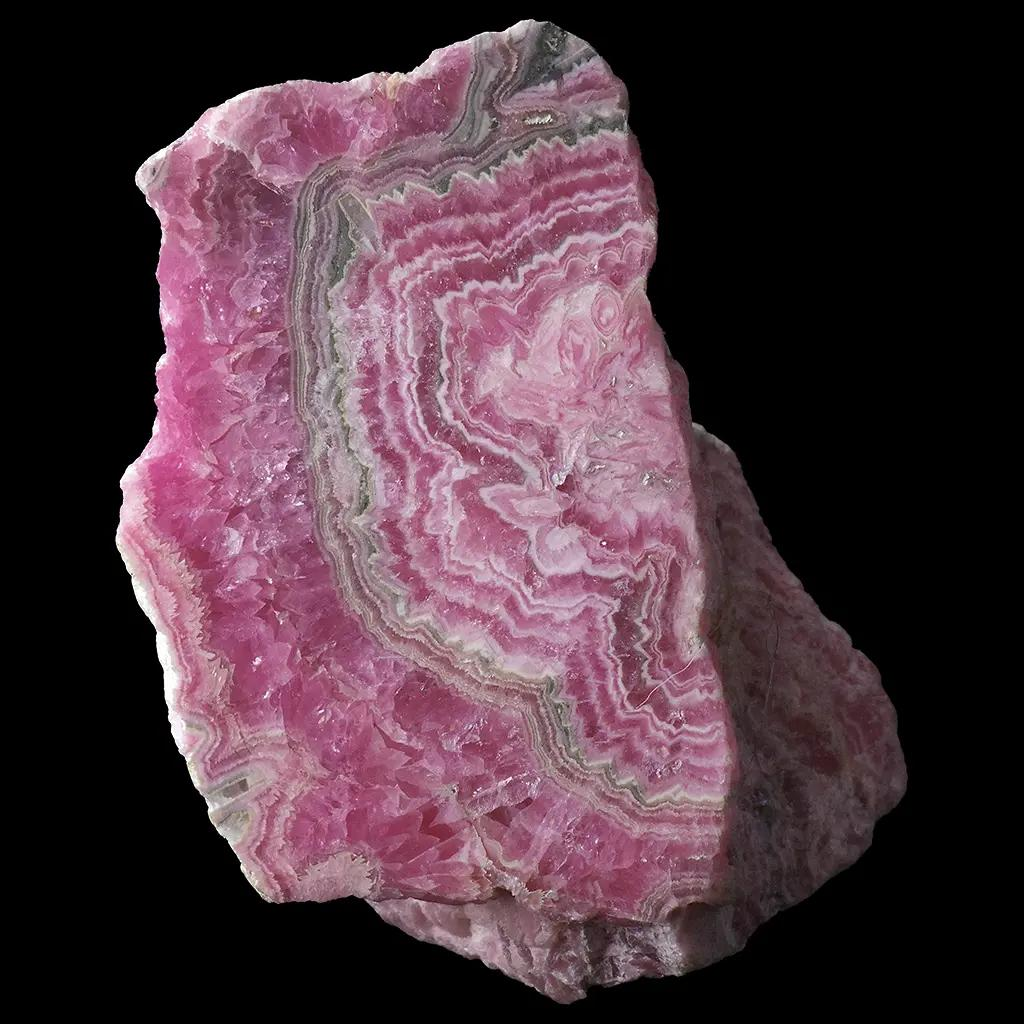
Rhodochrosite and its pink coloration
Rhodochrosite is a manganese carbonate mineral with the chemical formula MnCO₃. It is known for its pink to red color, which may range from pale rose to deep reddish tones.
Some specimens display distinctive bands or patterns, while others occur as crystalline forms or massive mineral aggregates.
The color and appearance of rhodochrosite are influenced by its composition, mineral structure, and the conditions under which it formed.
Geological formation
Rhodochrosite can form in hydrothermal veins and other geological environments associated with manganese mineralization.
It may develop through the precipitation of carbonate minerals from mineral-rich fluids or through processes involving the alteration of other manganese-bearing materials.
Its occurrence is often connected with particular geological conditions that allow manganese and carbonate components to combine and form the mineral.
Olympus and its geological complexity
Mount Olympus is one of Greece's most recognizable mountain regions and is known for its complex geological structure, diverse rock formations, and significant elevation.
The mountain's geological history involves tectonic processes, deformation, uplift, and the interaction of different rock types. Such complexity creates a varied geological landscape that can be studied through mapping and field investigation.
The title's reference to rhodochrosite on an Olympus ridge is hypothetical. The presence of manganese carbonate at a specific location would require mineralogical verification.
Scientific significance
Rhodochrosite can provide information about manganese mineralization and the chemical conditions of mineral-forming environments.
A hypothetical occurrence on Olympus would be relevant to regional geology, mineralogical studies, and the investigation of hydrothermal or other mineral-forming processes.
Researchers would need to examine the host rock, mineral associations, structural relationships, and chemical composition to establish how the rhodochrosite formed.
The study would also contribute to a broader understanding of the geological diversity of Olympus, a landscape whose scientific significance extends beyond its dramatic scenery and ecological importance.





