
Artificial Intelligence and the Reconstruction of Ancient Urban Landscapes
Hellenistic cities were often characterized by organized streets, public spaces, monumental buildings, residential areas, sanctuaries, and commercial structures. Their architecture reflected political authority, civic identity, social organization, and cultural exchange across the eastern Mediterranean.
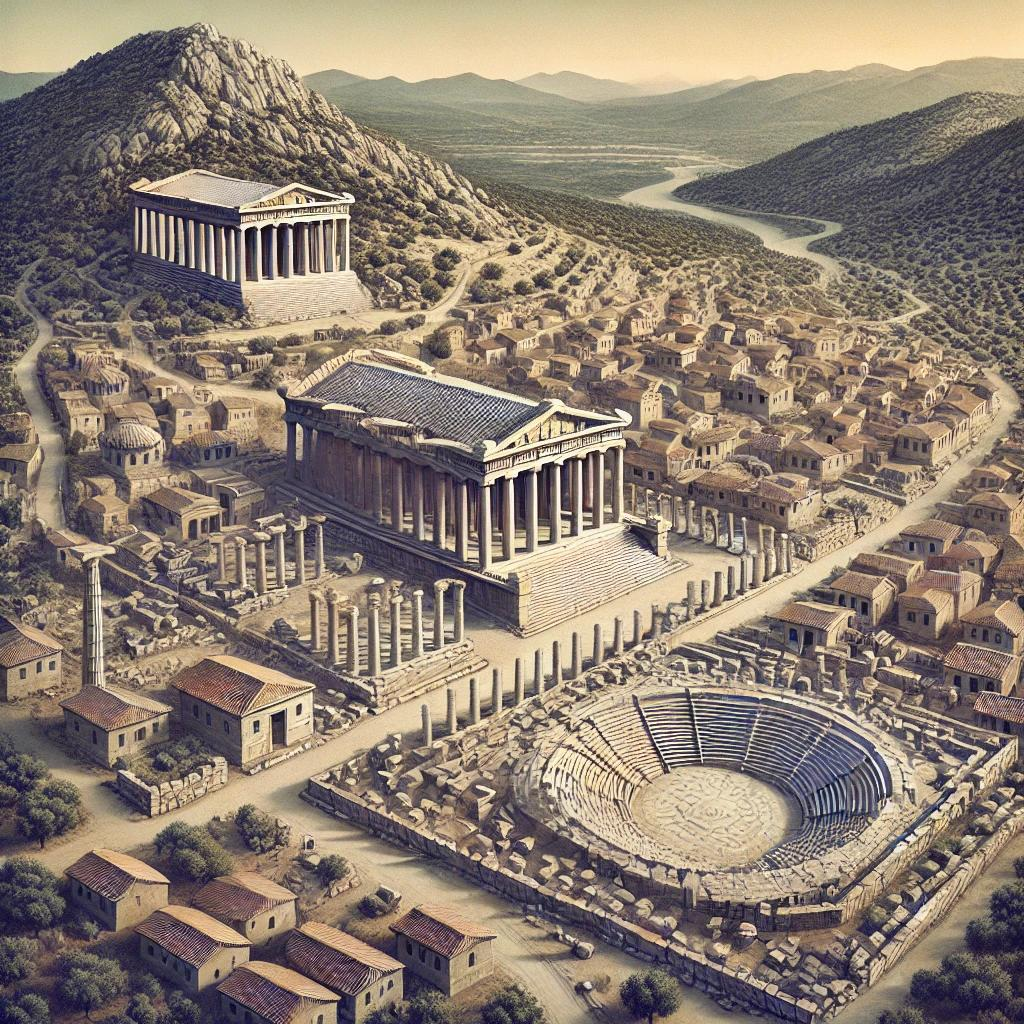
Artificial intelligence has increasingly become part of digital research and visualization. AI-assisted reconstruction of a lost Hellenistic city could combine archaeological evidence, architectural measurements, historical descriptions, and comparative data to produce visual interpretations of ancient urban environments.
The specific AI reconstruction referenced in the title is not verified as an existing project involving a particular lost city.
Evidence for Reconstructing Ancient Cities
Urban reconstruction requires a wide range of evidence. Archaeologists may use excavated foundations, architectural fragments, inscriptions, pottery, historical descriptions, maps, and environmental data.
A city may be partially known through excavated buildings while other sections remain buried or destroyed.
Digital reconstruction could therefore involve different levels of certainty:
Directly documented: Structures with excavated remains and measurable architectural features.
Comparatively reconstructed: Buildings interpreted using parallels from similar cities or architectural traditions.
Hypothetical: Features created to fill gaps where evidence is limited.
These categories should be clearly communicated in a digital model.
The Role of Artificial Intelligence
AI-assisted tools may help researchers organize large datasets, identify repeated architectural patterns, analyze images, classify archaeological materials, and generate preliminary visualization options.
For example, a reconstruction system could be provided with the dimensions of a temple foundation, surviving column fragments, regional architectural parallels, and historical descriptions. It might generate several possible reconstructions for researchers to evaluate.
AI could also help visualize street layouts, residential blocks, public buildings, and urban landscapes using existing spatial information.
However, AI-generated architectural details are not automatically historically accurate. The system may introduce features that look ancient but are based on incomplete data or inappropriate architectural parallels.
Reconstructing Urban Life
A digital reconstruction could help researchers and visitors understand how a Hellenistic city functioned.
The model might explore:
The relationship between the agora and surrounding public buildings.
Street organization and access routes.
Residential architecture.
Religious spaces and sanctuaries.
Commercial activity.
Defensive walls and gates.
Water systems and drainage.
Urban reconstruction could also be used to explore how a city's topography influenced its development.
By moving through a reconstructed environment, visitors may better understand the scale and organization of ancient urban life.
Historical Interpretation and Uncertainty
One of the greatest challenges of AI reconstruction is the risk of presenting uncertainty as fact.
A digitally reconstructed city may appear complete even when most of its buildings are hypothetical. Visitors may assume that every structure, roof, column, and decorative element is based on excavated evidence.
Researchers should therefore provide visual distinctions between known remains and reconstructed elements. Different transparency levels, color coding, evidence labels, and interactive explanations could communicate confidence and uncertainty.
AI should be treated as an interpretive tool rather than an archaeological authority.
Public Archaeology and Education
Digital city reconstructions can make archaeological research more accessible to students, museum visitors, and people unable to visit the physical site.
Interactive models could allow users to explore different historical phases, compare architectural features, and examine how the city changed over time.
They may also support classroom activities involving urban planning, ancient economies, architecture, and historical geography.
Conclusion
AI-assisted reconstruction of a lost Hellenistic city could combine archaeological evidence and digital modeling to create new ways of studying ancient urban environments. Its value would depend on the quality of its source data, the transparency of its methods, and the clear distinction between archaeological evidence and creative reconstruction.





