Introduction
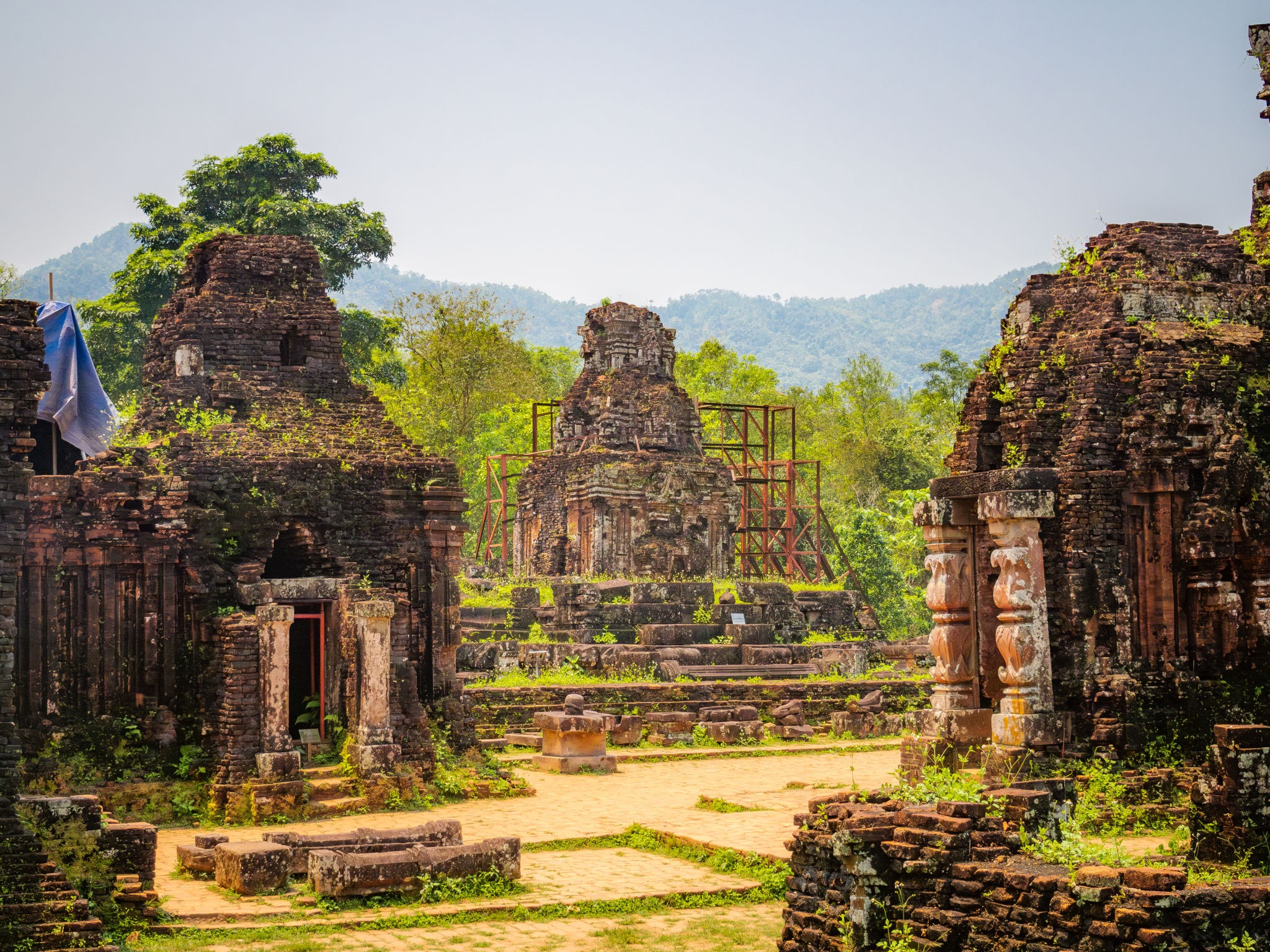
Nestled in a lush, ringed valley beneath Hon Quap (Cat’s Tooth Mountain) in Quảng Nam Province, central Vietnam, Mỹ Sơn Sanctuary was the spiritual heartland of the Champa Kingdom from the 4th to the 14th century CE. Established by King Bhadravarman I, this UNESCO World Heritage complex served as the royal burial site and principal Hindu sanctuary dedicated to Shiva, worshipped here under the title Bhadresvara.
Constructed continuously over a millennium, the seventy-plus red brick towers (kalan) document the stylistic evolution of Champa religious architecture and its deep synthesis of Indian iconography with Southeast Asian aesthetics.
Architectural Engineering and Mortarless Masonry
The enduring mystery of Mỹ Sơn lies in the exceptional structural engineering of its brick towers. Cham builders achieved seamless, razor-thin joints without using visible lime or mortar:
Organic Resins & Clays: Scientific analyses indicate bricks were bonded using a thin slurry composed of crushed clay and local vegetable resins (such as dầu rái tree resin), which polymerized to form a water-resistant bond.
In-Situ Carving: Rather than carving individual bricks before laying, Cham artisans laid entire solid brick walls first and then carved intricate bas-reliefs—depicting apsaras, makaras, and deities—directly into the integrated brickwork.
Surface Kiln Firing: Once carved, entire building facades were subjected to controlled surface firing, fusing the outer brick surfaces into a protective, weatherproof ceramic shell.
Conclusion
Mỹ Sơn Sanctuary stands as the longest-utilized site of religious architecture in Southeast Asia. Its brick towers remain a testament to Cham artistic sophistication, enduring as silent sentinels of a powerful maritime kingdom.