
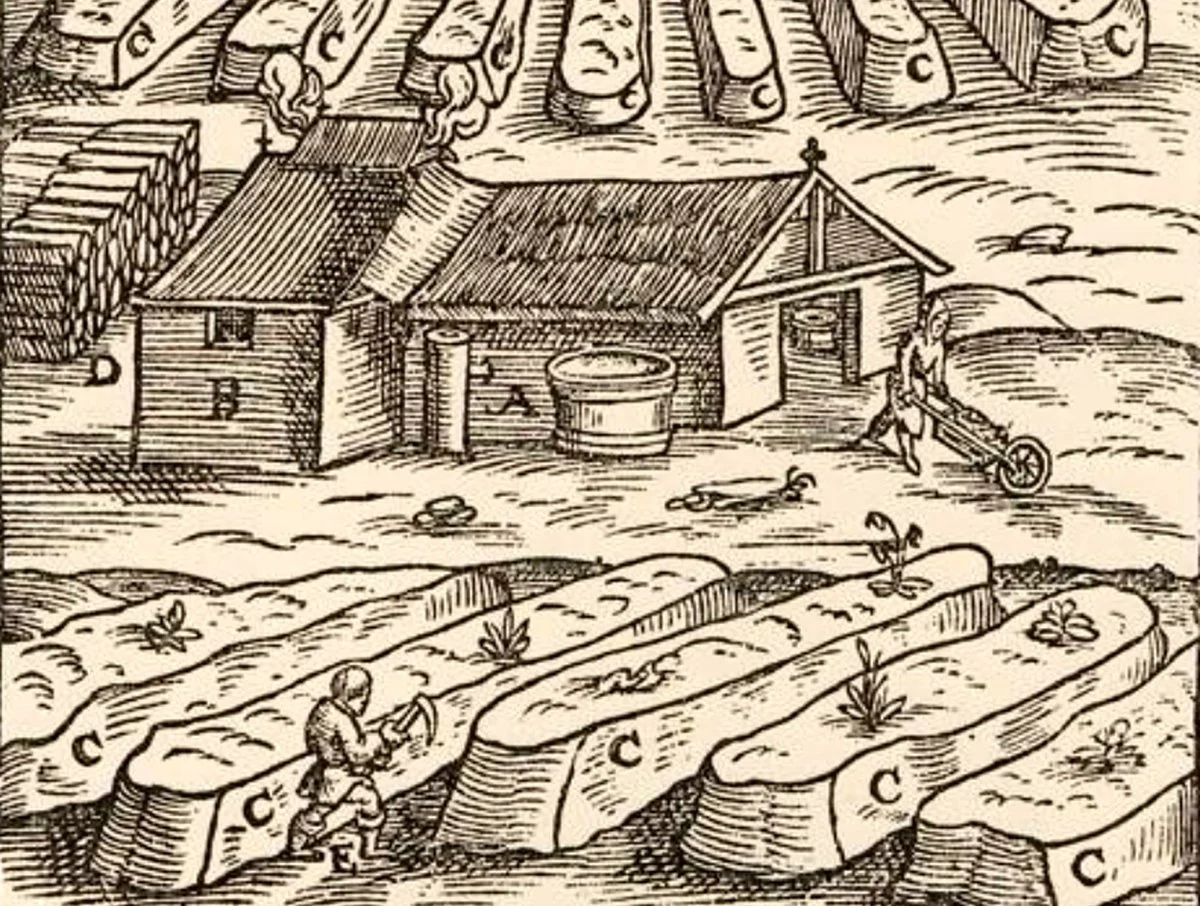
The chronology of nitrate resources, the history of gunpowder, and the danger of projecting later industries into the medieval past.
Saltpeter and the History of Gunpowder
Saltpeter, commonly referring to potassium nitrate in historical discussions of gunpowder, became an important material in the development of firearms and explosive technology. Its role in gunpowder production connected chemistry, military history, mining, and state finance.
The title presents a chronological challenge. The term medieval South America is not straightforward because the conventional European medieval period does not map neatly onto the histories of Indigenous American societies. More importantly, the large-scale nitrate industries associated with parts of South America developed much later than the medieval period, particularly during the nineteenth century.
This distinction is essential. The presence of naturally occurring nitrate deposits in South America does not establish that medieval communities extracted and processed saltpeter for gunpowder. Any claim of medieval production must be supported by specific historical evidence.
What Saltpeter Is and Why It Matters
Potassium nitrate is a chemical compound that can occur in natural deposits or be obtained through chemical processes. Historically, it became important as an oxidizing ingredient in gunpowder, supporting the rapid combustion of the mixture.
The production and use of gunpowder developed over a long period, with early evidence associated with China and later transmission and adaptation across Eurasia. The technology eventually became significant in military systems, mining, and other applications.
Saltpeter's importance increased as firearms and artillery became more widely used. Governments and military organizations needed dependable supplies, creating demand for materials that could be produced, collected, refined, or imported.
However, the presence of gunpowder technology in one region does not automatically imply that all of its ingredients were locally produced. Materials could be imported through commercial networks, and the organization of supply differed between political systems.
South America's Natural Nitrate Resources
Parts of western South America, particularly the Atacama Desert and adjacent regions, contain notable nitrate deposits. These resources later became central to major mining and export industries.
The geology of the region reflects long-term environmental processes involving aridity, mineral accumulation, and the interaction of different chemical sources. The resulting deposits attracted industrial interest in later centuries because they could be extracted and processed on a large scale.
Yet geological availability and historical exploitation are separate questions. A mineral deposit can exist for thousands of years before a society develops the technology, economic incentives, transport systems, or political institutions needed to exploit it commercially.
The existence of South American nitrate deposits therefore cannot independently support a claim of medieval saltpeter production.
Indigenous Societies Before European Conquest
Before European colonization, South America contained diverse societies with sophisticated agricultural systems, road networks, craft traditions, and forms of political organization. Their histories varied greatly across the Andes, Amazonia, coastal deserts, and other environments.
These communities used mineral and organic resources for different purposes, but any claim about a specific chemical industry must be based on evidence from the relevant society and period. It would be inaccurate to assume that the existence of advanced metallurgy or mining automatically implies the production of saltpeter for gunpowder.
Gunpowder production also requires a historical context in which the relevant technology, ingredients, and uses were known. A claim that medieval South American communities manufactured saltpeter for gunpowder would need particularly strong evidence.
The Later Nitrate Industry
The large-scale extraction of nitrate in the Atacama region became economically important during the nineteenth century. Nitrate products were traded internationally and used extensively in fertilizers and industrial applications, while the history of the industry became closely connected to labor, infrastructure, national revenues, and territorial conflict.
The War of the Pacific, fought between Chile and the alliance of Peru and Bolivia from 1879 to 1884, transformed political control over nitrate-rich territories. The industry subsequently became central to economic and political developments in the region.
This later history is well established, but it should not be projected backward into a medieval setting without evidence. The existence of nineteenth-century nitrate mines does not establish a continuous tradition of gunpowder-related production from earlier centuries.
What Evidence Would Be Needed for Medieval Production?
A credible claim would require a securely dated site, evidence of processing, and a clear relationship between the recovered material and saltpeter production. Archaeological residues would need to be distinguished from naturally occurring mineral deposits and other activities.
Written records, if available, would need to identify the material, its production or collection, and its intended use. Researchers would also need to consider whether the evidence reflects local manufacture, imported goods, or later occupation.
The date of a deposit is particularly important. A mineral layer that formed naturally cannot be treated as evidence of an industrial activity simply because it contains a relevant chemical compound.
Reassessing the Title's Chronology
The specific claim of medieval South American saltpeter production for a gunpowder economy remains unverified and raises significant chronological questions. The better-established history concerns the region's later nitrate industry and the wider development of gunpowder technology across Eurasia.
A rigorous article should separate these histories rather than merge them into a single continuous narrative. The broader subject remains valuable because it connects natural resources, chemical knowledge, military demand, colonial history, and industrial expansion.
The essential lesson is that the presence of a useful mineral does not prove that a particular society extracted it for a particular purpose. Archaeological evidence must establish not only what a material was, but when people used it and how it fitted into their economy.




