Growing bodies, early nutrition, and the evidence ancient human remains preserve about childhood.
Childhood as an Archaeological Subject
For much of the history of archaeology, research concentrated on monumental buildings, political leaders, warfare, and adult burial practices. Yet the lives of children are essential to understanding how past societies functioned. Children participated in household economies, learned social roles, experienced illness, and depended on caregivers for food and protection.
Bioarchaeology uses human skeletal remains and associated evidence to investigate past populations. The study of childhood is particularly challenging because children's bodies change rapidly during growth. Their bones and teeth can preserve evidence of development, nutritional stress, disease, and other biological processes, but these indicators must be interpreted carefully.
Weaning is an important topic because it marks a transition in infant feeding. A child may gradually receive foods other than breast milk while continuing to breastfeed for some time. The timing and nature of this transition can influence nutrition, exposure to pathogens, and the relationship between caregivers and children.
The term weaning marker refers to evidence that may help researchers reconstruct this transition. No single skeletal feature can reliably identify the exact age at which every child was weaned.
What Weaning Involves
Weaning is not always a sudden event. In many societies, complementary foods are introduced gradually, and breastfeeding continues alongside them. The timing depends on cultural practices, food availability, maternal circumstances, and the child's health.
The introduction of other foods changes an infant's nutritional environment. Breast milk provides nutrients and immune-related benefits, while complementary foods may expose children to different nutritional profiles and pathogens.
If complementary foods are insufficient in quantity or quality, children may experience nutritional stress. If food preparation or water supplies are contaminated, the transition can also increase exposure to infectious disease.
However, weaning does not affect every child in the same way. Outcomes depend on the foods available, the health of caregivers, household resources, and the broader disease environment.
Teeth as Records of Early Life
Teeth are especially valuable in bioarchaeology because they develop according to relatively structured biological schedules and can preserve chemical information from childhood.
Dental enamel forms during specific periods of development. Once formed, it does not remodel in the same way as bone, allowing some chemical signals to remain preserved. Researchers can examine enamel and other dental tissues to investigate diet, environmental exposure, and aspects of early development.
Stable isotope analysis is one technique used in this research. Carbon and nitrogen isotope ratios in suitable tissues can provide information about dietary sources and changes in protein consumption.
In some contexts, changes in nitrogen isotope values may be consistent with a transition away from breastfeeding. However, these patterns are influenced by several factors, including maternal diet, the child's physiology, the local food web, and the tissue being analyzed.
A change in isotope values should therefore not be interpreted as a precise weaning date without supporting evidence.
Skeletal Growth and Physiological Stress
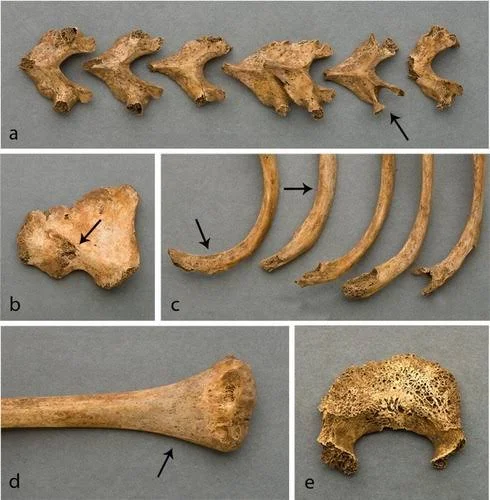
Bones grow and remodel in response to age, activity, nutrition, hormones, and disease. Some skeletal features can indicate that an individual experienced physiological stress during development, but they rarely reveal one specific cause.
For example, changes in bone growth or certain lesions may be associated with nutritional deficiencies or infection. Yet similar features can result from different conditions, and some children may experience serious illness without leaving visible skeletal traces.
Researchers also face the problem of survival bias. Skeletal collections contain individuals who died and whose remains survived, not a complete record of everyone who lived in the community. The children represented in a cemetery may not reflect the average health or feeding experiences of the wider population.
Comparing Global Skeletal Series
A global comparison can reveal how childhood experiences varied across environments and social systems. Researchers may compare communities with different subsistence practices, food supplies, disease burdens, and patterns of settlement.
However, comparisons must account for differences in preservation, sampling, age estimation, laboratory methods, and the types of tissues analyzed. A dataset from one region may not be directly comparable with another if the underlying methods differ.
Researchers should also avoid assuming that a pattern observed in one society applies universally. Weaning practices are shaped by culture as well as biology, and the same dietary transition may have different consequences in different environments.
The Limits of Reconstructing Infant Feeding
Ancient human remains cannot directly record every feeding decision made by a caregiver. Isotopic evidence can suggest dietary transitions, but it cannot always distinguish breastfeeding from other dietary changes or determine the precise age at which a child stopped nursing.
Archaeological context may provide additional clues. Food remains, animal bones, vessels, household organization, and written sources can help reconstruct what foods were available and how they might have been prepared.
Even these sources have limitations. A vessel may have served several purposes, and the presence of a particular food does not establish that infants consumed it.
Ethics and the Study of Children's Remains
Research involving human remains requires careful ethical consideration. Archaeologists must respect applicable laws, community expectations, and the wishes of descendant communities where relevant. Human remains should not be treated merely as laboratory material detached from the people they represent.
Responsible research also requires clear communication about uncertainty. Findings should not be used to stigmatize historical populations or suggest that a particular feeding practice inevitably caused poor health.
What Weaning Research Can Reveal
The bioarchaeology of childhood helps reconstruct how early nutrition, disease, and social circumstances interacted in the past. It can reveal broad patterns of development and dietary transition while also highlighting the limits of what biological evidence can establish.
The most reliable interpretations combine dental development, isotope analysis, skeletal evidence, archaeological context, and appropriate comparative data. Rather than assigning a precise weaning age from a single marker, researchers can use multiple lines of evidence to investigate how childhood experiences differed across populations and historical periods.