
Introduction
The rock shelters and caves of southern Africa preserve evidence from many different periods.
Some contain hunter-gatherer paintings.
Others preserve archaeological deposits associated with pastoralism, farming, or later communities.
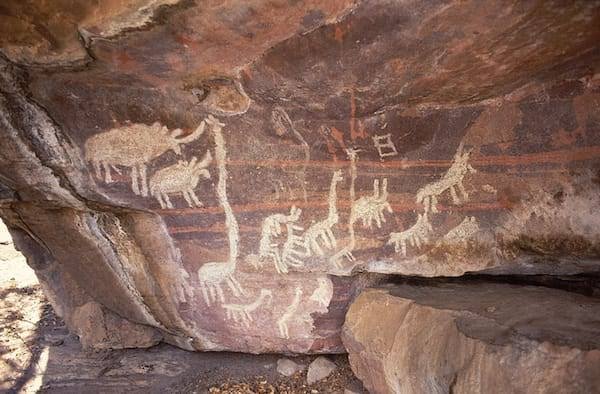
The title Sibhonyweni Cave: South Africa's Pastoral Rock Art evokes imagery associated with pastoral communities and the introduction of livestock into southern African landscapes.
The interpretation of particular paintings must be based on archaeological context rather than assumptions from subject matter alone.
Pastoralism in Southern Africa
Pastoralism introduced a major economic transformation into parts of southern Africa.
Early herding communities kept livestock such as sheep and cattle and developed new relationships with landscapes.
Pastoralism did not necessarily replace hunting and gathering immediately.
Different economic strategies could coexist.
Rock Art and Livestock
Some southern African rock art includes animals that researchers have interpreted as domestic livestock or scenes potentially related to herding.
However, distinguishing wild from domesticated animals in paintings can be difficult.
Artists did not necessarily depict animals realistically according to modern standards.
The Archaeological Context
A painting becomes more informative when associated with archaeological deposits.
Excavations can reveal:
animal bones,
pottery,
stone tools,
beads,
metal objects,
hearths,
and settlement remains.
These materials can help establish whether pastoralists occupied the shelter.
Interaction Between Communities
The arrival of pastoralism did not produce a simple replacement of one population by another.
Hunter-gatherers, herders, and later farmers interacted.
They exchanged goods.
They may have intermarried.
They sometimes competed for resources.
Rock art can provide evidence for this cultural interaction.
Symbolic Meaning
Pastoral imagery may have had meanings beyond economic activity.
Animals can represent wealth, fertility, ancestry, identity, or social status.
A painted livestock animal should therefore not automatically be interpreted as an inventory illustration.
Dating
Dating rock paintings remains challenging.
Researchers may combine pigment analysis with archaeological layers and stylistic studies.
Where direct dating is possible, it can greatly improve understanding.
But many paintings remain difficult to date precisely.
Conservation
Cave art can be damaged by moisture, touching, smoke, graffiti, and changes in the cave environment.
Conservation requires minimizing disturbance.
Digital photography and three-dimensional recording can help preserve information.
Conclusion
Sibhonyweni Cave: South Africa's Pastoral Rock Art offers a valuable framework for examining the transition toward herding economies in southern Africa.
A specific painting should not automatically be labeled pastoral without contextual evidence.
Nevertheless, the wider archaeological record demonstrates that livestock keeping became an important component of southern African history and created new relationships between people, animals, landscapes, and cultural identity.





