
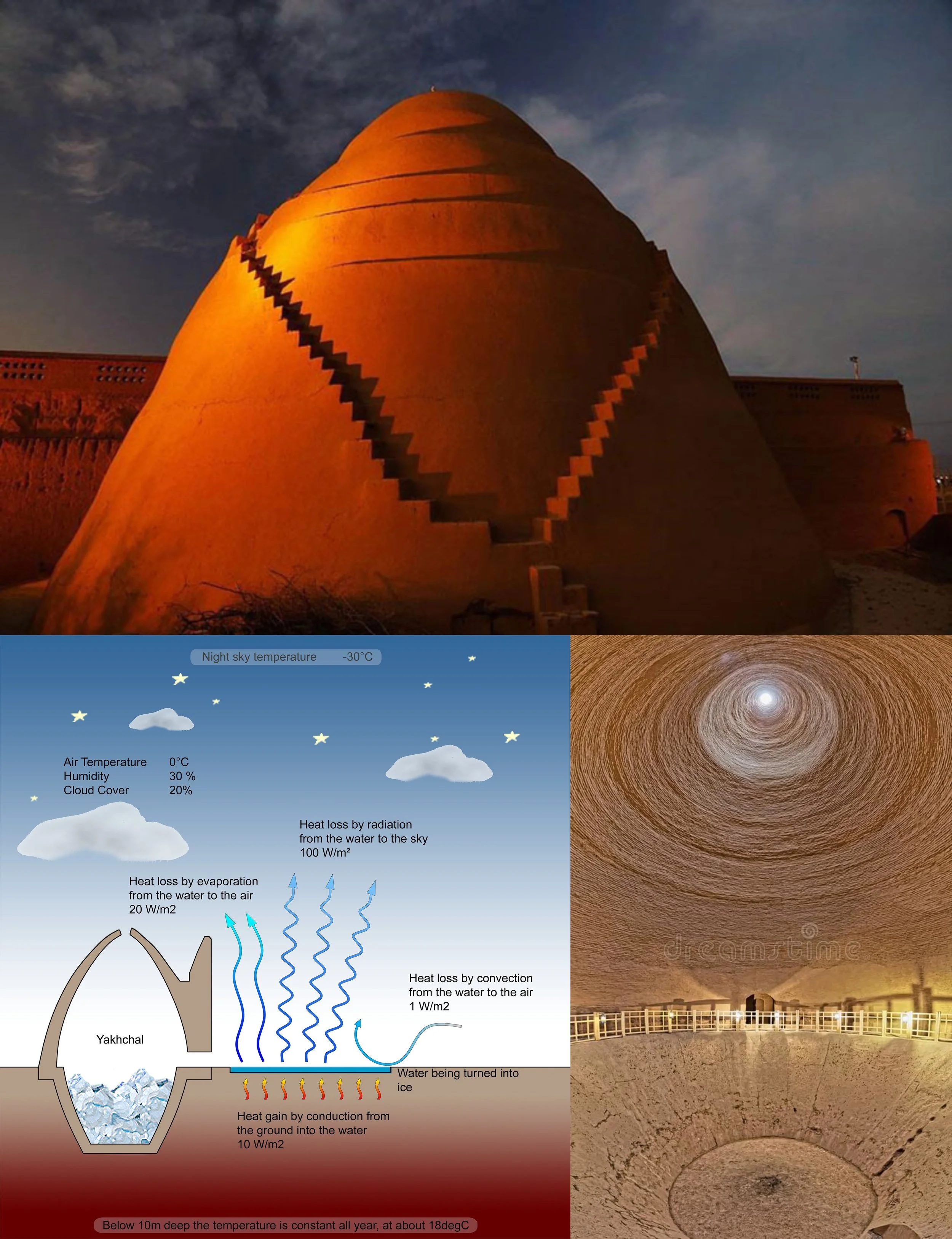
Investigating how communities stored ice, cooled food, and managed seasonal temperatures before mechanical refrigeration.
Introduction: Keeping Things Cold Before Electricity
Modern refrigeration depends on machinery, electricity, and carefully controlled systems of heat transfer. Before these technologies existed, people developed other ways to keep food and drink cool, extend storage life, and take advantage of seasonal cold.
These methods varied widely according to climate, geography, available materials, and social organization. Communities in colder regions could collect winter ice or snow and preserve it for use during warmer months. Other societies used underground chambers, shaded storage spaces, evaporative cooling, cool springs, or naturally cold environments to reduce temperatures.
The archaeological study of icehouses examines the structures and practices associated with such storage. These buildings and chambers can reveal how people managed food supplies, organized labor, and adapted architecture to local environmental conditions.
The term “ancient refrigeration,” however, must be used carefully. Ice storage and passive cooling are not equivalent to modern refrigeration, and not every underground storage structure was an icehouse. A convincing identification requires architectural, environmental, and contextual evidence.
How Icehouses Worked
An icehouse is generally a structure designed to store harvested ice or snow for later use. Many historical examples used thick walls, insulated roofs, underground chambers, drainage systems, and restricted openings to slow melting.
The basic principle is straightforward: ice absorbs heat as it melts, while insulation and limited exposure to warm air slow the transfer of energy into the storage space. Water must also be drained or managed to prevent the remaining ice from sitting in accumulated meltwater.
Different designs suited different environments. Underground chambers could benefit from relatively stable soil temperatures, while above-ground structures relied more heavily on insulation and shade. Some facilities were built near lakes, ponds, or rivers where ice could be harvested during cold periods.
The effectiveness of a system depended on more than the presence of ice. Insulation, chamber size, airflow, drainage, the quality of the stored ice, and the frequency of opening all influenced performance.
Archaeologists can investigate these features by recording wall construction, chamber dimensions, floor levels, drainage channels, and the relationship between the structure and its surroundings.
Distinguishing Icehouses from Other Storage Structures
Underground chambers have served many purposes, including food storage, grain storage, water management, burial, and industrial activity. A deep pit or stone-lined room cannot be identified as an icehouse based on its shape alone.
Researchers look for features consistent with ice storage, such as effective insulation, drainage, a design suited to retaining cold, and a location where ice could plausibly have been obtained. Historical records may describe the structure's use, while associated artifacts can provide chronological clues.
The surrounding landscape is equally important. Proximity to a former pond or lake may support the possibility of ice harvesting, but modern water features may differ from those available when the structure was built.
Environmental reconstruction can help determine whether seasonal freezing was sufficiently reliable. In regions where natural ice was scarce, a proposed icehouse may be more plausibly interpreted as a cool store or cellar unless additional evidence supports ice storage.
The identification should remain proportional to the evidence. A structure may be described as a possible icehouse if its function is plausible but not firmly established.
Food Preservation, Medicine, and Social Status
Cold storage could help preserve certain foods, chill drinks, and provide temporary relief from heat. Its value varied according to the local climate and the types of goods being stored.
Icehouses could also have served elite households, institutional kitchens, hospitals, or commercial establishments. Access to harvested ice required labor, storage space, and favorable environmental conditions, which could make the service expensive in some settings.
However, ice storage should not be assumed to have been exclusively elite. Communities could develop practical cold-storage methods using local materials and shared labor. The social distribution of such technology must be investigated through specific archaeological and historical evidence.
Cold storage also had limits. Ice could slow deterioration but did not sterilize food, and the effectiveness of preservation depended on temperature, cleanliness, and storage duration. Ancient users may have understood the practical benefits of cold without possessing a modern scientific explanation of microbial growth.
Reconstructing the Ice Supply Chain
An icehouse depended on a sequence of activities: obtaining ice, transporting it, preparing the storage chamber, packing the material, and retrieving it when needed.
Archaeologists can investigate these activities through landscape analysis, transport routes, associated buildings, and documentary evidence. If an icehouse stood near a frozen lake, for example, the distance between the water source and the storage facility may help estimate the logistical demands of harvesting.
Tools and equipment associated with cutting, lifting, or transporting ice may occasionally survive, but many were made of perishable materials. Their absence does not mean that ice harvesting did not occur.
The supply chain could also be seasonal. Ice might be collected during the coldest part of the year and stored for warmer months. Establishing this pattern requires environmental evidence and, where possible, historical records describing the timing of collection and use.
Climate, Architecture, and Technological Adaptation
Icehouses illustrate how architecture can compensate for environmental variability. Builders used earth, stone, timber, thatch, and other materials to reduce heat gain and create spaces with relatively stable temperatures.
Different climates demanded different solutions. In humid environments, ventilation and drainage could be important, while colder regions might emphasize insulation and the protection of stored ice from direct sunlight.
Archaeological comparisons can reveal whether builders adopted similar techniques independently or transmitted construction knowledge between communities. Yet architectural resemblance alone cannot establish direct contact, because comparable environmental problems can lead to similar designs.
Experimental reconstruction can help test how well a proposed design would have retained ice. Researchers may model heat transfer or construct replicas using historically plausible materials. Such experiments demonstrate the potential performance of a design, but they cannot establish that an ancient structure was used in exactly the same way without supporting contextual evidence.
Conclusion: Cooling as a Historical Technology
Icehouses and other passive cooling systems reveal how people managed temperature before mechanical refrigeration. Their construction reflects practical knowledge of insulation, drainage, seasonal conditions, and the movement of perishable goods.
Archaeologists must distinguish true icehouses from cellars and other storage structures through a combination of architecture, environmental reconstruction, and historical evidence. The presence of a deep chamber or cool interior is not sufficient by itself.
When the evidence converges, these structures illuminate the labor and ingenuity involved in preserving ice and controlling temperature. They also demonstrate that refrigeration history did not begin with electricity: it grew from many local experiments in architecture, environmental observation, and resource management.




