
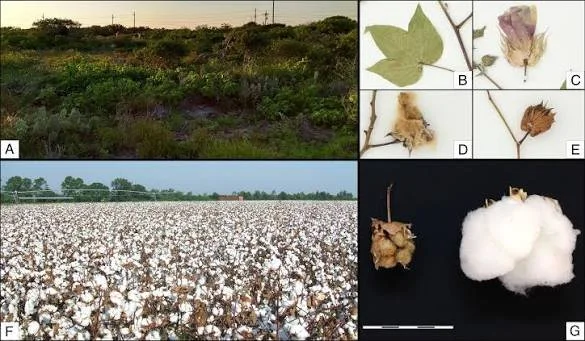
How ancient DNA, plant genetics, and archaeological evidence can help reconstruct the domestication and spread of cotton across the Old World.
Introduction: The Genetic History of a Global Fiber
Cotton has played a major role in the history of clothing, agriculture, trade, and industrial production. Its soft fibers can be spun into yarn and woven into textiles, making it one of the most economically significant plant resources in human history.
The cotton genus, Gossypium, includes numerous wild and cultivated species. Different species were domesticated in different parts of the world, and their histories should not be collapsed into a single origin story. Cotton's global importance emerged through multiple domestication processes, human selection, plant movement, and later hybridization.
Genomics provides a way to investigate these processes. By comparing genetic variation among wild and cultivated cotton plants, researchers can explore relationships between populations, identify signs of domestication, and investigate how cultivated varieties changed as people moved seeds across regions.
The Old World is especially important because several cotton species native to Africa and Asia contributed to the development of ancient and historical textile traditions. However, genetic evidence alone cannot establish exactly when a community first cultivated cotton or when cotton textiles became economically important. Archaeological evidence remains essential.
The Diversity of the Cotton Genus
The genus Gossypium contains species adapted to a range of environments, from dry regions to tropical and subtropical landscapes. Their evolutionary histories are complex, and the relationships among species provide important clues about cotton's development as a cultivated crop.
Two Old World species are particularly significant: Gossypium arboreum and Gossypium herbaceum. Both have long histories of cultivation, although their precise domestication histories and the relationships among ancient cultivated populations remain subjects of scientific investigation.
Other species, including New World cottons, contributed to the later global history of the crop. The movement of cotton plants between regions created opportunities for hybridization and genetic exchange, especially as agricultural and commercial networks expanded.
Researchers use genomic data to compare cultivated cotton with wild relatives. These comparisons can help identify genetic diversity that was retained, lost, or selected during domestication. They can also reveal whether modern varieties preserve traces of older breeding histories.
However, modern genetic diversity has been shaped by centuries of selection, migration, and agricultural change. A modern plant's closest genetic relative is not necessarily the exact wild population from which an ancient crop was domesticated.
Domestication as a Process of Selection
Domestication is not a single moment when a wild plant suddenly becomes cultivated. It is a process through which human management and selection gradually alter a population's characteristics.
For cotton, useful traits include fiber length, fiber quality, seed characteristics, growth habit, and adaptation to local environments. Farmers may have selected plants that produced better fibers or more reliable yields, even without understanding the genetic mechanisms underlying these differences.
Genomics can identify regions of the genome associated with traits that changed during domestication. Researchers compare genetic variation in wild and cultivated plants and investigate whether certain regions show patterns consistent with selection.
These findings must be interpreted cautiously. Genetic patterns can also arise through population bottlenecks, inbreeding, migration, and other demographic processes. Evidence for selection becomes stronger when genomic results correspond with known plant biology and observed differences in traits.
Archaeobotanical evidence can help establish the chronology of cultivation. Seeds, fiber fragments, impressions on artifacts, and other plant remains may provide evidence of cotton use, but their preservation and identification vary considerably.
Reconstructing Old World Cotton Movement
Cotton spread through networks of exchange that connected agricultural communities, textile producers, merchants, and consumers. Seeds could move with migrating farmers, traders, or people seeking suitable crops for new environments.
Genetic comparisons can reveal relationships among cultivated populations across regions. If populations share particular genetic patterns, researchers may investigate whether they reflect common ancestry, later movement, or exchange between cultivated varieties.
Yet genetic similarity does not necessarily identify the direction of movement. Researchers need chronological information from archaeological sites and historical records to determine which explanations are plausible.
The distinction between moving a plant and moving a textile is also important. Cotton fabric could circulate widely without cotton being cultivated locally. Conversely, a community might grow cotton for local use without participating in long-distance textile trade.
Archaeological evidence of seeds and cultivation must therefore be distinguished from evidence of finished cloth, which may have been imported.
Ancient DNA and the Challenges of Plant Preservation
Recovering ancient DNA from cotton remains can be difficult. Heat, moisture, microorganisms, and chemical changes degrade genetic material, and plant fibers may preserve poorly in many environments.
Where suitable samples survive, researchers can use specialized extraction and sequencing methods to investigate their genetic composition. Strict contamination controls are necessary because modern cotton fibers and laboratory materials can introduce misleading signals.
Ancient DNA may help connect archaeological specimens to known genetic lineages. However, a specimen's context and date remain crucial. Cotton fibers found in a later deposit may have been introduced through contamination or the movement of textiles, while a seed may have been transported far from where the plant originally grew.
Researchers therefore combine genetic evidence with microscopy, plant morphology, radiocarbon dating of appropriate material, and archaeological context.
Cotton, Labor, and Economic Transformation
Cotton's genetic history is inseparable from its social history. Cultivation and textile production required land, labor, processing knowledge, and systems for distributing raw fibers and finished cloth.
Different communities organized these activities in different ways. Cotton could be produced for household needs, regional exchange, taxation, or larger commercial markets. Its importance depended on local agricultural conditions and the availability of alternative fibers.
Genomic research cannot independently reconstruct these labor systems, but it can clarify how cultivated plants changed as they moved between regions. Archaeological textiles, spinning tools, loom weights, seeds, and documentary sources provide the broader context.
The history of cotton also requires attention to the unequal social arrangements that shaped its production in later periods. Genetic evidence can illuminate the movement of the crop, but it should not obscure the human labor and economic relationships that made cotton a major commodity.
Conclusion: Reconstructing Cotton's Multiple Origins
Gossypium genomics offers valuable tools for investigating cotton domestication, crop movement, and the genetic changes associated with cultivation. It can help identify relationships among wild and cultivated populations and generate hypotheses about how cotton spread across the Old World.
However, no single genetic pattern can establish a complete domestication route. Modern plants preserve the effects of many later changes, while ancient botanical remains are unevenly distributed and often poorly preserved.
The most reliable reconstruction combines genomic analysis with archaeobotany, textile studies, historical evidence, and agricultural research. Together, these disciplines reveal cotton not as a crop with one simple origin, but as a plant shaped by multiple communities, environments, and histories of human selection.




