
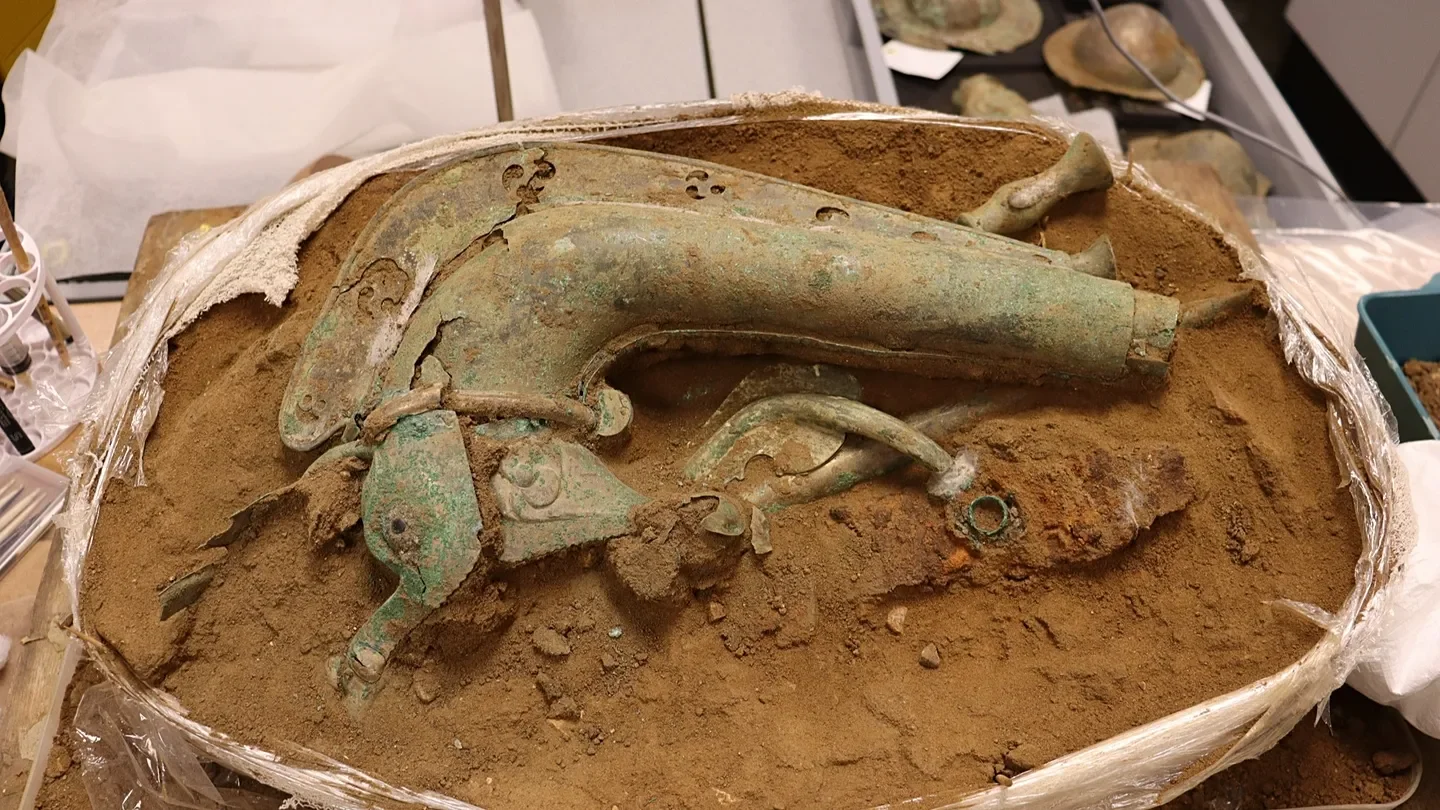
Investigating how sound-producing instruments may have helped Iron Age communities coordinate movement, announce gatherings, and communicate across landscapes.
Introduction: Communication Before Modern Infrastructure
Communication in the Iron Age depended on a combination of speech, messengers, visual signals, and sound. In communities spread across farms, hilltop settlements, fortified sites, and grazing lands, the ability to transmit information beyond ordinary speaking distance could have practical importance.
Horns and other sound-producing objects are intriguing because they could generate signals that traveled farther than a human voice. Depending on their construction and the surrounding terrain, such instruments might have been used to call people together, coordinate herding, announce arrivals, or communicate during conflict.
However, archaeological objects are not always easy to identify by function. A hollow metal object may have been a horn, a component of another instrument, or an item serving a different purpose. Even when an instrument's identity is secure, its precise use may remain uncertain.
The study of Iron Age sound horns therefore combines artifact analysis with acoustics, landscape reconstruction, and contextual archaeology. It asks not only how ancient instruments were made, but also how sound could have organized social life.
Identifying Ancient Sound-Producing Objects
Sound-producing artifacts may be manufactured from metal, animal horn, wood, or other materials. Organic examples often survive poorly, especially in environments where moisture, acidity, and biological activity destroy bone and wood. Metal objects may therefore be disproportionately represented in the archaeological record.
Researchers examine an artifact's shape, mouthpiece, opening, material thickness, and evidence of wear. Manufacturing marks can reveal whether it was cast, hammered, assembled from multiple pieces, or modified after production.
Comparative research is useful but must be handled carefully. Similar instruments from different periods may have served different purposes, and a modern instrument is not necessarily a reliable guide to an ancient one.
Context provides another line of evidence. An object recovered from a burial, a settlement, a ceremonial deposit, or a defensive structure may have had different social associations. Still, burial placement does not automatically establish that the instrument was used in ceremonies during life; grave goods may represent identity, status, symbolism, or other forms of selection.
Sound as a Practical Technology
A horn can communicate information without requiring the listener to see the sender. This makes sound useful in landscapes where hills, vegetation, buildings, or darkness restrict visibility.
For herding communities, acoustic signals could potentially coordinate people and animals across fields or upland grazing areas. In settlements, calls might announce gatherings, mark transitions in daily activity, or warn of approaching danger. During conflict, signals could help coordinate groups whose members were spread across a battlefield or defensive perimeter.
These possibilities should not be treated as universal Iron Age practices. The same instrument could be used differently in different societies, and not every community possessed a standardized system of signals.
To investigate such uses, researchers can compare the artifact's acoustic properties with the terrain around the discovery site. They may ask whether sound could travel between settlements, along valleys, or from a fortified position to surrounding fields. The resulting analysis can establish what was acoustically possible, although it cannot independently prove what people actually communicated.
Experimental Archaeology and Acoustic Reconstruction
Experimental archaeology can help researchers understand how an ancient instrument might have sounded. A replica made using plausible materials and dimensions can be played under controlled conditions, allowing investigators to record its pitch range, loudness, and tonal characteristics.
The experiment must be documented carefully. Modern replicas may differ from ancient objects in material composition, internal shape, or manufacturing precision. A successful modern reconstruction demonstrates feasibility, not necessarily historical identity or use.
Acoustic modeling adds another layer. Researchers can examine how terrain, wind, vegetation, humidity, and surrounding structures affect sound transmission. Valleys may channel sound, while ridges and dense vegetation may interrupt it. Buildings can reflect or absorb sound in ways that change how a signal is perceived.
Such models should include uncertainty. Modern landscapes rarely reproduce Iron Age conditions exactly, and environmental reconstruction may be incomplete. The aim is to identify plausible communication ranges rather than to assign a precise historical distance without sufficient evidence.
From Individual Instruments to Communication Networks
A single horn tells us that someone possessed a sound-producing object. A network requires evidence of relationships among multiple places, instruments, or repeated practices.
Archaeologists might investigate whether comparable horns occur at several settlements, whether their dimensions suggest shared conventions, and whether their distribution follows particular routes or regional boundaries. Similarity could reflect exchange, common manufacturing traditions, imitation, or independent solutions to similar practical needs.
If several sites were within plausible acoustic range, researchers might test whether a signal could travel between them. Yet this does not establish that the sites maintained a coordinated signaling system. People could have used instruments independently, or the artifacts could have been acquired for ceremonial and display purposes.
A stronger argument would combine repeated finds, chronological compatibility, contextual evidence, and a plausible pattern of communication. Written descriptions or iconography from a relevant region and period, when available, could offer additional support, but they should not be applied indiscriminately across different societies.
Social Meaning, Identity, and Public Performance
Sound is not only a practical tool. A loud or distinctive instrument can draw attention, mark authority, or create a shared experience among listeners. The use of a horn in a public gathering might have signaled a transition, announced a leader's presence, or contributed to a ceremony.
Archaeological context can suggest these possibilities, particularly when instruments occur alongside other objects associated with status or collective activity. But status interpretations must be based on the wider assemblage and burial or settlement patterns, not on the instrument alone.
The sound itself may also have carried cultural meaning. Different pitches, rhythms, or timbres could have been recognized by people familiar with a community's conventions. Unfortunately, these codes are rarely recoverable from the instrument's physical remains alone.
This limitation reminds us that acoustic archaeology can reconstruct aspects of sound production more readily than the meanings listeners attached to sound.
Conclusion: Listening to the Iron Age Through Material Evidence
Iron Age sound horns offer a promising route into the study of communication, mobility, and collective life. Their physical properties can be analyzed, their sounds can be approximated experimentally, and their locations can be compared with the landscapes in which they were found.
The evidence must nevertheless be interpreted with restraint. An instrument's acoustic potential does not prove that it served as a military alarm or connected a network of settlements.
By integrating artifact analysis, experimental reconstruction, landscape modeling, and contextual study, archaeologists can investigate how sound may have extended human communication beyond direct conversation. The result is a richer picture of Iron Age society—one in which information could travel through a landscape not only by foot, but also through the sound of an instrument carried across the distance.




