
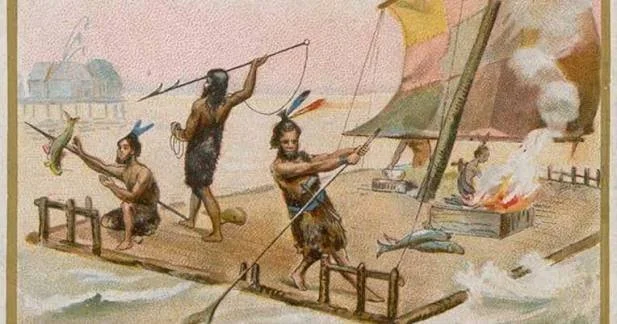
How waterways, wooden flotation technologies, and archaeological evidence can help reconstruct the movement of people and goods before the development of extensive road networks.
Introduction: Rivers as Corridors of Movement
Rivers have long shaped the movement of people, animals, and materials. They provide water, connect different ecological zones, and can offer routes through landscapes that are difficult to cross on foot. In prehistoric societies, waterways may have supported fishing, communication, migration, and the transport of resources between settlements.
Timber rafts represent one possible form of water transport. Constructed from logs, branches, or bundled plant materials, rafts can provide a relatively simple means of moving people and cargo across water. Their exact design depends on available materials, current conditions, the intended load, and the distance to be traveled.
Unlike stone or ceramic artifacts, rafts are usually made from perishable materials. Their archaeological evidence may therefore be indirect, surviving as impressions, wooden remains in waterlogged deposits, associated equipment, or patterns of resource movement.
The challenge is to distinguish evidence for raft use from broader evidence of river transport. A riverbank settlement with imported goods does not automatically prove that timber rafts carried those objects.
The Construction and Performance of Timber Rafts
A raft uses buoyant materials arranged to support a load. Logs can be bound together, while lighter plant materials may be bundled or combined with a supporting framework. The simplest designs can be made without complex joinery, although more elaborate structures may require specialized construction knowledge.
The performance of a raft depends on buoyancy, load distribution, stability, and water conditions. A design suitable for calm water may be unsafe in strong currents or rough conditions. Transporting heavy cargo also requires careful attention to how weight is distributed across the structure.
Experimental archaeology can test possible raft designs using historically plausible materials. Researchers can investigate flotation, stability, maneuverability, and the amount of cargo a replica might carry.
These experiments establish physical feasibility, not historical use. A successful reconstruction does not prove that prehistoric people built the same raft, and a modern replica may behave differently because of variations in timber, binding materials, or construction techniques.
Archaeological Evidence for River Transport
Direct evidence of prehistoric rafts is uncommon because wood and plant-fiber bindings often decay. Waterlogged environments can preserve wooden components, but preservation varies greatly with oxygen levels, water chemistry, and sediment conditions.
Researchers may investigate shaped timber, repeated notches, binding marks, or other features that suggest a component was part of a flotation structure. Yet such marks can also occur on building materials, tools, or other wooden objects.
Associated artifacts may provide additional clues. Transport equipment, landing structures, storage facilities, and concentrations of goods near navigable waterways can indicate riverine movement. However, these features can also serve local fishing, crossing, or settlement activities.
A strong interpretation combines the physical remains with environmental reconstruction and evidence that the location could support the proposed type of transport.
Rivers, Cargo, and the Movement of Resources
River transport can reduce the effort required to move heavy goods across long distances, although the advantages depend on the direction of flow, navigability, and the availability of suitable craft.
Archaeologists investigate riverine exchange by examining the distribution of raw materials, pottery, metal objects, stone tools, and other transported goods. If materials from one region appear in settlements along a river corridor, researchers can investigate whether the waterway provided a route for their movement.
Provenance analysis can help identify the geological or chemical origin of certain materials. However, identifying an object's source does not establish whether it traveled by raft, canoe, larger boat, or overland route.
The transport of bulky materials may be especially relevant to riverine systems. Timber, stone, and agricultural products can be difficult to move over land, making waterways potentially valuable. Yet the archaeological evidence must establish the relationship between the material and the proposed route.
River Seasonality and Navigation
River conditions change over time. Seasonal rainfall, snowmelt, drought, flooding, and sediment accumulation can affect water depth and current speed. These changes influence when and where a raft could be used safely.
Environmental archaeology can reconstruct aspects of past river behavior through sediment cores, flood deposits, pollen records, and geomorphological analysis. Such evidence helps determine whether a waterway was navigable during the period under investigation.
However, the modern course of a river may differ from its prehistoric route. Channels can migrate, wetlands can expand or contract, and sedimentation can change the relationship between settlements and the water.
Researchers must therefore reconstruct the relevant landscape before assuming that a present-day river was navigable in the same way during prehistory.
River Transport and Social Organization
Even simple water transport requires knowledge of materials, currents, landing places, and cargo handling. Communities may have developed shared practices for building rafts, maintaining equipment, and coordinating movement.
The scale of transport can vary from household activity to organized exchange. A raft carrying a small load between neighboring settlements does not require the same organization as repeated transport of large quantities of goods over long distances.
Archaeological evidence may reveal differences in the scale of exchange through settlement size, storage facilities, and the distribution of materials. However, it rarely identifies the precise ownership or social organization of the transport system.
Riverine trade should therefore be understood as a range of activities rather than one uniform institution. Household movement, seasonal exchange, and specialized transport may have coexisted within the same region.
Conclusion: Recovering Prehistoric Water Transport
Timber rafts offer a plausible and technologically accessible means of prehistoric water transport, particularly where suitable wood and navigable rivers were available. Their study can help researchers investigate how communities moved goods and connected settlements across landscapes.
Direct archaeological evidence is often limited, so interpretations must distinguish confirmed wooden structures from indirect indicators of river transport. Imported materials near a river do not independently establish that rafts were used.
By combining wood analysis, experimental archaeology, river reconstruction, and provenance studies, researchers can explore the potential role of rafts within prehistoric exchange systems. These investigations highlight how even relatively simple technologies may have supported complex networks of movement and interaction.




