
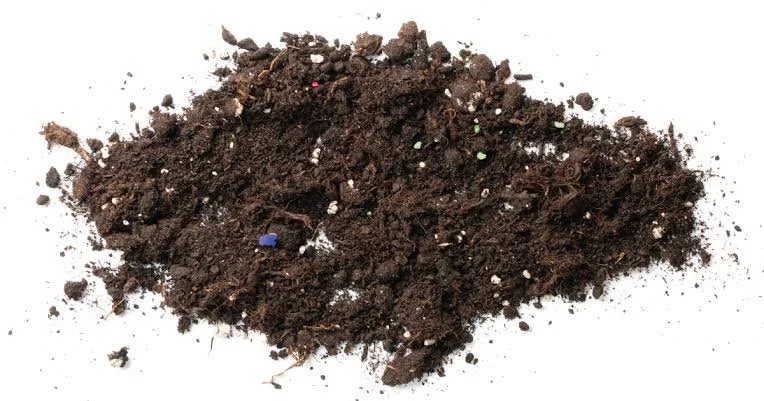
How microscopic plastic particles complicate the archaeological study of recent deposits, organic waste, and environmental change.
Introduction: A New Material in the Archaeological Record
Archaeology is increasingly concerned with deposits formed during the recent past. Household rubbish, agricultural waste, landfills, compost heaps, and other modern accumulations can preserve evidence of changing consumption patterns, environmental practices, and waste management.
These deposits also contain materials that were absent from most earlier archaeological contexts. Microplastics—small plastic particles commonly defined as less than five millimeters in size—can enter soils through packaging, synthetic textiles, agricultural films, wastewater, and the breakdown of larger plastic objects.
Compost heaps are particularly interesting because they bring together organic material, soil, food waste, and sometimes plastic contamination. Composting can change the physical and chemical composition of waste, while plastic particles may persist or fragment during processing.
For archaeologists and environmental researchers, these particles create interpretive challenges. Their presence may reveal modern contamination or waste practices, but researchers must establish when and how the particles entered a deposit before using them to reconstruct past activity.
How Microplastics Enter Compost and Soil
Microplastics can originate from the breakdown of larger plastic items or be introduced as small particles from products and materials. They may enter compost through contaminated food packaging, synthetic fibers, plastic garden materials, or other waste streams.
Wind, surface runoff, irrigation water, and the movement of contaminated soil can also transport particles into compost heaps and surrounding deposits. Once present, they may be redistributed during turning, screening, decomposition, or later disturbance.
The concentration of microplastics can therefore reflect several processes rather than one specific activity. A high concentration in a compost sample may indicate contaminated inputs, but it may also result from differences in particle retention or sampling location.
Researchers investigate these pathways by comparing particles in compost ingredients, finished compost, surrounding soil, and other potential sources. This helps determine whether contamination occurred before, during, or after the composting process.
Identifying and Measuring Microplastics
Microplastics vary in size, shape, color, and chemical composition. They may occur as fibers, fragments, films, beads, or other forms. Visual identification alone is unreliable because natural materials can resemble plastic.
Laboratory techniques such as Fourier-transform infrared spectroscopy and Raman spectroscopy can help identify polymer types. Microscopy provides information about particle shape and size, while other analytical methods may be used to investigate chemical composition.
Contamination control is essential. Synthetic fibers can enter samples from clothing, laboratory equipment, packaging, and airborne dust. Researchers use procedural blanks, appropriate sampling materials, and documented handling protocols to estimate the risk of contamination.
Particle counts also depend on the method used. Different studies may use different size thresholds, separation techniques, and identification criteria, making direct comparisons difficult unless the methods are compatible.
What Microplastics Reveal About Modern Deposits
Microplastics can help characterize the composition of recent waste deposits and investigate how plastic materials enter agricultural and domestic environments. Their polymer types and physical condition may provide clues about the sources and processes involved.
However, microplastics are not reliable chronological markers by themselves. Although plastics became widespread during the modern period, particles can move through soil and water, and older deposits can become contaminated by later materials.
A microplastic particle found in an apparently old layer does not automatically mean that the layer was deposited during the period when that plastic was manufactured. The particle may have migrated downward through roots, cracks, animal burrows, or human disturbance.
Researchers must therefore establish the integrity of the stratigraphy and compare microplastic evidence with independent dating and contextual information. The presence of a modern material can be informative, but only when its depositional history is understood.
Composting, Decomposition, and Particle Transformation
Composting involves the biological breakdown of organic matter under controlled or semi-controlled conditions. Temperature, moisture, oxygen availability, and microbial activity influence how quickly the organic material decomposes.
Many common plastics do not break down in the same way as food waste or plant material. Some may fragment into smaller pieces, while others remain relatively intact. Certain materials marketed as compostable require specific conditions to degrade effectively, and their behavior varies with the composition of the material and the composting environment.
Researchers can compare microplastic abundance before and after composting to investigate whether particles are retained, fragmented, or removed during processing. However, a change in particle count may reflect sampling differences or changes in the detection method rather than a true increase or decrease.
This is important for interpreting archaeological deposits. A compost heap may become richer in plastic particles relative to its organic content as decomposition proceeds, even if no additional plastic enters the system.
Implications for Archaeological Interpretation
Microplastics complicate the interpretation of recent deposits because they can move between layers and contaminate materials that were originally plastic-free. They may also affect attempts to distinguish primary deposition from later disturbance.
Researchers studying historical composting, agricultural practices, or waste management must separate the original contents of a deposit from later environmental inputs. This requires careful sampling, stratigraphic recording, and analysis of surrounding sediments.
Microplastics also raise broader questions about how future archaeologists will interpret contemporary life. Plastic fragments may become widespread markers of modern activity, but their distribution will reflect manufacturing, consumption, disposal, and environmental transport rather than a single uniform event.
Their presence can provide valuable evidence of human influence on the environment, provided researchers do not treat the particles as precise dates or straightforward indicators of a specific behavior.
Conclusion: Interpreting Plastic in the Recent Past
Microplastics introduce a new set of challenges for studying compost heaps, agricultural soils, and other modern archaeological deposits. Their presence can reveal contamination pathways and changes in waste management, but their movement and transformation complicate chronological interpretation.
Reliable analysis requires standardized sampling, chemical identification, contamination controls, and independent evidence of deposit formation. Researchers must distinguish the original composition of a layer from particles introduced later through water, wind, soil movement, or human activity.
By integrating microplastic analysis with environmental archaeology and stratigraphic study, researchers can investigate how modern materials enter the landscape and alter the archaeological record. The goal is not simply to detect plastic, but to understand its history within a complex system of production, disposal, decomposition, and environmental transport.




