
Introduction
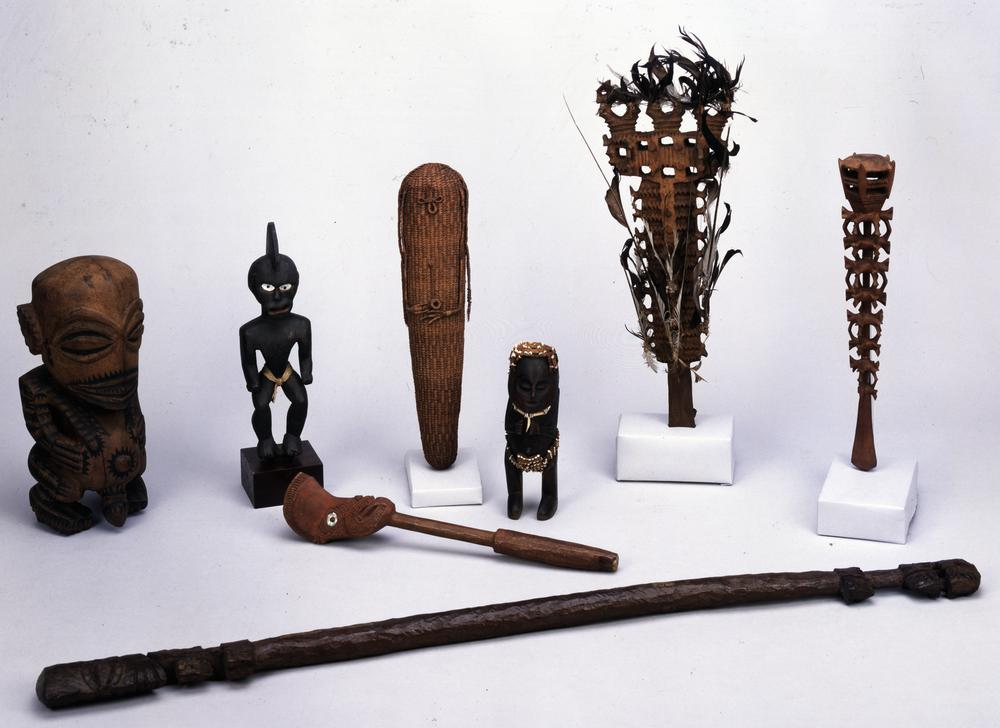
Miniature figurines are among the most interesting objects in archaeological and ethnographic studies because their small size does not necessarily reflect their importance.
In Pacific communities, objects associated with ancestors, spirits, protection, identity, ritual authority, or household activities could occupy significant positions within domestic and ceremonial spaces.
The distribution of miniature figurines in house shrines provides a research opportunity to explore the relationships between material culture, household religion, social organization, and ritual practices.
However, the Pacific contains diverse cultures, languages, traditions, and religious histories. Figurines should not be interpreted as representing a single shared belief system across the region.
Miniature Objects and Their Functions
Miniature figurines may be made from wood, stone, bone, shell, clay, fiber, or other materials.
Their small size could make them easier to transport, store, conceal, or display.
Possible functions include:
Household protective objects.
Representations of ancestors.
Ritual offerings.
Symbolic objects associated with fertility or prosperity.
Teaching or commemorative objects.
Personal devotional items.
These interpretations remain context-dependent.
An object that resembles a human figure might be a toy, decoration, ritual object, ancestor representation, or something else entirely.
House Shrines and Domestic Ritual
Domestic religious practices are important because they reveal how ritual life may have been integrated into ordinary household activities.
Shrines could be located in particular areas of a dwelling, near entrances, storage spaces, sleeping areas, or other locations.
Their organization might reflect:
Household relationships.
Ancestral connections.
Protection of family members.
Ritual responsibilities.
Seasonal activities.
Social status.
The spatial arrangement of figurines could provide clues about how people organized sacred objects within domestic spaces.
Distribution and Archaeological Interpretation
The distribution of figurines across house shrines may help researchers examine differences between households.
Questions might include:
Were figurines found in every household or only selected dwellings?
Were certain materials associated with particular house types?
Did figurine placement change over time?
Were miniature objects concentrated in household spaces or ceremonial structures?
Did communities exchange figurines through trade?
Spatial analysis can identify patterns, but the meaning of those patterns requires careful interpretation.
Material and Craft Analysis
The material used to make figurines may reflect local resources, trade, specialized craftsmanship, or cultural preferences.
Researchers could study:
Stone composition.
Wood species.
Shell identification.
Surface treatments.
Pigments.
Carving marks.
Manufacturing techniques.
A figurine made from a material unavailable locally may indicate exchange or movement of objects.
Ritual Meaning and Cultural Continuity
Miniature figurines may have been associated with spiritual beliefs, but archaeological evidence rarely allows researchers to reconstruct exact prayers, rituals, or meanings without additional sources.
Ethnographic comparisons can help generate hypotheses, but modern practices should not automatically be treated as unchanged survivals of ancient traditions.
Community perspectives are particularly important when interpreting objects that may remain culturally sensitive.
Conclusion
The study of miniature figurines in Pacific house shrines can illuminate household religion, social identity, craftsmanship, and the organization of ritual space.
Their small physical size may conceal significant cultural value, making contextual documentation and respectful interpretation essential.





