
Introduction
Bronze artifacts recovered from wet burial environments often display complex corrosion patterns. Waterlogged soil, groundwater, dissolved salts, oxygen availability, and microorganisms can influence the chemical transformation of bronze over time.
One of the most concerning forms of bronze corrosion is commonly called bronze disease. It is associated with chloride-containing corrosion products that can produce destructive reactions within copper-based artifacts.
The forensic chemistry of bronze disease is important because it helps conservators distinguish stable corrosion from active deterioration and determine appropriate treatment strategies.
Bronze Composition and Corrosion
Bronze is generally a copper-based alloy, often containing tin and sometimes other elements.
When bronze is exposed to environmental conditions, its surface may react with water, oxygen, salts, and other substances.
Corrosion can produce layers containing copper oxides, carbonates, chlorides, and other compounds.
Some corrosion products form relatively stable protective layers. Others may contribute to continued deterioration.
The composition of the alloy and the surrounding burial environment both influence the corrosion process.
Understanding Bronze Disease
Bronze disease is commonly associated with chloride-bearing corrosion products, particularly copper chloride compounds.
In the presence of moisture and oxygen, chloride-related corrosion reactions may continue and generate powdery or crystalline corrosion products.
The process can create localized damage, including pits, cracks, and progressive loss of metal.
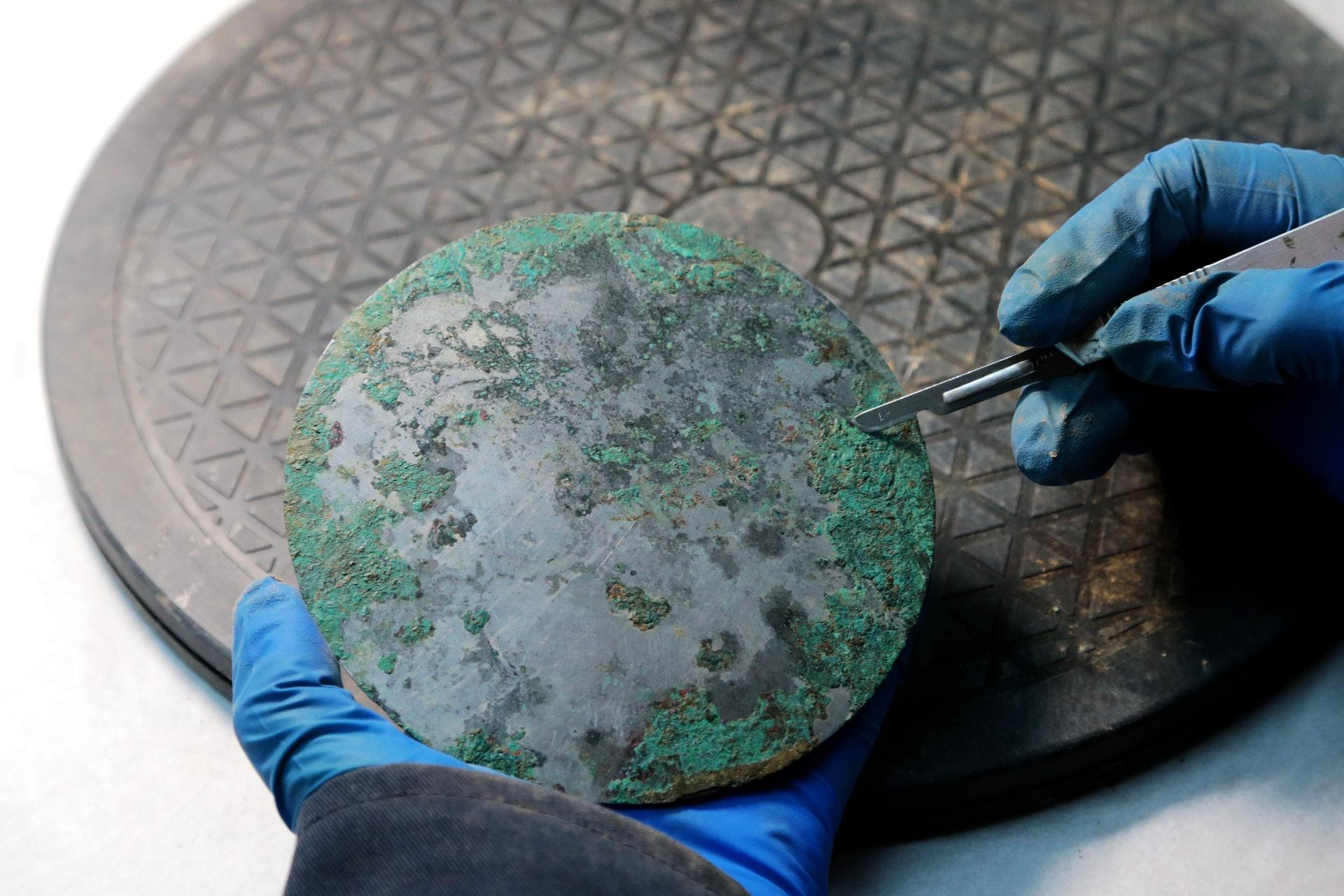
Typical visible signs may include pale green or powdery deposits, but color alone is insufficient for diagnosis. Many copper corrosion products appear green or blue and may be stable.
Wet Burial Environments
Wet burials create complex conditions for bronze preservation.
Waterlogged environments may contain dissolved salts, organic matter, microorganisms, and varying levels of oxygen.
The chemical conditions may change when an artifact is excavated and exposed to air.
An object that remained relatively stable underground may begin deteriorating after recovery because the environmental conditions that maintained its stability have changed.
This makes excavation, storage, and conservation particularly important.
Forensic Chemical Analysis
The identification of bronze disease requires more than visual inspection.
Conservation scientists may use several analytical techniques.
Common analytical methods
X-ray fluorescence (XRF): Helps determine elemental composition.
X-ray diffraction (XRD): Identifies crystalline corrosion products.
Scanning electron microscopy (SEM): Examines surface structure and corrosion features.
Energy-dispersive X-ray spectroscopy (EDS): Provides elemental information from selected areas.
Raman spectroscopy: Can help identify mineral compounds.
Ion analysis: May determine chloride concentrations in corrosion layers or associated materials.
The combination of these techniques allows researchers to identify corrosion products and investigate how they formed.
Conservation and Treatment
Treatment depends on the condition of the artifact, its composition, the corrosion products present, and the conservation objectives.
Possible approaches include:
Controlled environmental storage.
Stabilization.
Monitoring corrosion activity.
Carefully selected chemical treatment.
Mechanical removal of harmful deposits where appropriate.
Documentation before and after treatment.
Removing all corrosion is not necessarily desirable. Some corrosion layers may be stable and provide evidence of the object's history.
Archaeological Significance
Corrosion analysis may reveal information about burial conditions, environmental exposure, alloy composition, and the artifact's preservation history.
The chemical composition of corrosion layers can sometimes help identify differences between burial environments or explain why particular objects survived.
However, corrosion patterns should not be used alone to determine an artifact's age, origin, or function.
Conclusion
Bronze disease is an important conservation concern because chloride-related corrosion can continue damaging copper alloys after excavation.
Forensic chemistry provides the tools needed to distinguish corrosion processes, identify unstable materials, and develop appropriate preservation strategies.
The study of bronze artifacts from wet burials demonstrates the close relationship between archaeology, chemistry, environmental science, and conservation.





