
Introduction
Underberg lies in the foothills of the southern Drakensberg in KwaZulu-Natal.
The surrounding landscape contains an extraordinary concentration of rock art associated primarily with San hunter-gatherer traditions.
The title Underberg: South Africa's Natal San Art places the region within this larger rock-art heritage.
The southern Drakensberg is especially important because its shelters preserve paintings that provide insights into the symbolic worlds, social practices, and spiritual traditions of southern African hunter-gatherer communities.
San Rock Art
San rock art is among the most important archaeological records in southern Africa.
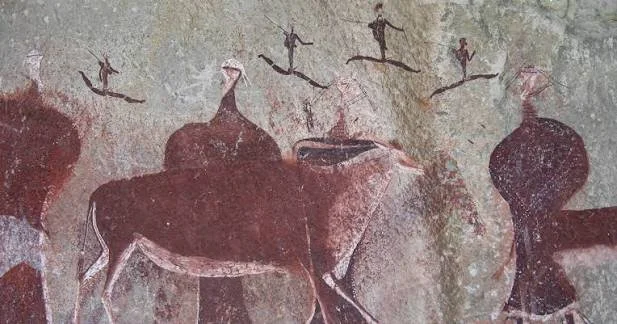
Paintings commonly depict:
humans,
eland,
other animals,
hunting scenes,
dancing figures,
therianthropes,
and abstract or unusual forms.
These images were not simply illustrations.
They could have religious, social, and ritual meanings.
The Eland
The eland occupies an especially important position in many interpretations of San rock art.
It was a large and powerful animal.
Eland imagery may be associated with concepts of potency, rain, transformation, trance, and spiritual power.
However, not every eland painting necessarily carried exactly the same meaning.
Context matters.
The Drakensberg Shelters
The mountains contain thousands of rock shelters.
Some preserve paintings remarkably well because they are protected from direct rainfall.
Pigments were commonly made from mineral and organic materials.
Red, orange, white, yellow, black, and other tones could be produced from locally available substances.
Dating the Art
Dating rock art is difficult.
Researchers use multiple methods, including:
pigment analysis,
radiocarbon dating where possible,
archaeological deposits,
stylistic comparison,
and association with dated cultural materials.
Not every painting can be assigned a precise age.
Underberg's Landscape
The Underberg area provides an important transition between lowlands and mountains.
This environmental diversity supported different forms of subsistence.
People could hunt, collect plant foods, exploit river systems, and move between ecological zones.
The landscape therefore formed part of the cultural world represented in the art.
Colonial Contact
Later colonial expansion profoundly affected San communities.
Land dispossession, warfare, labor changes, and demographic transformation disrupted many traditional ways of life.
The disappearance of particular communities does not mean their cultural history disappeared.
Rock shelters preserve material evidence of earlier lifeways.
Conservation
Rock art is extremely fragile.
Damage can result from:
moisture,
biological growth,
vandalism,
touching,
smoke,
dust,
and uncontrolled tourism.
Conservation therefore requires careful management.
Conclusion
Underberg: South Africa's Natal San Art belongs to one of the world's most important traditions of prehistoric and historic rock art.
The paintings should not be treated simply as ancient decoration.
They represent a sophisticated visual record of relationships between people, animals, landscape, ritual, and spiritual experience.
Their survival provides an extraordinary opportunity to understand southern Africa's deep human history.





