On a hill not far from Jerusalem, archaeologists working at a previously unexamined location make an incredible discovery. Digging at the ancient site, one that goes back thousands of years, the international team discover evidence that could solve an enduring Biblical mystery. And it’s all to do with Jesus’ travels following the resurrection.
Secrets of an Ancient Civilization / The Lost World of the Maya
Step into the mysterious world of the Maya civilization that thrived in Mesoamerica for over 2,000 years. Discover their advanced system of astronomy and mathematics , intricate artwork and complex social structure. Join us on a journey to unravel the secrets of this fascinating civilization, including their gods and goddesses, and gain a deeper understanding of their beliefs and culture.
Trier's Golden Treasure The "Golden Treasure Of Trier" Is The Largest Ever Discovered Roman Gold Treasure
The largest Roman gold hoard ever discovered was the "Trier Gold Hoard." The discovery, which included 2,500 gold pieces totaling 18.5 kg, was uncovered in 1993 during excavation work, approximately 1,800 years after it was hidden.
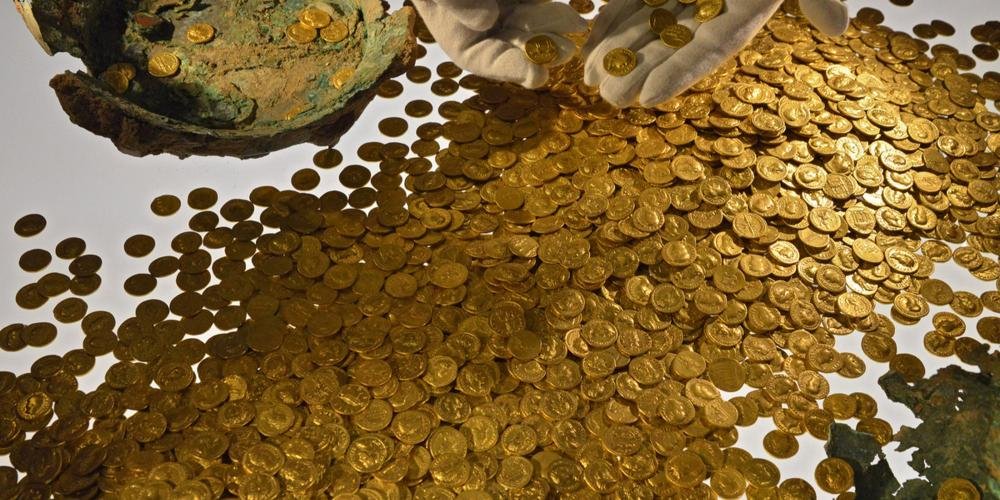
The oldest coins were struck on Emperor Nero in the years 63/64 AD, the youngest under Septimius Severus between 193 and 196. – © Thomas Zühmer
The 1993 discovery of the Trier Gold Hoard generated a lot of media attention. Further investigation indicated that it was likely an official treasury and not just someone's personal money. The treasury had been managed with care, and it had expanded over time. The Hoard was equivalent to about 130 Roman soldiers' yearly pay. There are a total of 27 emperors, empresses, and members of the imperial family shown on the aurei (gold coins), some of which are still regarded as being unique today.
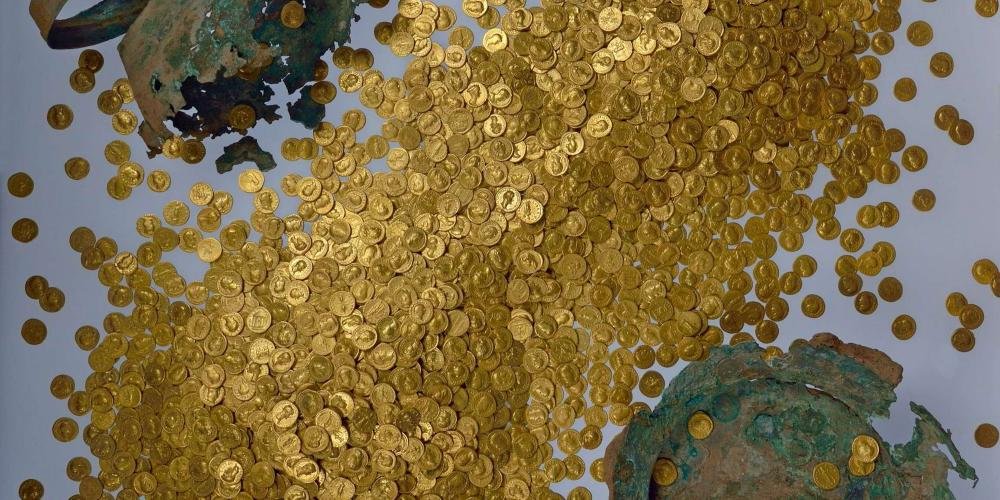
The earliest coins in the hoard were minted 63 AD. – © Thomas Zühmer
What caused the coins to be buried?
During a civil war in 196 AD, the gold coins were interred in a cellar. When Clodius Albinus named his son Caracalla as the heir apparent rather than Albinus, Septimius Severus' rule was overthrown. It's likely that the former hoard manager carried the knowledge of the hidden cache with him to the afterlife.
The hoard was hidden for the first time in 167 AD, probably because of the Antonine Plague. – © Thomas Zühmer
Viewing methods for coins
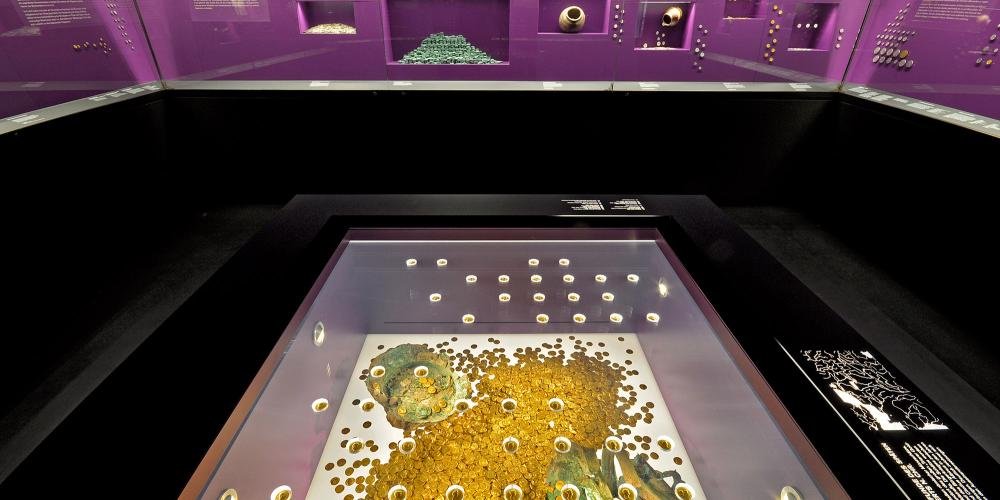
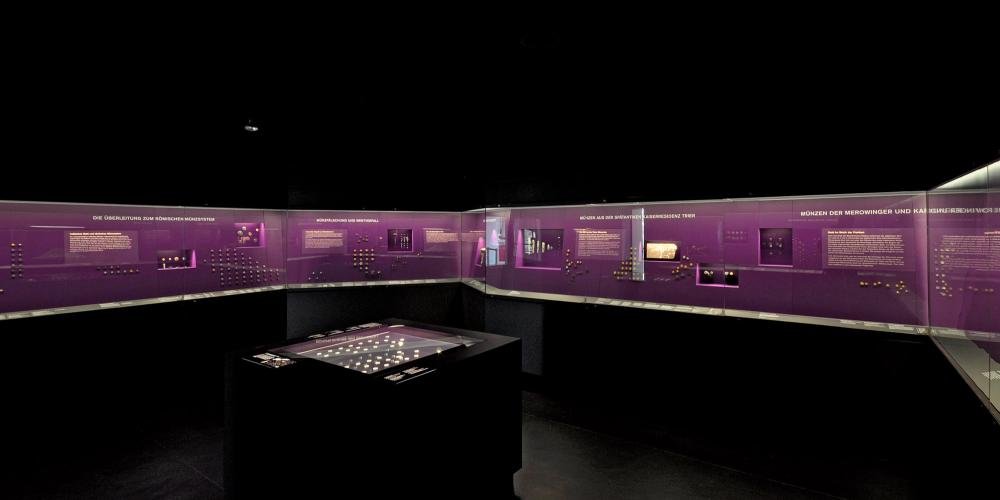
Currently, the Rheinisches Landesmuseum Trier's coin collection features this one-of-a-kind collection on display. One of Germany's largest archaeological museums, the state museum has an exhibition that features 12,000 coins in total. The Gold Hoard presentation room offers significant information on the development of the monetary system and how ancient, medieval, and modern money have been produced in addition to archaeological discoveries.
The gold treasure is exhibited in the Rheinisches Landesmuseum. – © Thomas Zühmer
Mysterious Archaeological Find Leaves Experts Stumped
Have you ever stumbled upon a mysterious finding that made you question if you really know half of what our world is made of? We have heard of the wonders of the world, but do you know several unexplainable mysteries exist on Earth? You may have thought science and technology had unraveled it all, but there are several puzzling questions that even scientists find mind-boggling. Stay tuned as we unveil the mysterious archeological discoveries scientists can't explain.
Weird Rulers of Ancient Egypt
In the following video we will be talking about the weirdest rulers of Egypt. Watch the video to find out more!
Why You Wouldn’t Survive Life in Tudor England
Imagine stepping into the lavish yet treacherous world of Tudor England, where the extravagance of royal courts collides with the specter of mortal danger lurking in every shadow. From the deadly dance of political intrigue to the unforgiving grasp of rampant disease, the perils of Tudor life would test even the most tenacious modern individual. So, buckle up and brace yourself, for we're about to uncover the harrowing reasons why surviving in the realm of Henry VIII and Elizabeth I would be a feat beyond the reach of most mere mortals.
The Ishtar Gate: Uncovering the Mysteries of Babylon's Marvelous Monument
The ancient city of Babylon is steeped in history and mystery, and the Ishtar Gate of Babylon is one of its most enduring wonders. In this video, "The Ishtar Gate of Babylon - Uncovering the Mystery," you will take a deep dive into the fascinating facts surrounding this magnificent structure. With its towering stones, intricate designs, and stunning colors, the Ishtar Gate has captured the imagination of people for centuries. And today, it can be viewed in full splendor at the Pergamon Museum in Berlin, where it has been reconstructed for all to see.
In this video, you'll get a glimpse of the incredible engineering and artistry that went into the creation of the Ishtar Gate. You'll discover the unique features of the gate, including the mythical creatures that adorn it, and you'll learn about the significance of the gate in Babylonian culture and religion. You'll also delve into the mystery of how the gate disappeared from history, only to be rediscovered and reconstructed in the modern era.
With its in-depth exploration of Babylon's history and culture, "The Ishtar Gate of Babylon - Uncovering the Mystery" offers a full and comprehensive view of this incredible wonder. Whether you're a history buff, an art lover, or simply fascinated by the ancient world, this video is a must-see. So step back in time and immerse yourself in the awe-inspiring world of the Ishtar Gate and the city of Babylon.
A Secret Chamber Hiding in Plain Sight? The Tomb of Khentkawas, Giza
The Tomb of Khentkawas may not be the most breathtaking ancient monument on the Giza Plateau, but this Old Kingdom ruin is certainly one of the most prominent. Today it is very much unloved and off limits to tourists, which for me is a real shame because I think it may still have a secret hiding in plain sight.
For the first half of this video, I take a close look at the mysterious and incomplete history of Tomb of Khentkawas, before highlighting a curious anomaly I’ve identified on the 2006 laser scanning survey results, which I think could be a concealed entrance into a secret hidden chamber or corridor, unopened for 4,500 years.
15 Largest Humans To Ever Live
In the video below we will analyze the 15 largest humans that have ever lived. Watch the video to find out more!
Tallest Statue Without Base Size Comparison (60+ statues) | 3d Animation Comparison
In this video we made 3d Comparison of tallest statues and this is true real scale comparison of tallest statues. Watch the video to find out more!
12 Most Amazing Ancient Artifacts Finds
From ancient treasures to forgotten ruins, this video is going to take you on a thrilling journey into the world of archaeology, showcasing some of the most fascinating discoveries made by archaeologists and, in some cases, by non-archaeologists who got the shocks of their lives when they came across their surprising finds! Get ready to uncover the secrets of the past and experience the excitement of unearthing history.
20 Turtles You Won’t Believe Actually Exist
In the following video we will analyze 20 turtles you won’t believe actually exist. Watch the video to find out more!
What They Just Captured In Africa Shocks The Whole World
From a cave layered with human remains to Africa splitting apart, what scientists have just discovered in Africa terrified them! It's no surprise that Africa has secrets that still make us question everything we’ve ever known. Join us as we uncover the most unsettling discoveries that hide within the world’s second-largest continent.
Secret History Revealed: Who Really Built the Gigantic Stone Blocks in Baalbek?
In Baalbek, Lebanon, researchers are faced with a mystery. Three stones are built into the foundation of a temple that should not actually exist. On top of that, the pillars of the temple are made of a stone that only occurs in Aswan in Egypt, almost 1,500 kilometers away. The transport of heavy stones already poses problems in the present. Stones weighing as much as the largest of Baalbek would have to be lifted by 18 heavy-duty cranes today. Even the components of nearly 100 columns would require incredible convoys of specially secured heavy-duty trucks. But these stones were moved over this distance at a time when there was neither asphalt nor engines.
All this gave rise to speculation: Are the stones of Baalbek also legacies of a much older culture that had advanced technologies? Who could really be behind the construction of the Temple of Baalbek, we look at today in this video.
9 Most Bizarre Creatures People Used To Believe Existed
Check out these 9 creatures people used to believe existed! This top 10 list of mythical and mysterious creatures from mythology has been an unexplained mystery for people for centuries.
10 Terrifying Prehistoric Giants
The heaviest animal that has ever lived on Earth is the blue whale, whose weight exceeds 150 tons. As far as we know, no living organism in history has had a similar mass. But some creatures could boast of larger sizes.
Dinosaurs enjoy, perhaps, undeserved attention of the public, because besides them, many other animals of enormous size lived on Earth, which we will never see in the flesh. Some of them are gigantic ancestors of living creatures, while others did not leave offspring, and therefore seem especially amazing. The remains of prehistoric giants can shed light on the gradual changes in living conditions on Earth, since the size of animals is often directly dependent on the environment.
In addition, there is something bewitching in the extinct giants, the appearance of which we can only imagine.
The Most Humiliating Execution Methods Used in the Roman Empire
Step back in time and uncover the most humiliating execution methods employed by the Roman Empire. Witness the chilling techniques used to maintain order and instill fear, as we delve into the darker side of ancient Rome's justice system. Prepare for a shocking and eye-opening experience!
The Eye: Argentina's enigmatic revolving island
Between Buonos Aires and Campana, in Argentina's Parana river delta, is the small and enigmatic islet known as The Eye. It is a narrow strip of land that is a perfect 120-meter circle, a shape that revolves around itself. It floats in a pool that is entirely unique to the area, floating between the clear and frozen waters. This strange occurrence is so flawless that it almost seems manufactured.
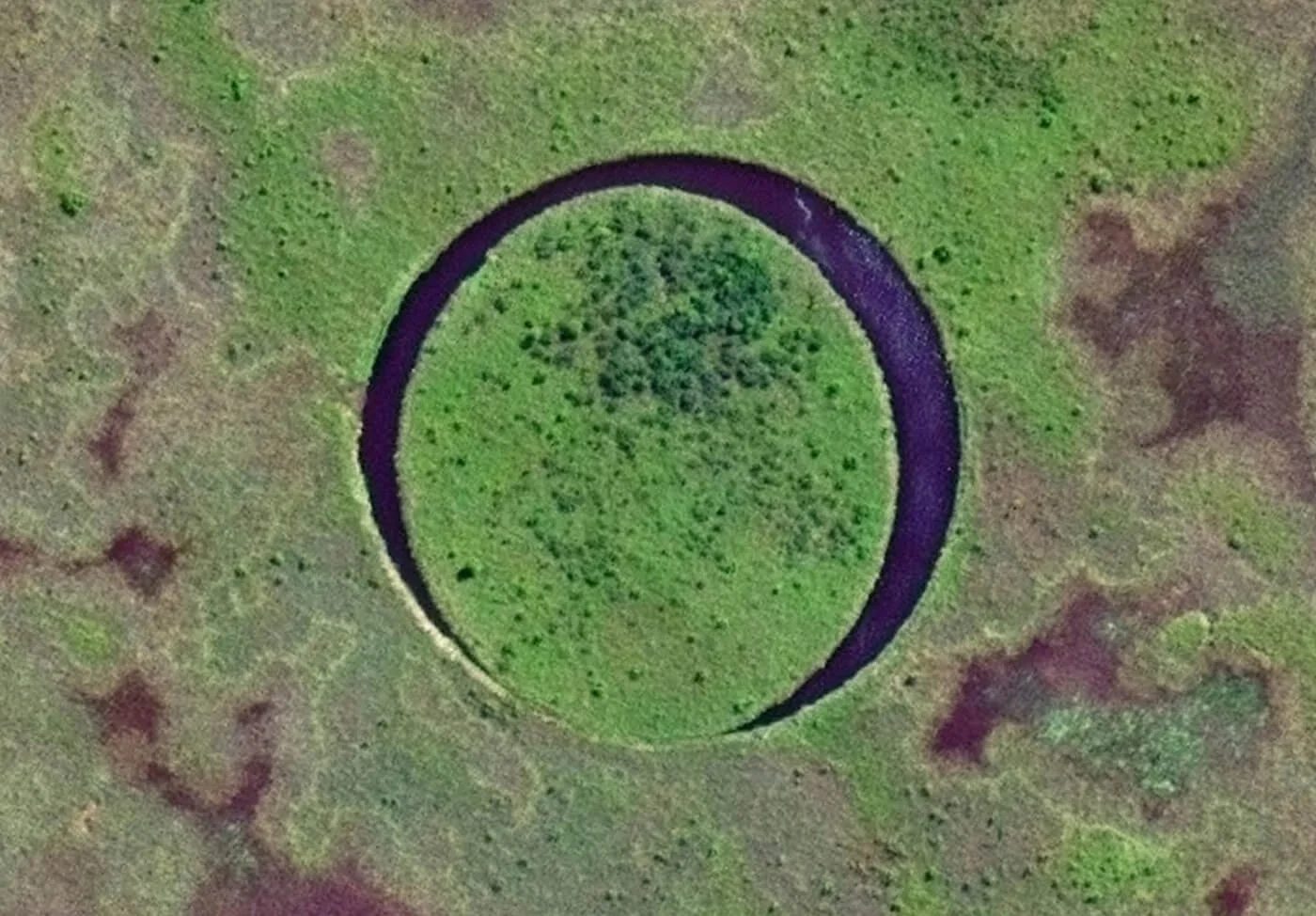
Scientists explain the island's odd rotation around its axis by the existence of massive natural wells that produce streams of water that are capable of moving the island. The rotating eye appears to collide with the surrounding soil, providing it the necessary impetus, causing the muddy area to separate and erode. The rotation's scientific basis is disputed by others, who assert that it is a'supernatural' occurrence connected to extraterrestrial life rather than a natural phenomena.

The Argentine director Sergio Neuspiller found The Eye while looking for a location to shoot a movie on the paranormal. The location provided the ideal backdrop right away, but when the director went back to evaluate it, he realized that the island had moved. As a result, he made the decision to dig deeper and forgo the film in favor of a scientific documentary. By entering "El Ojo" at these coordinates: 34 ° 15'07.8? S 58 ° 49'47.4? W, the phenomena can be seen in Google Earth satellite photographs taken at various periods.


Oldest Bat Skeletons Help Identify New Extinct Bat Species
For many years, researchers have been finding early Eocene bat fossils in Wyoming's Green River Formation, a well-known fossil site. Generally speaking, it was believed that the fossils represented just two species, the first of which was recognized and given a name in 1966.

Photo of a newly described bat skeleton representing Icaronycteris gunnelli. This specimen is the holotype, the name-bearing representative of a new species, and is in the American Museum of Natural History’s research collections.
Nancy Simmons, a museum curator who contributed to the 2008 description of the second species, had her concerns. She explains, "I always thought there must be even more species there."
So did scientists at the Naturalis Biodiversity Center in Leiden, Netherlands, who just started looking more closely at the bat species called Icaronycteris index that had been described in 1966.
Tim Rietbergen, an evolutionary biologist at Naturalis, started taking measurements and other information from museum specimens after wondering why so many bats that have been identified as Icaronycteris index had been collected by paleontologists.
Reitbergen's involvement with the Museum led to him learning about a new skeleton, an unusually well-preserved fossil that had been acquired by the Museum in 2017 from a private collector.
When compared to the other fossils in Rietbergen's dataset, it became clear that the 2017 specimen belonged to a distinct species. It was also determined that a second fossil skeleton found in the same quarry in 1994 and now housed in the Royal Ontario Museum's collections belonged to the same new species, which was given the name Icaronycteris gunnelli in memory of the late naturalist Gregg Gunnell. Today, the journal PLOS One released a research describing the new species.
The two I. gunnelli fossils are the oldest bat skeletons ever discovered, dating back 52 million years, although there are somewhat older fossilized bat teeth from Asia.
Scientists clone an endangered horse using DNA that is 40 years old
Wild horses who are highly endangered have recently received some fresh blood.

Kurt, a clone whose DNA was cryogenically stored 40 years ago, is ready to provide his species' limited population with a much-needed dose of genetic variation.
How Important Is Genetic Diversity?
The stocky Przewalski's horse, sometimes referred to as the takhi, is a type of horse that is indigenous to central Asia. Przewalski's horses were formerly extinct in the wild, but because to conservation efforts, there are currently roughly 2,000 of them in zoos and rebuilt wild populations all over the world.
The fact that all of those horses are decedents of the same 12 wild-born horses, however, puts the species' future in peril and suggests that a lack of genetic variety may be the species' undoing.
A species' ability to create offspring with the qualities needed to survive in a changing environment is essential for its survival. This process is known as natural selection.
Lack of genetic variety raises the likelihood of inbreeding in addition to limiting a species' capacity to adapt to environmental change. As a result, undesirable features may spread among the population, lowering the species' prospects of long-term survival.
Kurt the Replicant Horse
The San Diego Zoo created the first ever frozen zoo (a location where scientists preserve animal genetic material that has been cryogenically frozen) in 1972, and 40 years ago it added the DNA of a male Przewalski's horse named Kuporovic to the collection.
The zoo collaborated with a wildlife conservation organization called Revive & Restore and a company that clones pets and horses called ViaGen Equine to create Kuporovic 2.0, a horse that is also a descendant of the original 12 Przewalski's horses.
The cloned horse, called Kurt after Kurt Benirschke, the creator of San Diego's frozen zoo, was born on August 6, 2020, via surrogate. The foal will eventually join a breeding herd and is said to be content and healthy.
The goal of the initiative, according to Revive & Restore, is for Kurt to successfully mate and add to the genetic variety of his species as well as the advancement of conservation innovation during the next five to ten years as he develops into the first cloned Przewalski's stallion in the world.
Cloning as a Weapon against extinction
Scientists are working to clone other extinct or critically endangered animals in addition to Przewalski's horse. The black-footed ferret, northern white rhinoceros, and even the long-extinct woolly mammoth are all targets of continuing conservation efforts.
Kurt may not be the last time that cloning is used to try to save Przewalski's horse from extinction.
Numerous Przewalski's horses' genetic material is stored in San Diego's frozen zoo, and now that scientists are aware that it is feasible to clone the animals, other clones might follow in Kurt's footsteps, providing the critically endangered species with more genetic diversity.