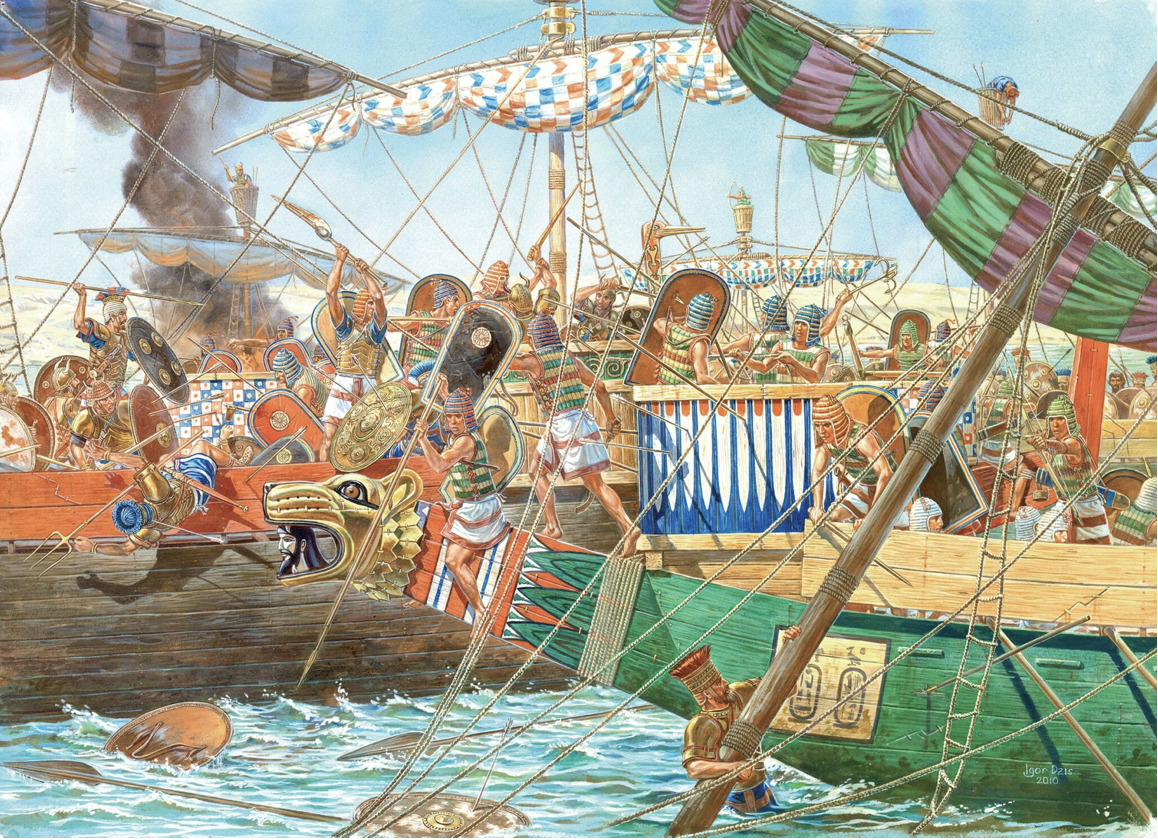
To understand the context of the Philistine migration, one must examine the geopolitical catastrophe that struck the ancient world around 1200 BCE. Within a matter of decades, the great empires of the Late Bronze Age—the Hittite Empire in Anatolia, the Mycenaean palatial civilizations of Greece, and the New Kingdom of Egypt's networks in the Levant—either collapsed entirely or were severely fractured. Ancient Egyptian hieroglyphic inscriptions from the reign of Pharaoh Ramesses III at Medinet Habu vividly describe a confederation of seafaring invaders known collectively as the "Sea Peoples." Among these displaced groups, the Egyptians specifically named the "Peleset"—a group that historical linguists and archaeologists have long equated with the biblical Philistines.
The Egyptian reliefs depict these Peleset as migrating with their entire families, loading women, children, and household goods into ox-carts while their warships battled Egyptian forces along the Nile Delta. Defeated by Ramesses III but unable to be completely driven back, these groups ultimately settled along the southern coast of Canaan, strategically positioning themselves along the vital maritime and overland trade routes connecting Egypt with Mesopotamia.