We still don't know when humans arrived in North America but I think this is our best bet so far. It's Pre-Clovis, lines up with genetics and has a connection to Asia. Watch the video to find out more!
15 Newly Discovered Animals Species In Africa That Shocked The World
In the following video we will analyze 15 animal species that have been recently discovered in Africa and shocked the world. Enjoy!
10 Most Amazing Fossil Discoveries Ever Made
From mummified armor-plated plant eaters, to a well preserved T-Rex investigated by the FBI that sold for millions, here are 10 of the most amazing fossil discoveries ever! Enjoy!
12 Most Amazing Recent Archaeological Discoveries
The human race is growing in number every day, but at the same time we’re building up into the skies to accommodate our ever-growing population, we’re also digging deeper into the ground to find out more about the people and places who came before us. Barely a day goes by without somebody finding something that sheds new light on how our ancestors used to live, and we’re very happy to be able to bring you some great recent discoveries in this video.
Despite her death, a medieval woman gave birth
Two rarely observed medical phenomena from the Early Middle Ages have been revealed by a horrific discovery in Italy.

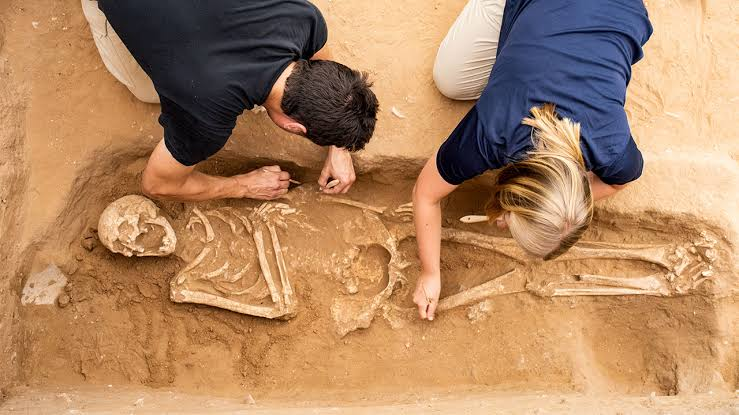
Among several burials unearthed in Imola, Italy in 2010, archaeologists found the well-preserved remains of an adult laid to rest with the bones of a fetus positioned between its legs (shown). A closer look has now revealed the pair represents an unusual case of ‘coffin birth’
Archaeologists discovered the well-preserved remains of an adult buried with the bones of a fetus positioned between the legs among many burials discovered in Imola, Italy, in 2010.
Now that the pair has been examined more closely, it is clear that their odd "coffin birth" situation.
Both the mother and the infant had already passed away by the time they were buried, but it wasn't until then that the stillborn baby was expelled from her body.
The exact cause of the pregnant woman's death, which occurred hundreds of years ago when she was between the ages of 25 and 35, is still unknown, but markings on her skull suggest she had medieval brain surgery at least a week previously, during which a clean hole was drilled into her skull.
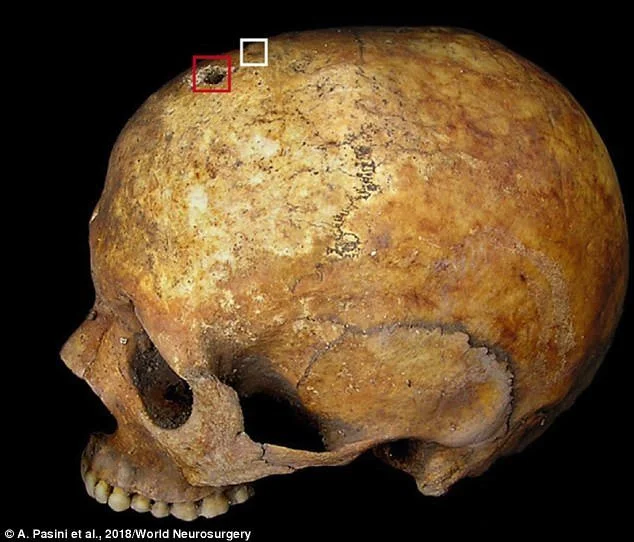
It remains a mystery how exactly the pregnant woman died hundreds of years ago around the age of 25-35, but markings on her skull indicate she underwent medieval brain surgery at least a week prior, with a hole drilled neatly into her skull. The procedure is known as trepanation
In a manuscript that was published to the journal World Neurosurgery, researchers from the Universities of Ferrara and Bologna described the sobering findings.
Trepanation, a method used in the burial from the 7th to 8th century AD, is supposed to have originated in the Neolithic era.
By drilling or cutting into the skull, it was utilized to cure a variety of diseases, including a pregnancy problem that is still prevalent today.
According to the authors of the study, hypertensive illnesses continue to be the leading cause of maternal death. "Eclampsia is the outcome of seizures of pre-eclampsia, which can affect women after the twentieth week of pregnancy," they said.

By the time of burial, both the mother and child were already dead – but, it wasn’t until after that the stillborn baby was pushed from her body. The 'immature' bones can be seen lying between the mother's legs, above
High fever, convulsions, persistent frontal and occipital cephalalgia, high intracranial pressure, and brain bleeding are some of the most typical symptoms of this illness.
From Prehistory to the 20th century, trepanation was used to treat all of these ailments.
The ancient skull's lesion appears to have been caused by surgery rather than a violent trauma, according to its nature.
Furthermore, according to the researchers, it even shows early signs of bone healing, proving the woman survived for at least a week following the procedure.
She had been pregnant for about 38 weeks at the time.
Even while it's impossible to know for sure why the trepanation was done, the researchers believe it was probably an effort to lessen eclampsia-related pressure in the skull.
It's even unclear how she passed away.
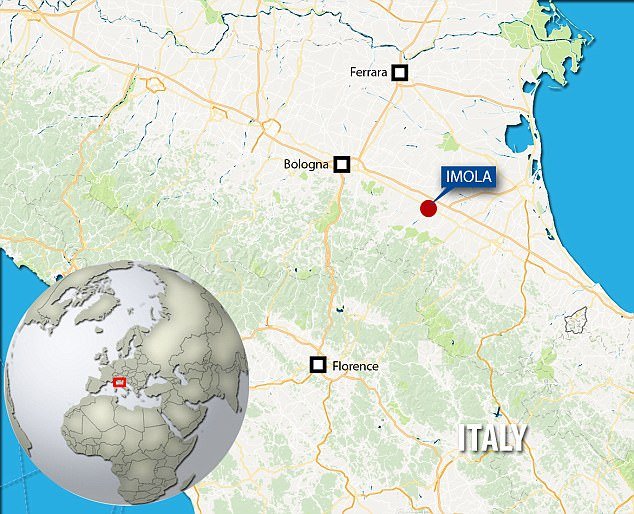
A macabre discovery in Imola, Italy has offered a haunting glimpse at two rarely seen medical phenomena dating back to the Early Middle Ages
The cause of the woman's death is still mostly unknown, according to the authors, who note that it might have been the pregnancy problem, complications during labor, or the procedure itself.
In any event, the discovery of both trepanation and coffin delivery in the same set of bones, according to the researchers, is incredibly uncommon.
According to the authors, this discovery is one of the few known instances of trepanation throughout the European Early Middle Ages and the only one to involve a pregnant lady and the phenomena of post-mortem fetal extrusion.
Given all of these circumstances, this case stands out as unique and adds to our understanding of the clinical development of neurosurgery and pregnancy during this historical time.
Egypt reveals recently found ancient tombs and workshops in the Saqqara necropolis in photos
Authorities in charge of Egypt's antiquities have revealed ancient tombs and workshops that they claim were found at a Pharaonic necropolis not far from Cairo. The locations were discovered in the vast Saqqara necropolis, which is a part of Memphis, the former capital of Egypt and a UNESCO World Heritage site. The crafts had been utilized to embalm both sacred animals and people. In the meantime, the tombs belonged to an important official and a priest from ancient Egypt. The Egyptian government has been extensively promoting fresh archaeological discoveries to foreign diplomats and the media in recent years. It anticipates that these discoveries will aid in boosting tourism in the nation.

Canopic jars, which were made to contain organs that were removed from the body in the process of mummification, are seen at the site of the Step Pyramid of Djoser in Saqqara, 24 kilometers (15 miles) southwest of Cairo, Egypt, Saturday, May 27, 2023. Saqqara is a part of Egypt's ancient capital of Memphis, a UNESCO World Heritage site. (AP Photo/Amr Nabil)

A Canopic jar, which was made to contain organs that were removed from the body in the process of mummification, are seen at the site of the Step Pyramid of Djoser in Saqqara, 15 miles southwest of Cairo, Egypt.

A recently unearthed ancient wooden sarcophagus is seen Saturday in Saqqara near Cairo, Egypt.

An Egyptian archeologist points at a colored painting showing the offering of sacrifices at a recently uncovered tomb that was said to belong to a top official of the fifth Dynasty named "Ne Hesut Ba" in Saqqara, Egypt.

Mostafa Waziri, secretary-general of the Supreme Council of Antiquities, displays a recently unearthed ancient wooden sarcophagus at the site of the Step Pyramid of Djoser in Saqqara, 24 kilometers (15 miles) southwest of Cairo, Egypt, Saturday, May 27, 2023. Saqqara is a part of Egypt's ancient capital of Memphis, a UNESCO World Heritage site. Waziri said the workshops had been used to mummify humans and sacred animals, dated back to the 30th Pharaonic Dynasty 380 BC to 343 BC and Ptolemaic period 305 BC to 30 BC. (AP Photo/Amr Nabil)

A colored painting is seen on a recently unearthed ancient wooden sarcophagus in Saqqara, Egypt.

A visitor is reflected on a panel that holds recently unearthed ancient artifacts Saturday in Saqqara, Egypt.

Canopic jars, made to contain organs removed from a body during the mummification process, are displayed in Saqqara, Egypt.

Visitors pose for pictures Saturday on top of recently unearthed ancient embalming workshops in Saqqara, Egypt.
12 Most Amazing Recent Archaeological Finds
The work of archaeologists has remained the same throughout the centuries; they dig into the past to uncover the secrets of ancient civilisations. Some of the most recent discoveries made by archaeologists have been extraordinary, and we’ve packaged together some of the best of them for you in this video. Let’s get started!
9 Rarest & Most Mysterious Maps Ever
In today’s video we will investigate the 9 rarest and most mysterious maps ever. Watch the video below for more!
Who was the Amesbury Archer? (Bronze Age Britain Documentary)
In 2002, archaeologists found the burial of a man who died in about 2,300 BC at Amesbury in Wiltshire, England, just three miles from the famous ancient site of Stonehenge.
The grave dates to the early Bronze Age in Britain, a time of great change that brought new people to these islands from northern Europe. With them came new technologies like metalworking in and new traditions, involving pottery vessels that archaeologists call Bell Beakers.
Most of these Bell beaker era graves contain few burial goods. But this one is different. It contained the richest array of items ever found in a grave from this period in Britain.
The astonishing number and richness of the finds also led to the British media calling him “The King of Stonehenge.”
So who was this man? Where did he come from and why was he buried here? Did he really have anything to do with the building of Stonehenge or ruling over the area? And what was happening here and in the rest of Britain at this time of immense change?
This is the story of the Amesbury Archer.
The Bizarre Things Qianlong China's Emperor Did During His Reign
On the eve of his father's death, the Yongzheng Emperor, Hongli, was declared the heir apparent on October 7, 1735. (reigned 1722-35). In fact, despite the fact that Hongli was the fourth-born son of the Kangxi emperor (reigned 1661-1722), Hongli had been secretly designated as Yongzheng's successor shortly after the latter had ascended from the throne (he was, however, the eldest surviving son when he was actually named heir). Kangxi had noticed his grandson's exceptional qualities and resolved to do everything he could to prepare him for his upcoming task. Hongli received a well-planned education that included the teachings of the eminent scholar Fumin. He was then initiated into state affairs and made a prince of the first degree in 1733. He ascended the throne at 24 on October 18, 1735 (25 according to the Chinese system), and ruled for more than 60 years under the regnal title of Qianlong.
New Research Changes Origin of Human Species
For most of human history, the Earth was like the planet of the apes. Indeed, The road to humanity was a long road. It began in Africa some 7 million years ago, when our lineage split from that of our closest living relatives, the chimpanzees. Our ancestors still resembled apes nearly 4 million years later.
At least a million years ago, a ghost ancestor walked this planet with a face similar to yours. The modern face, the one with a flat profile in which the nose stands out, appeared at least a million years ago somewhere between eastern Africa and southern Europe.
The key to the statement lies in a bone from the center of the face unearthed in Spain. The bone, a maxilla, belonged to a boy who lived about 900,000 years ago in the area. His face was modern enough to go virtually unnoticed on a crowded street. Body size, height, and shape are also similar to modern humans.
That ghost is the origin of modern humanity. We still don't know who it was because we are talking about a very dark time, a million years ago, with few fossil remains. This ghost with a modern face could have arisen from the African Homo ergaster or even from Eurasian Homo georgicus, who lived in present-day Georgia 1.8 million years ago. At the moment, Homo antecessor fossils are the closest thing we know to the ghost.
Incredible Archaeological Finds that History is Silent about
Today’s video offers viewers a fascinating immersion into the world of archeology, revealing finds that have remained on the brink of oblivion. From the very beginning, viewers meet with incredible finds of archaeologists, the existence of which does not fit into the generally accepted scientific framework. These artifacts, whether relics from lost civilizations, mysterious scriptures or inexplicable tools, give a whole new dimension to the term "archaeological mysteries".
The World's Oldest Man-Made Adam's Calendar at 75,000 Years
The 75,000-year-old Adam’s calendar is crobably the World’s oldest man-made structure.
Also referred to as “African Stonehenge,” Adam’s Calendar is a standing stone circle about 30 m in diameter in Mpumalanga, South Africa. Although uncertain, the structure is estimated to be 75,000 years old, making it the oldest man-made structure on Earth.
Even though there are numerous astronomical alignments at the site, Adam’s Calendar is probably the only fully functional and almost intact megalithic stone calendar in the world.
According to the latest estimations, there are at least 100 000 stone circles throughout the mountains of South Africa.
Known as the Birthplace of the Sun, this enigmatic site first draw public attention in 2003 when the South African pilot Johan Heine started photographing the region.
The experts first thought that the ruins were the remains of cattle kraal "livestock enclosure" abandoned by the Bantu people around the 14th century.
The Most Popular Stolen Artefacts from Africa
In today's video, we'll be discussing some of the most popular stolen artefacts from Africa! From ancient Egyptian texts to iconic pieces from the African diaspora, we'll be covering some of the most interesting mysteries and mind-blowing facts about these artifacts. Enjoy!
15 Most Incredible Medieval Castles In The World
Whole medieval times were, no-doubt, tough to live through- with most people living in horrific and devastating squalor. But, for the less than 1%, times were not all that bad: especially from “home décor” point-of-view. Who, if they were honest with themselves, wouldn’t want to live in a castle? Not only are castles the dream home, the ultimate symbol of decadence and wealth, but they are positively dripping with fascinating, and sometimes grim, history. These are the 15 most incredible medievalcastles in the world!
What If You Lived in the Devonian Period?
Human beings have existed for 300,000 years and have managed to live in many unstable environments. We've survived ice ages, devastating pandemics and world wars. But how would we fare even further back in time? What about 400 million years ago, when deadly marine life dominated our oceans and creatures on land were practically non-existent? Watch the video below!
5 Unexplained Historical Mysteries That Experts Cannot Solve
In the video below we will analyze 5 unexplained historical mysteries that experts cannot solve. Watch the video to find out more!
10 Amazing Archaeological Discoveries
From a knuckle bone dice to ancient chompers in the video below we will analyze 10 amazing archaeological discoveries. Enjoy!
The Most Advanced Ancient Technology
In the following video we will be talking about the most advanced ancient technology. Watch the video for more!
Norse Mythology
Norse mythology, a body of myths of the North Germanic people stemming from Norse paganism, tells tales of gods, goddesses, beings, and heroes that have captivated the world for centuries. Rooted in the Scandinavian region's cultural heart, these tales, encapsulated in works like the Poetic Edda and the Prose Edda, weave a rich tapestry of a fantastical world that mirrors the challenges, triumphs, and mysteries of human life.