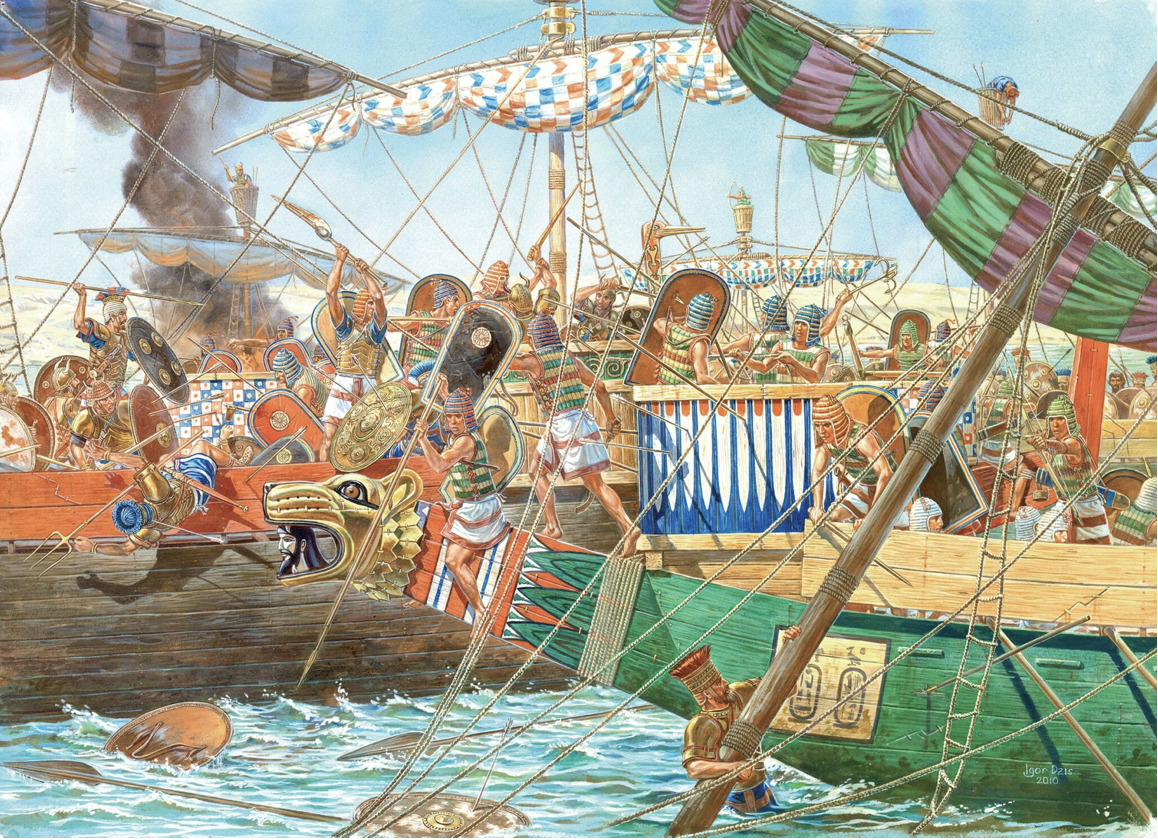
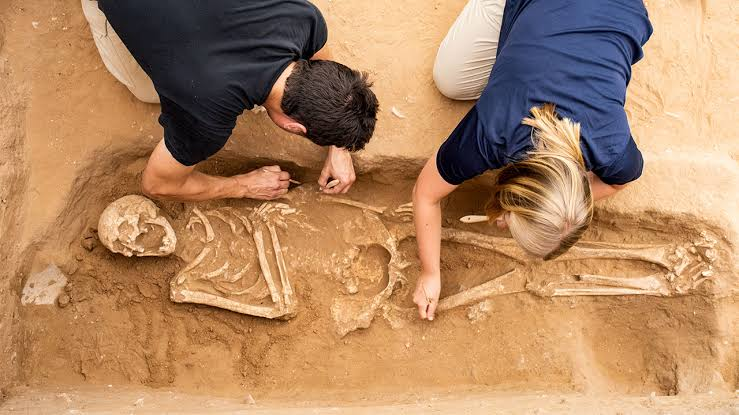
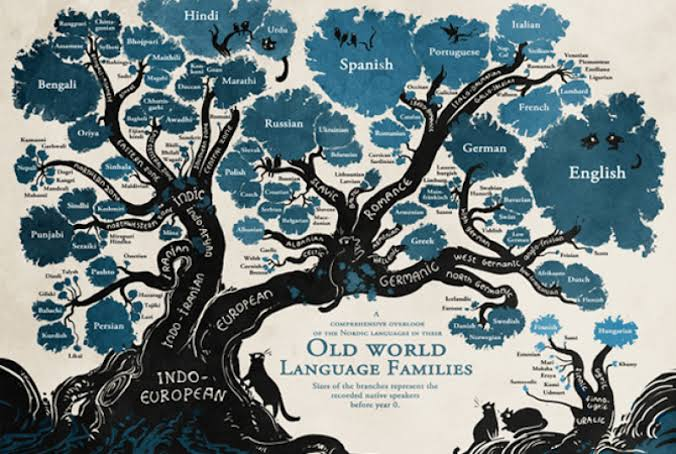
In today’s video we will analyze the genetic evidence for one of the greatest voyages in history. Watch the video to find out more!
Why The Himalayan Mountains Don't Have Volcanoes
In the following video we will be explaining why the Himalayan Mountains don’t have any volcanoes. Enjoy!
Graham Hancock’s Terrifying New Discovery On The Top Of The Pyramids
In the video below Graham Hancock will be explaining a new terrifying discovery made on the top of the Pyramids. Watch the video for more!
Alexander the Great Family Tree
In the video below we will be exploring the family tree of Alexander the Great. Watch the video to find out more & enjoy!
The Anunnaki Gods: The Astronaut Gods of the Sumerians
In today’s video we will be explaining everything about the Anunnaki Gods, the astronaut gods of the Sumerians. Enjoy!
Greek Mythology Creation Story Explained in 8 Minutes (Animation)
This video on Greek mythology explains the beginning of the gods, goddesses, monsters, and mortals. It includes greek gods and goddesses such as Zeus, Cronus Gaia, Hades, Hera and many more. It also covers the Olympian war between the Titans and the Olympians. Enjoy!
Eastern Dragons: The Majestic Creatures of Oriental Culture
In this video we will be exploring the Eastern Dragons, the majestic creatures of Oriental culture. Enjoy!
Norse Mythology Stories: The Essential - From Creation to Ragnarok
In the video below we will be discussing about the essential of Norse Mythology, starting from Creation to Ragnarok. Watch the video to find out more!
What Was Hygiene Like On Pirate Ships
Pirate ships were dirty - there's no way around it. The life of a pirate was fraught with danger and disease, but the pirates themselves did find ways to clean themselves and their surroundings - at times.
Maintaining hygienic practices on a pirate ship was an uphill battle. Lack of access to clean water, combined with confined living spaces, led to the rapid spread of disease. Harsh elements and inadequate nutrition further contributed to generally poor health. Baths, laundry, and oral hygiene were at a minimum, even with a somewhat surprising amount of medical resources.
The Founding of Mexico - Aztec Myths
Huitzilopochtli, god of bloody victory, had promised the Mexica people a city. Before they would eventually settle down at Tenochtitlan, they wandered from place to place, inadvertently causing destruction on the orders of the violent god.
The Myth of Osiris Explained in 10 Minutes | Egyptian Mythology Animated
This video on Egyptian mythology explains the Osiris Myth. It includes the Osiris vs Set feud, and also battles between Horus and Set. It also covers other Egyptian gods such as Ra, Isis, Thoth, and Nut. Enjoy!
The Tragic Death of Prophet Muhammad and His Family
In the video below we will be explaining the tragic death of Prophet Muhammad and his family. Enjoy!
Tyrannosaurus Rex Evolution May Be Explained by New Dinosaur Species
Even though we have a lot of knowledge about the T. rex that existed millions of years ago, scientists are still puzzled as to how the renowned predator came to be. It's possible that researchers have uncovered the final piece with a recent finding.

T. Rex roaring on a deserted land. (Credit: DM7/Shutterstock)
The Tyrannosaurus Rex is probably the most well-known dinosaur to date. This mega-beast had teeth as long as your forearm, a bite force to match, and was also the biggest predator in its habitat. For at least 2 million years, it could consume prey as large as a school bus. It was still standing when an asteroid ravaged the earth at the end of the dinosaur era. Even still, despite how much we do know about T. rex, we know comparatively little about its evolutionary background.
Daspletosaurus, a rare species of theropod discovered in Montana, is thought to have later developed into T. rex, according to researchers. And in a further investigation that was revealed in a PeerJ article from November 2022, scientists discovered a third Daspletosaurus species called Daspletosaurus wilsoni that, in addition to the two previous known species, may aid in bridging the gap.
D. wilsoni, which lived 76 million years ago, "displays a unique combination of ancestral and derived characteristics" that indicate it was an intermediate species before T. rex.
"We named a species that fits into the genus Daspletosaurus that forms a halfway point between the two other species (D. torosus and D. horneri)," explains Elas Warshaw, study author and research associate at the Badlands Dinosaur Museum in Dickinson, North Dakota.
Looking Back at T. Rex
D. wilsoni, like T. rex, would have been the biggest predator in the region, feasting on enormous herbivores with horns and duck bills like Brachylophosaurus and Centrosaurus. The planet would have also seemed differently than it does today.
According to Warshaw, the Western Interior Sea, a swallow-sized inland sea, spanned much of North America and Montana 76 million years ago. When the dinosaur was alive, the region where the scientists discovered D. wilsoni would have been coastal. He says, "I would liken it to a modern Louisiana with dinosaurs."
According to researchers, D. wilsoni was a precursor of T. rex, which emerged 10 million years later and evolved into a larger dinosaur with slenderer horns. This study and a significant portion of Warshaw's research demonstrate that Daspletosaurus did not become extinct but instead developed into T. rex.
However, Warshaw notes that there is still much we do not know due to a lack of research. The oldest T. rex and the final Daspletosaurus are separated by several million years.
Mind the Gap of Evolution
While we're still not there, Scott Persons, head curator of the Mace Brown Museum of Natural History in Charleston, South Carolina, who was not involved in the study, argues that we are moving in the right direction. This study demonstrates a crucial connection.
According to Persons, "the interesting thing about this study is that they have this new definable species of Daspletosaurus that falls right in the middle of the two previously known species - both because it appears at a middle point in time and in terms of its evolutionary relationships." The species possesses a mix of recent and historical characteristics that further demonstrate its ambiguous status.
Additionally, this finding is significantly more important to Warshaw and the Badlands Dinosaur Museum team than simply identifying a new species since it demonstrates how dinosaurs evolved. Anagenesis is a theory that suggests one species developed into another.
The research team is demonstrating that many dinosaurs did not become extinct before the Chicxulub crater 66 million years ago; rather, "their replacements are descendants that evolved into one another," according to Warshaw. This would apply to a lot more animals than only the most well-known mega-predator in the planet.
Aztec Mythology Creation Story Explained in Animation
This video on Aztec mythology covers the creation myth of the Aztecs. Watch the video to find out more! Enjoy!
How Did Catholicism Start?
The Catholic Church has a history that spans over two thousand years, and it began with none other than Jesus Christ himself. At least, that is what modern popes believe. But at first, there was just one church, and there was no division between Catholics, Protestants, Eastern Orthodox, and other branches of Christianity. Christians all over the known world were united, and together, they made their spirituality bloom. Their religion took over the lives of villagers, nobles, kings, queens, and even newly-arrived pagan armies that came to conquer Europe.
The Untold Story Of Emperor Vespasian
Vespasian, one of the Roman Empire's finest emperors remains largely unknown, yet his reign in 1st century AD transitioned a weakening Empire into a period of stability and growth that was the legacy of the other great emperors Trajan, Hadrian, Marcus Aurelius and Septimius Severus. Vespasian ultimately saved Rome from disaster and made possible the Golden Age of the 2nd century AD.
Odyssey is your journey into the world of Ancient History; from the dawn of Mesopotamia to the fall of Rome. We'll be bringing you only the best documentaries that journey into the mysteries and ruins of worlds long lost.
History Of Ancient China | Dynasties, Confucius, And The First Emperor
This is China. It's big. Most of your stuff probably comes from there and they have a solar farm shaped like a Panda. But most interestingly China is old. For as long as people have been talking about history there has been a China to point to. So how did China become the world's oldest continuous civilsation. What's a dynasty, who's Confucius, and is it ever ok bury people alive. Well. Let's find out.
The Greatest King of Persia | Cyrus the Great | Achaemenid Empire Documentary
Cyrus II was a relentlessly ambitious Persian king who founded the Achaemenid Empire. Its reach would stretch from the Mediterranean Sea to the Indus River, making it the largest empire the world had ever seen. His insistence on treating his subjects with mercy, kindness, and compassion earned him the name, “Cyrus the Great”!
Significant Isle of Wight ammonite fossil found in Chale
One of the largest ammonites ever discovered on our coasts was collected by an Isle of Wight fossil hunter.

Jack Wonfor with his discovery. (Image: Wight Coast Fossils)
The 111kg Ammonitoceras was discovered by Jack Wonfor of Wight Coast Fossils on a beach in Chale.
It is nearly 18 stone in weight and 115 million years old.
With the aid of Theo Vickers, Jack was able to remove it from a rock and carry it the entire way up Whale Chine while concealing it in his pack.
The remainder of the fossil can then be seen by prying it off of the surrounding rock.
Magyarosuchus fitosi: 'Missing Link' in Crocodile Evolution Found in 180-Million-Year-Old Fossil
A 180 million year old crocodyliform fossil has been found by paleontologists, and it is believed to be the long-missing link in the transformation of some ancient crocodiles into dolphin-like creatures.

An artist’s impression of Magyarosuchus fitosi. Image credit: Marton Szabo.
The prehistoric crocodile, known as Magyarosuchus fitosi, lived in the Tethys Ocean's Mediterranean region during the Early Jurassic period.
It belongs to a class of animals called crocodilians, which also includes living alligators and caimans, and is what paleontologists refer to as a crocodyliform.
In the Gerecse Mountains of northwest Hungary, the fragmentary skeleton of Magyarosuchus fitosi was discovered in 1996.
Dr. Mark Young from the University of Edinburgh and his associates from Germany and Hungary examined it.
The paleontologists claimed that Magyarosuchus fitosi was one of the biggest coastal predators throughout the Jurassic era.
It had a length of 15.3–15.9 feet (4.67–4.83 m), huge, pointed teeth, and was capable of catching prey. Additionally, it shared important physical characteristics with two different families of ancient crocodiles.
Some crocodiles from the Jurassic period had bone armor on their backs and bellies and limbs designed for walking on land, whereas another group had flippers and tail fins but no armor.
Although it featured a tail fin and was extensively armored, Magyarosuchus fitosi may be the missing link between the two groups.
"This fossil provides a unique insight into how crocodiles began evolving into dolphin and killer whale-like forms more than 180 million years ago," Dr. Young said.
"The presence of both tail fins and bony armor highlights the remarkable diversity of Jurassic-era crocodiles."