In the following video we will be explaining the book of Enoch. Watch the video to find out more!
What is Neoplatonism?
In this video we will analyze what Neoplatonism is. Watch the video below to find out more!
The Creation Myth of the Proto Indo-Europeans
This is the story of Manu, Yemo, and Trito; There are many religions that began across Eurasia, however what you may not know is that many are linked by an ancient myth, the Indo European Creation Myth, a myth spoken by the Proto Indo Europeans. This video will tell the myth, explain it, and then compare it with other religions to see if they are descended from it.
The World's Mysterious Underwater Kingdoms That Have Been Lost to Time
Explore the world's sunken cities, from Shicheng's underwater lions to Alexandria's lost streets. See how rising water levels and climate change are revealing hidden treasures and shedding light on long-forgotten civilizations. Learn about Pavlopetri, the oldest sunken city, and uncover the mysteries surrounding its fate. Join us as we dive into history and the impact of the environment on our past and future.
The Middle Kingdoms of India and the Empires of Southeast Asia: A Complete Overview
The Middle Kingdoms of India picks up where Ancient India left off, and goes through the period following the Mauryan Empire, through the Gupta Empire, and the Delhi Sultanate. The last part is about the Southeast Asian empires and India's influence. It is meant to be an overview.
It begins with the Kushan Empire and the spread of Buddhism. It goes through the rulers of the Gupta Empire and its fall. The Muslim invasions would begin in the early Medieval, culminating in the Delhi Sultanate. The cultural part of the video goes into the mixing of the Indian and Islamic culture, and the daily life, art, and architecture of the Middle Kingdoms period. The video ends with an overview of the major Southeast Asian empires, like the Khmer, Pagan, Ayutthaya, and Srivijaya, along with some of their art and architecture as well.
Insane Life of an Egyptian Pharaoh
Egyptian Pharaohs were worshiped like they were gods walking the Earth, but what was an average day like for a Pharaoh? Check out today's epic new video that looks back into ancient history to find out how insane the Egyptian royals lived!
Why Chiso Kimonos Are So Expensive
Kimonos are known for being expensive, and a kimono from the Japanese brand Chiso is one of the most expensive you can buy. One kimono takes around 20 artisans over six months to make, and it can cost over $10,000. We followed the process of creating a handmade kimono, step-by-step, to find out what makes these garments so expensive.
Introduction to the Bible (from an academic point of view)
In the following video we will have an introduction to the Bible from an academic point of view. Enjoy!
The Mecca Mystery: Are Muslims Praying In The Wrong Direction?
The Sacred City presents compelling evidence that suggests the holy city of Mecca is in the wrong location and that the worlds 1.6 billion Muslims are praying in the direction of the wrong city. Compiling evidence from both historic sources and new technologies point to the correct location in this seismic, revelatory new film.
In this startling and original documentary, writer and historian, Dan Gibson, shows that descriptions of Mohamed’s original holy city – as detailed in the Qur’an and Islamic histories, do not match that of the Mecca we know today. If true this could shake Islam to it’s roots, because every Muslim is required to pray towards the ‘forbidden gathering place’. If Dan Gibson is right, Muslims are praying in the wrong direction.
In the film ‘The Sacred City’ we set out his evidence from within Islamic and ancient histories – while also using modern technologies - to track down the biggest secret of the last fifteen hundred years. Gibson not only finds the location of the original Mecca but also provides a convincing argument as to how such a great misunderstanding in Islamic history came about.
While clearly controversial, The Sacred City is respectful of Islam’s prophet, and does not dispute the events of the Qur’an; but shows how a deliberate attempt was made to hide from Islam, secrets that impact every Muslim today. The evidence is compelling and fascinating.
In a time when the world agenda is being set by Islam, it is more important than ever for the origins and history of this world religion to be examined afresh. This is an important documentary with world-wide appeal for both religious and secular audiences.
Beautifully filmed in the ruins and deserts of the middle east, the film is a detective story that investigates the dawn of Islam and will become the most talked about film for years to come.
Why Didn't the Chinese Colonize America
For the vast majority of history, the Chinese civilization was vastly wealthier and more populous than Europe - yet somehow, it was the Europeans that got away with colonizing the Americas, right under the nose of the Chinese. So, why didn't the Chinese Empire colonize the Americas?
Photo Shooting with the Highest Grade Oiran Kimono in Kyoto, Japan
In the past, there existed a government-approved entertainment district where women called yujyo worked. The top rank of these women were oiran (courtesans). You may have seen oiran in anime or manga. This facility allows visitors to experience the costumes and makeup that these women actually wore. If you want to take a memorable photo, please visit this facility.
The Gnostic Gospels: Were They Illegal?
A common theory is that the Nag Hammadi Library, a collection of Gnostic texts, were an illegal stash of books hidden from Orthodox Christian authorities. But recent scholarship has called this theory into question. Were the Gnostic Gospels legal?
The Germans: The Brave Warrior People of Central Europe
In the following video we will be talking about the Germans, the brave warrior people of Central Europe. Watch the video to find out more about them!
Joe Rogan: Lost Civilizations Proof! Ancient Sites Being Uncovered!
Joe Rogan and Graham Hancock discuss recent findings for ancient lost civilizations. It's been Graham's life work to uncover these sites. Watch the video for more!
'It's the find of a lifetime,' said students and the professor who discovered the 1.5-ton triceratops head
Students and teachers from Westminster College started a research dig in the South Dakota Badlands in the summer of 2020.

The entire trip lasted about two months and yielded the skull, around 20 other bones believed to be from the same triceratops and two turtle shells. (Photo from Dr. David Schmidt)
The squad came back with what can only be described as the biggest of trophies after two months.
Colette Faiella, a senior, described it as "the find of a lifetime." Although I'm a little sorry it happened so soon in my life, this was a fantastic study opportunity.
That discovery turned out to be a unique triceratops skull that was nearly 7 feet long and 3,000 pounds in weight.

For the longest time, we believed it to be a T-Rex pelvis because of the way it seemed, according to Faiella. We continued to dig around it until one of the girls on the expedition saw teeth, at which point we realized that it might not be a hip.
Students discovered the skull among 20 other bones thought to be from the same triceratops, two turtle shells, and the entire expedition lasted around two months.
The more information we discovered, the more thrilling it was, said senior Sophia Hessenkemper. "Realizing we were going to be able to take it back here to Westminster and starting a donations page in order to help fund the process of getting it back... that was big."

The process of organizing the dig began in 2019.
Professor of environmental science David Schmidt claimed that after a farmer near Shade Hill, South Dakota, informed local authorities about bone parts poking out of the earth on his land, officials learned of the dig.
Schmidt was given the option to excavate the location, but he was had to wait for the necessary authorizations from many agencies.
Schmidt claimed that despite the delay, by the first week the dig had become a reality.

As a young child, I always dreamed of doing this, Schmidt stated. We were extremely overwhelmed when we realized what we had because "I never thought I would find something as big and significant as this."
The skull and other fossils uncovered during the excavation are officially owned by Schmidt. It took a lot of work to transport the find back to Westminster, and the skull had to be covered in thick layers of plaster to keep it safe.

The 1.5-ton skull was difficult to move into its present storage location, and the weight of the fossil actually caused some floor tiles in the school's science center to break. To preserve the fossil on campus, the program is presently soliciting money to repair a room in the building.
Schmidt stated that whenever that occurs, their work will only just begin.
“The ultimate objective, according to him, is to ascertain the triceratops' story and its place in the evolution of life as a whole. That is our ultimate objective.”
Whale fossil from 36 million years ago discovered in Peruvian desert
The petrified remains of an ancient whale, which lived 36 million years ago and was discovered last year in a Peruvian desert, were revealed by paleontologists in March 2022.

The skull of a basilosaurus, an ancient whale, is seen in Lima, Peru on March 17, 2022.
"We have presented the new Peruvian basilosaurus, it is the complete skull of an archaic whale that lived 36 million years ago," said paleontologist Mario Urbina, who oversaw the team that found the bones, to AFP.
Approximately 350 kilometers (215 miles) south of Lima, in the Ocucaje Desert of the Ica department, the basilosaurus was discovered at the end of 2021, according to Urbina. Millions of years ago, the barren area was a shallow sea, and its dunes have preserved a staggering amount of strikingly prehistoric sea animal remains.
The "Ocucaje Predator," as the researchers named it, was around 17 meters (55 feet) long and fed on tuna, sharks, and schools of sardines with the help of its enormous, powerful teeth.
According to Urbina, a researcher at the National University of San Marcos in Lima, "this discovery is very important because there are no other similar specimens discovered in the world."
The basilosaurus distinguishes from other known ancient whale species by its size and the development of its teeth, both of which suggest the animal was probably at the top of the food chain, according to team member Rodolfo Salas-Gismondi.
The excellent condition of preservation makes this a remarkable find, he told AFP. One of the biggest predators of its era was this creature.
Salas-Gismondi, who oversees the Department of Vertebrate Paleontology at the Natural History Museum in Lima, continued, "At that period, the Peruvian water was warm. "We can reconstruct the history of the Peruvian sea thanks to this type of fossil."
About 55 million years ago, the first cetaceans, including the basilosaurus, diverged from land creatures.
Cetaceans had reached full adaptation to marine life by the late Eocene epoch (between 56 million and 34 million years ago).
According to the research team, whales had not yet undergone evolution and the majority of cetaceans were marine macropredators.
Fossils from the Ocucaje Desert, according to the experts, have been around for 42 million years, giving scientists proof of evolution.
Other fossils discovered there date to the Miocene epoch (between 23 million and 5 million years ago), and include four-legged dwarf whales, dolphins, sharks, and other species.
Fossilized prehistoric teeth from 9.7 million years ago "could rewrite human history"
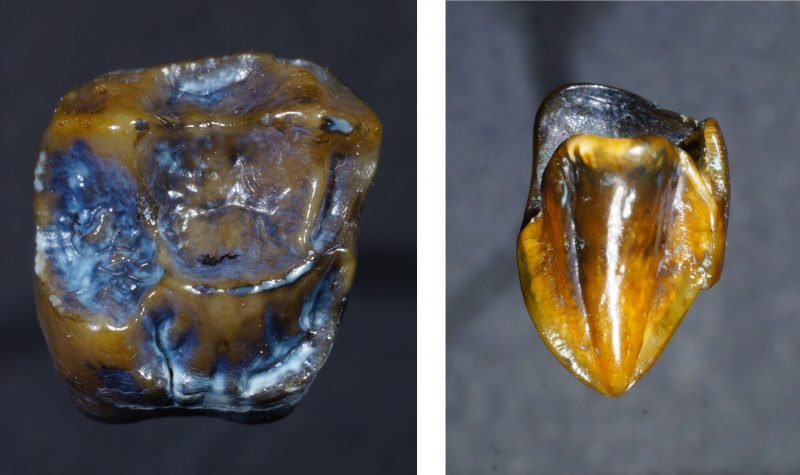
A German politician has praised the discovery of 9.7 million-year-old fossilized teeth by German paleontologists as potentially "rewriting" the course of human history.

Researchers digging over gravel and sand in an old Rhine riverbed close to Eppelsheim discovered the tooth bones.
They resemble the remains of "Lucy," a 3.2 million-year-old extinct monkey skeleton discovered in Ethiopia. Lucy was a primate related to humans.
They are unlike those of any other species that may be found in Asia or Europe, though.
According to Deutsche Welle, scientists were so perplexed by the discovery that they postponed publicizing their work for a year.

The research team's leader and director of the Mainz Natural History Museum, Herbert Lutz, told the local media, "They are certainly ape teeth. Their traits reflect fossils discovered in Africa that are four to five million years older than the Eppelsheim specimens.
This is a terrific accident, but it's also a big mystery.
The mayor of Mainz said during a press conference to announce the discovery that it might prompt researchers to reexamine the origins of early humanity.
Without wanting to oversimplify, he remarked, "I would hypothesize that after today, we will have to start rewriting the history of mankind."
Local archaeologist Axel von Berg said that the fresh discoveries would "amaze experts".
The "real work" to solve the puzzle has only just begun, according to Dr. Lutz, whose first report on the study has just been published.
The presence of hominins, a species closely related to humans, on the continent has not been established, despite the fact that there is a wealth of fossil evidence indicating that great apes roamed Europe millions of years ago.
According to the current scientific agreement, modern humans originated in east Africa between 400,000 and 200,000 years ago and spread to other parts of the world as recently as 70,000 years ago.
The Largest Volcano Of All Time Is Splitting The Earth Apart!
Volcanic eruptions can be devastating and harmful. They have the ability to eject heated tephra clouds from a volcano's side or top. These scorching storms consume practically everything in their path as they race down steep slopes. As with snow, volcanic ash that is thrown into the air will eventually fall back to Earth. If ash piles up high enough, it can suffocate plants, animals, and people. In the presence of cold water, such as that found in streams or the melting of snow and ice, mudflows can form. Mudflows (lahars) have buried entire communities near erupting volcanoes. Scientists and the entire world are experiencing fear and worry as the largest active volcano on Earth is erupting for the first time in 38 years.
New Discovery on the Edge of Antarctica That Scares Scientists
Antarctica is a mysterious continent that has long captured researchers' and the public's attention with its uncharted and unexplored bounds. It may look like a massive expanse of nothingness and ice, but beneath its frozen surface lies a world brimming with undiscovered wonders.
From a 90-million-year-old rainforest to a land bridge the dinosaurs used, here are 20 fascinating discoveries in Antarctica that could change history!
Homo Sapiens Left Africa 86,000 Years Ago?!
It’s been known that Homo sapiens left the continent of Africa around 50,000 to 60,000 years ago, which contributed to our current gene pool.
But, could there have been an earlier out of Africa migration by Homo sapiens, our species?
Let's look at the latest discovery from Laos, where archaeologists have found 2 fossils in the Tam Pa Ling cave in Northeastern Laos. Enjoy!