The Tibetan Book of the Dead, or the Bardo Thodol, is arguably the most popular Buddhist text in Europe and the United States. Carl Jung loved it. So did John Lennon. But why? What is this text all about?
Discovering the Majestic Guardian Colossus: A Prominent Brick and Stone Sculpture from the 16th Century
A spectacular work of art, The Appennino (Italian: Colosso Appenninico), is a 35-foot-tall sculpture that can be found in Villa Demidoff, a portion of the former Villa Medici in Pratolino, 7 miles north of Florence. The Appennino, a personification of the Apennine mountain ranges created by the Flemish artist Giambologna between 1579 and 1580, is sculpted in such a way that it looks to be on the dividing line between man and landscape, with its smooth skin blending into the rugged terrain. The Appennino also has a stalactite-made shaggy beard.
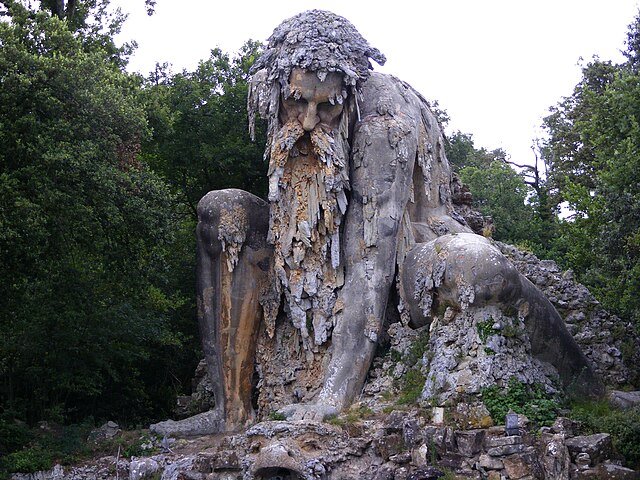
Giambologna carved a fish pond into the Appennino while it was clutching the head of a horrible beast. The Appennino is not only a sculpture; it is also a structure that has a network of grottoes that are decorated with paintings of muscular men and priceless minerals as well as shells, corals, pearls, and crystals. Two functional fountains and a room for a small orchestra are also included in The Appennino's head. Additionally, the head contained a fireplace that could be lit through the Appennino's nose and would emit smoke.

The Appennino in 1911.
The Appennino is housed in Villa Demidoff, which is 10 kilometers north of Florence at the foot of the Apennine mountain range. The Prato del Appennino, a rectangular square, is situated in front of the enormous statue. After Francesco de' Medici and his wife Bianca Capello passed away, the Villa di Pratolino deteriorated and was eventually destroyed in 1822. The Demidoff family purchased the site in 1872, and they proceeded to develop their own villa there. The Province of Florence acquired the Villa Demidoff in 1981, and it is currently accessible to the general public.

Section of Appennino. Illustration by P. van der Ree.
How Mummy Princess looked when she was Alive
The Princess of Xiaohe brought back to life based on her 3,800 year old mummy. Her striking and well-preserved mummy was excavated from a tomb complex in the Tarim basin within modern-day China. Surprisingly, her features (as well as the features of the other bodies buried there) have distinctly European features, sparking intrigue about the history of this region.
The first Metropolises that hosted kings are being rediscovered thanks to Archeology
The buried wonders of cities long gone, once home to kings and buzzing with everyday life, are being rediscovered thanks to modern-day archeology. Uruk, Ur, Megiddo, Babylon and Nineveh; They rose among the planet's first major urban centers, thriving with palaces, temples, markets, and taverns serving fig wine. While little remains of these once-great civilizations, modern archeology brings together fascinating stories about its once-dwelling inhabitants, uncovering fragments of their shattered pasts.
Spoiler: These stories include dental plaque, sleeping potion, and apocalyptic warfare.
7,500 year old cursed Sialk Hills city of Iran
Sialk Hills, located in the southwestern part of Kashan city in Iran, was known among the locals as a ‘cursed city’ where people were afraid to approach. Before a severe flood led to the discovery of Sialk Hills, no one dared to approach this terrifying location.
Thanks to the flood of 1930, the story of the Sialk Hills, dating back 7500 years to the Achaemenid Period, was also revealed.
In reality, this structure is a ziggurat, a rectangular stepped tower that occasionally has a temple on top and is made primarily of clay; it is possible that calling it “hills” would not be accurate.
It is claimed to be the world’s oldest ziggurat, dating to the 3rd millennium BC, tucked away in the suburbs of the city of Kashan, in central Iran, close to Fin Garden.
Oldest Genesis Myth in the World is Shocking
The ancient Pelasgians mentioned by the Greek poet Homer were a mysterious and enigmatic people who played a significant role in early Greek mythology and history. Homer described them as a prehistoric civilization, often associated with the region of Thessaly and the city of Argos. However, the exact origins and characteristics of the Pelasgians remain a subject of debate among historians and scholars.
15 Largest Abandoned Cities on Earth
Cities long left abandoned. Skyscrapers left in solitude. There are some cities around the world that are completely abandoned. Today we're taking a look at the largest abandoned cities on Earth!
History's Greatest Mysteries | What was the Feejee Mermaid
The Feejee Mermaid was a common feature of sideshows where it was presented as the mummified body of a creature that was supposedly half mammal and half fish, a version of a mermaid. In this video we will be explaining everything about this “creature”. Enjoy!
Uncovering the Secrets of the Last Day of Dinosaurs (Documentary)
In this documentary, you'll learn what really happened on the "last day of dinosaurs". From the asteroid that killed the dinosaurs to the rise of mammals, you'll find out the whole story in this exciting documentary.
This documentary is full of exciting information about dinosaurs and the prehistoric period. If you're a dinosaur lover or just want to learn more about this fascinating period of history, then watch this documentary now!
12 Most Mysterious Ancient Technologies That Really Exist
The scientists and inventors who created the technologies of the ancient world are no longer alive. That means we can't ask them about their techniques or ideas. In a lot of cases, they didn't leave any written records behind because they didn't have a written language! All of this leaves us with a lot of mysteries when it comes to ancient technologies - mysteries you'll hear all about in this video!
Mongols: Invasions of Japan 1274 and 1281 Documentary
In today’s video we will analyze the peak of the Mongol power under Kublai and the invasions of Japan in 1274 and 1281 and the battle of Tsushima. Enjoy!
Finding of a Treasure Chest of Sixth-Century Gold Jewelry by a Novice Treasure Hunter
Ole Ginnerup Schytz, a novice treasure hunter, had only been using his new metal detector for a few hours when he made an incredible find: a cache of 1,500-year-old gold items from the Iron Age. Experts now consider the discovery, which was unearthed in a field close to the Danish town of Jelling in the southwest in December, to be among the biggest and most significant in Danish history.

Experts say the cache is one of the largest and most significant of its kind ever found in Denmark. Vejlemuseerne
After hearing the device operate, Schytz recalled removing some dirt to reveal a little, bent bit of metal.
According to Sarah Cascone of Artnet News' translation of his words, "It was scratched and covered in mud," he tells Steffen Neupert of the Danish television network TV Syd. "I had no idea; the only thing that came to mind was that it resembled the top of a can of herring."
In fact, the novice metal detectorist had discovered the first of 22 pieces of gold jewelry from the sixth century. The collection weighted little over two pounds in total.
According to Felix Allen of the Sun's reporting on Schytz's interview with TV Syd, the discovery is "the epitome of pure luck."
“Denmark has a total area of 16,621 square miles, and I just so happened to place the detector there, where this find was made”, he continues.
The ancient artifacts were finally made public by the Vejlemuseerne in Jutland months after Schytz's accidental discovery.

Close-up view of gold artifact found in the cache Konserveringscenter Vejle / Vejlemuseerne
Archaeologist Peter Vang Petersen told TV Syd that "this is the biggest find that has come in the 40 years I have been at the National Museum [of Denmark]," according to Artnet News. "To find something similar, we have to go back to the 16th and 18th centuries."
The majority of the haul, according to a statement, are bracteates, or medallions, which were common in northern Europe throughout the Migration Period (approximately 300 to 700 C.E.). The pendants, which were frequently etched with runes or magical symbols, were worn by women as a form of protection.
Experts aren't familiar with many of the symbols seen on the recently discovered bracteates, according to Mads Ravn, director of research at the Vejle museums, who spoke to Agence France-Presse (AFP). By interpreting them, we can learn more about the little-known pre-Viking societies that lived in the area.
More than their rarity, these items' meaning, according to Ravn, is what makes them special.
Older antiquities discovered in the cache include Roman gold coins that were made into jewelry. One shows the great Constantine, who ruled from 306 to 337 CE. According to Artnet News, the coin's discovery implies that Jelling, which is recognized as the birthplace of the Viking civilisation between the eighth and the twelfth centuries, was a major trading hub with connections to other parts of Europe.
The flawless craftsmanship of the items indicates a likely high social rank for their first owner.

Many of the symbols seen on the bracteates are unfamiliar to researchers. Konserveringscenter Vejle / Vejlemuseerne
"Only one member of society's absolute top [would have] been able to collect a treasure like the one found here," said Ravn in the statement.
The ruins of a village longhouse were found when researchers explored the location where Schytz discovered the gold. Nothing that "could [have] made us predict that an unprecedented warlord or great man lived here, long before the kingdom of Denmark arose in the following centuries" existed prior to the amateur treasure hunter's discovery, argues Ravn.
According to archaeologists, the riches may have been buried as a last-ditch sacrifice to the gods or as a means of defense against invaders. The discovery is dated to a period in or around 536, when an Icelandic volcanic eruption coated the sky in ash and led to a severe famine throughout Scandinavia. It has been determined that other gold hoards discovered in the area, notably a collection of 32 objects discovered on the island of Hjarn, date to this time period.
Square where Julius Caesar was killed will open to public in Rome
Four temples from ancient Rome, dating back as far as the 3rd century BC stand smack in the middle of one of the modern city's busiest crossroads.
But until Monday, practically the only ones getting a close-up view of the temples were the cats that prowl the so-called "Sacred Area," on the edge of the site where Julius Caesar was assassinated.
Now, with the help of funding from Bulgari, the luxury jeweler, the group of temples can be visited by the public.
For decades, the curious had to gaze down from the bustling sidewalks rimming Largo Argentina (Argentina Square) to admire the temples below. That's because, over the centuries, the city had been built up, layer by layer, to levels several meters above the area where Caesar masterminded his political strategies and was later fatally stabbed in 44 BC.

The Ancient Greek Myth of Soulmates: How We Became Human
A Comparative Analysis of Greek Mythology and Biblical Narratives
The notion of a soulmate, a person with whom one forms an unbreakable bond, transcends time and culture, permeating the hearts and minds of individuals across the globe. The belief in this powerful concept is deeply rooted in ancient traditions, prominent among which are the ancient Greek myths and the Judeo-Christian narratives. This article will delve into the parallels between these two significant narratives, namely the Greek myth of Aristophanes and the Biblical story of Adam and Eve.
Aristophanes' Speech in Plato's Symposium: The Greek Myth of Soulmates

Humans were born with two pairs of legs and arms with two faces sprouting from each side of the head. | Photo Credits: Elligold
According to Plato's "Symposium," Aristophanes, the comic playwright of ancient Athens, explained the origin of humanity and the concept of soulmates. In the myth, the first humans were spherical beings, with two sets of human limbs, two faces on opposing sides of a head with two necks, and three genders: male, female, and androgynous, which in Greek literally means "man-woman." The androgynous had both male and female genitalia, while each gender had two sets of genitalia. Males were the children of the Sun, while Women were the children of the Earth. This had something to do with the gender of humans. But androgynous were offspring of the Moon, conceived from the union of the Sun and the earth.
Zeus, the King of the Gods, split these original beings into two as punishment for their hubris, resulting in the humans we are familiar with today. This violent act of separation left humans with a perpetual longing to reunite with their other halves. This yearning, Aristophanes suggests, is what we now refer to as the search for our soulmate.
There was a time when people were extremely strong, brave, and courageous creatures who even dared to threaten the Gods. They made threats to overthrow them, establish themselves as the new gods, and govern in their place. The Gods were forced to respond, and they thought about how to handle the threat posed by humanity as well as what had to be done to bring harmony and balance back into the universe.

Zeus punished man by dividing him into two halves. | Photo Credits: Dreamstime
They considered eradicating all humankind, engaging in combat with them, and killing them with lightning, as they had done with the Titans. Nevertheless, if humanity disappeared, there would also be an end to human sacrifices to the Gods, which was an idea that the Gods did not find at all amusing.
Zeus therefore devised a different solution. The humans would be split in half as a form of retribution for their arrogance and conceit. They would double the human population, which would double the amount of tribute that humans would have to pay to them, in addition to the misery that would result from this. And when they did, all of the people split in half.

These new creatures were wallowing in utter despair, saturated in their suffering and anguish. They were so depressed that they didn't care if they died and went for days without drinking or eating.
Apollo, the god of music, prophecy, healing, and light, could not bear to see them in this state. In order to spare them, he stitched them back together, rebuilt their bodies, and only left the navel as a trace of their former selves. Therefore, humans evolved from being creatures with two faces and two sexes and eight limbs to beings with one face and one sex and two arms and legs. And they had an unquenchable desire for their soul and physical counterpart.

Their soul would want for their soulmate, the other half of their soul, to be entire, just as their physical nature would sense a burning need to be completed by the physical nature of the other sex. The myth further states that when these two halves come together, there will be a silent comprehension of one another, a sense of being connected and being in harmony with one another, and there will be no greater bliss than that.

Imagery describes humans eagerly looking for their soulmates after being separated. Photo Credits: Pinterest
The Creation and Separation of Adam and Eve
The idea that God created androgynous souls—souls that are both male and female—remains prevalent in Theosophy even today. According to other ideas, the souls' division into the two genders may have resulted from either their "separation from God" or the karma they accrued during their time on Earth. In some Theosophical schools, it is taught that after many reincarnations in this world, each soul's half searches for the other. The two halves will unite once more in oneness and return to the Ultimate once their karmic debts have been satisfied and they have been set free.
Genesis, the first book of the Bible, narrates the creation of the world and its first human inhabitants—Adam and Eve. According to the account, God created Adam, the first man, out of the dust of the ground. He was alone, the sole human in the divine blueprint of the Earth. Sensing Adam's loneliness, God decided to make a helper suitable for him.
God caused Adam to fall into a deep sleep, took one of his ribs, and fashioned Eve. This narrative underscores Eve as not merely a separate being but an intrinsic part of Adam, created from his bones and flesh. The implication is profound: Eve was not a distinct entity but a division of a unified whole—paralleling the concept of the soulmate in Greek mythology.

Parallels Between the Two Narratives
Despite the cultural and temporal differences between these narratives, their core themes share fascinating parallels, underscoring the universal longing for connection and unity.
The first parallel can be seen in the nature of separation in both stories. In each case, the separation is inflicted by a higher power—Zeus in Aristophanes' narrative and God in the Genesis account. This introduces the theme of divine intervention in human affairs, emphasizing the gods' role in shaping human destiny.
Secondly, both narratives depict the separation as a form of punishment or remedy for a problem, resulting in a lifelong yearning for reunification. This longing is a driving force that influences human behavior and relationships, instilling a ceaseless quest for wholeness through the discovery of one's "other half."
Lastly, both narratives underscore the concept of unity and complementarity between the separated entities. The Bible account depicts Eve as 'bone of my bones and flesh of my flesh,' indicating her innate connection to Adam. Similarly, the Aristophanic humans sought their other halves to restore their original unified state.
The Greek myth of soulmates and the biblical story of Adam and Eve provide profound insights into the human longing for connection, unity, and completion. While they originate from different cultural contexts, these narratives intersect in their depiction of the separation of original unified entities into halves and the perpetual desire for reunification.
These timeless narratives speak to the intrinsic human yearning for connection, suggesting that the search for a soulmate is more than just a romantic endeavor—it's a spiritual journey towards wholeness and completion. The exploration of these parallels ultimately reveals the universality of human experiences across time and culture, reminding us of our shared longing for love and connection.
Scientists Terrifying New Discovery Under Sahara Desert Changes Everything
In today’s video we will be explaining a new scary discovery made by scientists under the Sahara Desert that changes everything. Watch the video to find out more!
Greek DNA History
In the following video we will be exploring the Greek DNA history. Watch the video to find out more!
Creepy Archaeological Discoveries
In the following video we will be talking about creepy archaeological discoveries. Watch the video to find out more!
Dark Secrets of the Vatican Hidden from Us for Thousands of Years
In the following video we will be exploring some dark secrets of the Vatican that have been hidden from us for thousands of years. Watch the video to find out more!
How did women use the toilet in those huge puffy dresses?
In the following video we will be explaining how women used the toilet in those huge puffy dresses. Watch the video to find out!
Archaeological Finds That Shouldn’t Exist
In this bone-rattling video, we unravel the enigma of 20 unearthly archaeological discoveries that defy logic and reason. Prepare to have your beliefs shattered as we unearth ancient relics that should never have existed. Join us as we embark on a heart-pounding journey into the forbidden secrets of the past. But beware, for the truth we uncover may haunt your every step. Brace yourself for a mind-bending and hair-raising adventure. These are 20 Archaeological Finds That Shouldn’t Exist!