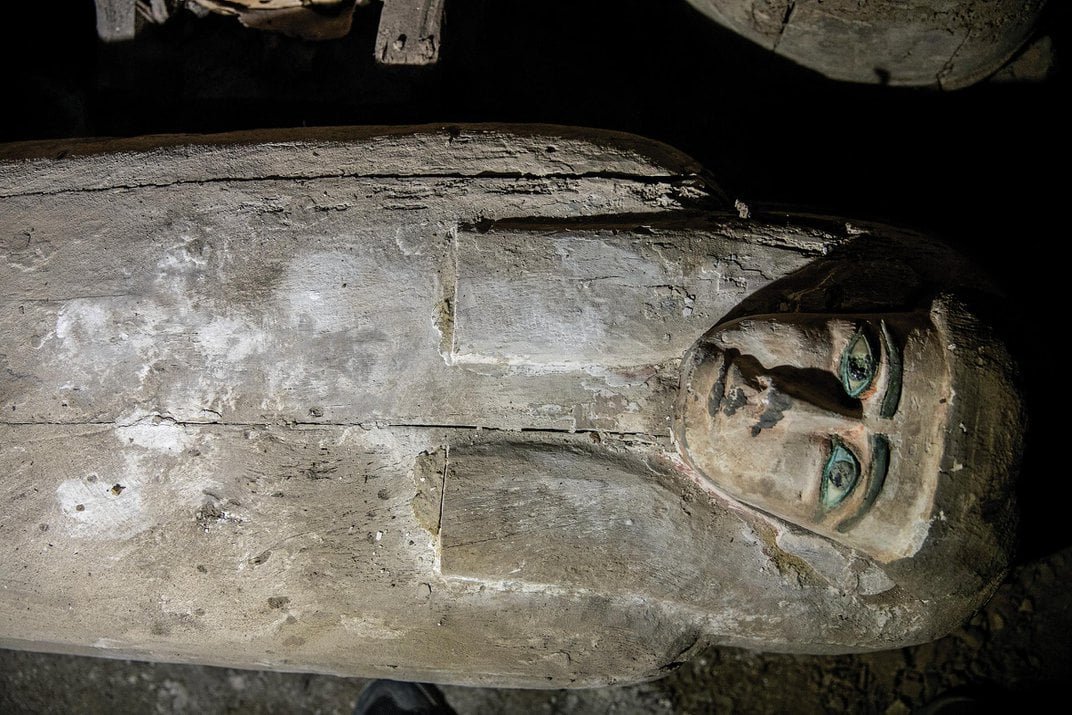
The team dug deeper, a painfully slow process that involved the help of local laborers, who scooped out the sand by hand and hauled basketsful of debris to the surface using a traditional wooden winch called a tambora, the design of which hasn’t changed in centuries. Below Psamtik’s burial niche was a room filled with many additional coffins, covered in rubble and damaged by ancient rockfalls. The bottom of the shaft led to a second, even bigger cavern, inside of which were jammed more than a hundred coffins of different styles and sizes. There were also loose grave goods, including ushabtis, miniature figures intended as servants in the afterlife, and hundreds of Ptah-Sokar-Osiris statuettes. There were even coffins buried in the base of the shaft itself, as if whoever put them there was running out of space. The result was a megatomb described by the research team as the largest concentration of coffins ever unearthed in Egypt.
Great collections of mummies and coffins have been found before, but never grouped so densely together. This was mass burial on an astonishing scale, and it shines a light on Egyptian culture at a moment of transition. In the Old Kingdom, in the third millennium B.C.—Djoser’s time—the elites appear to have favored private family spaces such as the priest Wahtye’s rock-cut tomb, which included an ornate, above-ground chapel for visitors lined with painted reliefs, inscriptions and statues of Wahtye himself. Burial shafts dug into the floor of such tombs were dedicated to particular family members. By the Late Period, some 2,000 years later, well-to-do Egyptians such as Ta-Gemi and Psamtik were packed into tight, shared spaces like cheap crates. Why did people who could clearly afford expensive coffins settle for such a crowded resting place?
According to Aidan Dodson, an Egyptologist at the University of Bristol, in England, they did so in part because by then the practice was simply routine. Shared tombs became popular across Egypt around 1000 B.C., driven by economic necessity as the kingdom faced a period of instability and collapse. When Psamtik I restored order in the seventh century B.C., the practice stuck. “We know that from the Late Period, that’s how burials are done,” Dodson says.
Campbell Price, of the Manchester Museum, adds that the answer also has to do with Saqqara’s pyramids. The necropolis had always been a center for religious cults, from the time high-ranking Egyptians were first buried there, often in low, flat-roofed tombs called mastabas, and probably long before. To help bring the country together after turbulent times, Psamtik encouraged a revival of traditional rituals and belief; after a long period as a backwater, Saqqara exploded again in popularity. Far more than a local cemetery, says Price, it became a pilgrimage site, “like an ancient Mecca or Lourdes,” attracting visitors not just from Egypt but from all over the eastern Mediterranean. Buildings such as the Step Pyramid were already thousands of years old at this time, and people believed their creators, such as Djoser and his architect Imhotep, were gods themselves. Cults and temples sprang up. Pilgrims would bring offerings, and they vied for burial spaces for themselves and their families near the ancient, sacred tombs. “Saqqara would have been the place to be seen dead in,” says Price. “It had this numinous, divine energy that would help you get into the afterlife.”
That created conditions for a thriving commercial operation entwined with the spiritual one, resulting in a kind of real estate market for the dead. “It’s a business,” says Dodson. There was probably a sliding scale of options available. Senior officials and military officers were interred in large tombs near the Old Kingdom pyramids of Unas and Userkaf, for example, while the poorest in society were probably buried “in the desert in a sheet.” But the wealthy middle classes appear to have opted for a shared shaft, perhaps with a private niche if they could afford it, or were simply piled with others on the floor. If you wanted to be close to the magical energy of Saqqara’s gods and festivals, Dodson says, “you bought yourself a space in a shaft.”
The supersized burials unearthed by Waziri’s archaeology team reveal how intense the desire for particular locations became—and how profitable they were. Instead of digging new tombs, the priests in charge of burials reused older shafts, expanding them and, Price and Dodson suggest, cramming in as many coffins as they could. The cliffs of the Bubasteion, overlooking the landscape and close to the main processional route, may have been one of the most sought-after spots of all.
On October 2020, the archaeologists found a new shaft beneath the ruins of the Bubasteion—the chaotic, painted chamber illuminated by Youssef’s flashlight. It was another megatomb, bursting with some of the finest coffins and mummies yet discovered, as well as grave goods including a falcon-topped wooden box (possibly a canopic chest, used to store internal organs removed during mummification) and numerous painted Ptah-Sokar-Osiris statues, one of which contained seeds, a symbol of rebirth.
Many of the burials date later than the other finds at Saqqara, to the era of Greek rule in Egypt following the Late Period, after Ptolemy, one of Alexander the Great’s top generals, founded a new dynasty of pharaohs in 305 B.C. With the Ptolemaic pharaohs came strong Greek cultural influences, particularly at the Mediterranean capital of Alexandria, home to some of the finest scholars of the Hellenistic world, such as the mathematician Euclid and the physician-anatomist Herophilus. Hundreds of thousands of migrants from across the Greek world settled elsewhere in Egypt, and many were awarded plots of land. Public life was Greek-run, but in private life, including religious worship, there was considerable freedom, and many of the new arrivals appear to have adopted Egyptian beliefs and customs, including mummification. As time went on, says Dodson, “more people who self-identified as Greeks were being buried according to Egyptian customs.” Saqqara was as busy as ever, and the new discoveries suggest the priests were still squeezing as many bodies as possible into the shafts.
In a nearby shaft, the team unearthed cat mummies along with human remains. Previous excavations had discovered a huge cat necropolis at the Bubasteion, where the animals, sacred to the feline goddess Bastet, were embalmed and left as offerings. It was one of many local animal cults. Just north of the Bubasteion is the Anubieion, a temple complex dedicated to the jackal-headed god of death, Anubis, where mazelike tunnels are estimated to have held millions of mummified dogs. Beyond that are catacombs once filled with mummified ibises, hawks and baboons. To the west is the Serapeum, where Apis bulls were laid to rest.
These cults always existed at Saqqara. Their roots stretch back to predynastic times, and they thrived especially in the Late Period, during the renaissance inaugurated by Psamtik, perhaps because they were seen as archetypally Egyptian, says Salima Ikram, an Egyptologist based at the American University in Cairo—a symbol of national identity when foreign influence was an ever-present threat. But they became even more popular under the Greeks, with millions of animals bred to order, presumably on nearby farms, and often sacrificed shortly after birth. Waziri and his colleagues found animal mummies of varying qualities, which were probably priced accordingly. X-rays reveal that some “mummies” have no cat remains inside at all. And the mix with human bones suggests that if priests ran out of space in the dedicated animal catacombs, they simply commandeered older human tombs. The animal cults, in other words, became an ever more significant economic and spiritual force, helping to drive Saqqara’s final flourish. Or as Price puts it: “Saqqara was like an enormous, divine magnet or battery, powered by all these animal mummies.”
To the Greeks, part of the appeal of such Egyptian customs may have been the ease of making a personal plea to the gods, by visiting a stall selling mummified animals and choosing from a range of prepared products on offer. And the reward would likewise have been appealing: the promise, unique to Egyptian theology at that time, of an eternal afterlife of splendor. By contrast, “Greek ideas for the afterlife were pretty dull,” says Price. In classic Greek literature, for example, the dead were mere shadows inhabiting a dark underworld. The Babylonian and Jewish traditions had very exclusive notions of heaven; eternal life was reserved for the gods. But Egyptian texts covering the walls inside the Saqqara pyramids describe the king’s soul rising up after death to join the sun in the sky. By around 2000 B.C., resurrection spells were written onto coffins directly, enabling even ordinary citizens such as Ta-Gemi to make the journey to idyllic, golden fields. Although the details of the afterlife changed over time, the most desirable postmortem destination during the Ptolemaic period was the “Field of Reeds,” an agricultural paradise with unfailing harvests and eternal spring.
After Cleopatra ended her life in 30 B.C., bringing the Ptolemaic era to an end, Rome ruled Egypt. Whereas the Greeks had integrated into Egyptian culture, the Romans remade it, imposing their laws and administrative systems and, in time, their newly adopted Christian faith. At Saqqara, the last Egyptian mummies date to the third century A.D. Despite the cultural triumph of Rome, however, some Egyptian iconography lives on in Christian narratives. Many scholars have noted similarities between Egyptian and Christian religious symbolism, for example in stories of the goddess Isis and her son Horus and the Virgin Mary and her son Jesus. “A lot of the iconography in Christianity is derived from ancient Egypt,” says Ikram, of the American University in Cairo.
Which is not to say that these images were necessarily appropriated directly; rather, in antiquity these influences ran in many directions. The historian Diarmaid MacCulloch, of Oxford, notes that Christian ideas of the afterlife in particular drew heavily on Greek belief, which by then had developed a “vocabulary” for concepts such as Plato’s notion that the human soul “might reflect a divine force beyond itself.” Plato, for his part, was influenced by Pythagoras, who is thought to have studied in Egypt in the sixth century B.C. “By the time Christians were beginning to construct their own literature,” MacCulloch writes in Christianity: The First Three Thousand Years, “their writers clearly found such talk of the individual soul and of resurrection completely natural.”
Today, the pace of discoveries at Saqqara remains high. “We found something last Saturday,” Waziri said recently, buzzing from excitement. “But I can’t tell you about it yet.” Salima Ikram is working with Japanese archaeologists just north of the Bubasteion, where some coffins appear to have been deposited directly in the sand. The archaeologist Zahi Hawass recently reported finding a temple belonging to a previously unknown wife of the Old Kingdom pharaoh Teti. A group working near Unas’ pyramid found a Late Period mummification workshop, complete with embalmer’s platform, incense burner and rock-cut channels to drain the blood. Waziri hopes to discover workshops where the wooden coffins were made. “What we found in the last three years,” he says, “is not even 10 percent of what we will find.”
Egyptologists, meanwhile, are eager to study the hundreds of new mummies and coffins. “The interesting thing would be to try to map these people onto the landscape,” says Price. He has previously used geophysical techniques to probe below the ground at Saqqara, which revealed the remains of numerous temples lining the processional route to the Serapeum, but this approach can’t yield texts or names to identify which gods were worshiped at these sites. Now we can add the “social layer,” he hopes, to discover who the people working in these temples were and what they believed. Ikram says the coffin inscriptions might identify relationships between individuals, perhaps revealing if families were buried together or with people of similar occupations.
Already, though, the recent discoveries are helping to redefine this necropolis not as a silent graveyard but as a vibrant economic and spiritual center, filled with temples, embalming houses, stalls and workshops. There were offerings and burials to suit all budgets, profit squeezed out of every encounter, and above all, the fierce determination to defy earthly mortality and survive forever. The secret of Saqqara, then, wasn’t death. It was life.