How transport containers carried more than cargo—and what ancient pottery can reveal about the movement of organisms across the Mediterranean and beyond.
Introduction: The Unintended Passengers of Ancient Trade
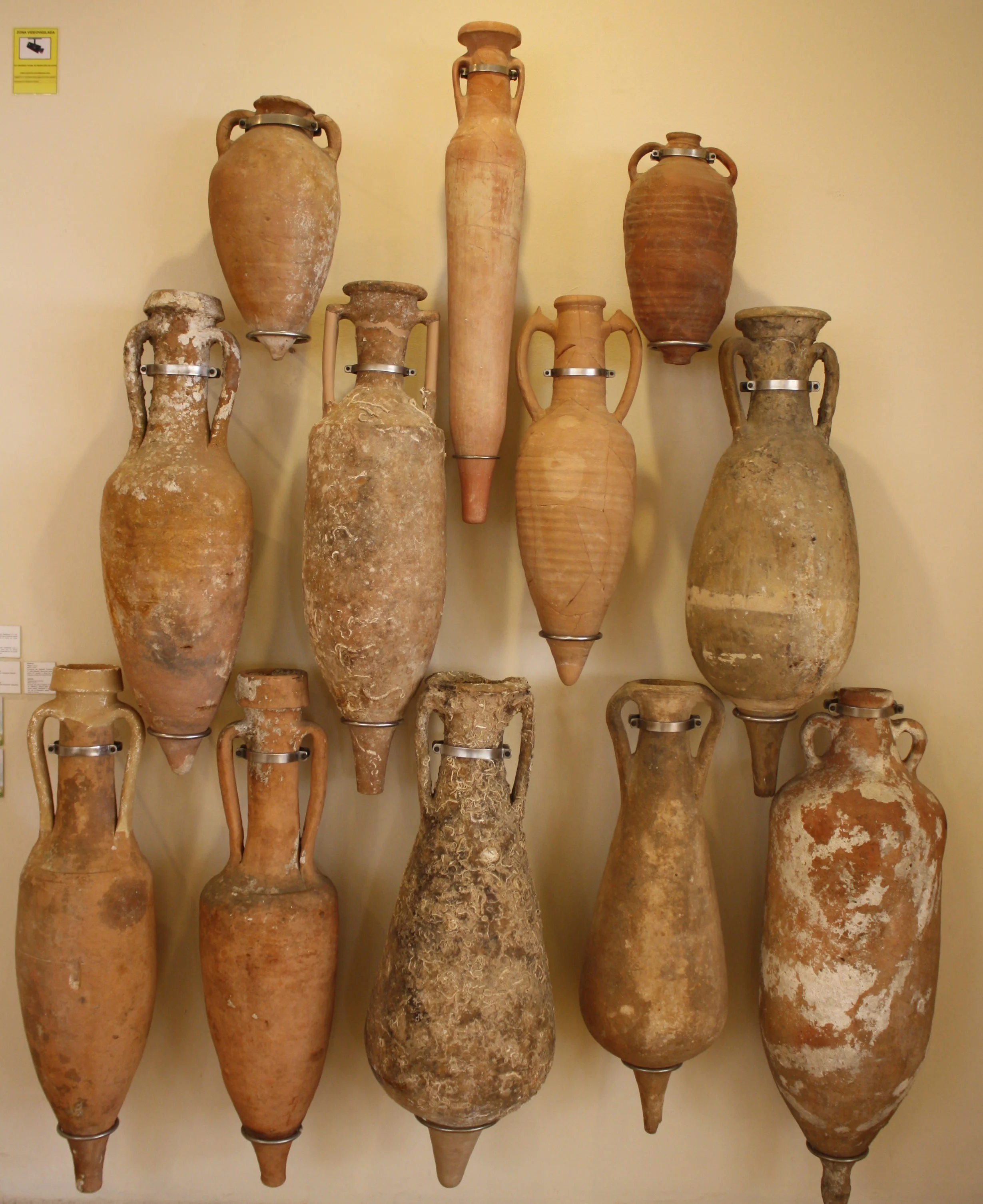
Ancient ships transported wine, olive oil, grain, fish products, and countless other commodities between coastal settlements and distant markets. Among the most recognizable objects associated with this commerce are amphorae: ceramic containers designed for storing and transporting liquids and other goods.
Amphorae are valuable archaeological evidence because their shapes, fabrics, stamps, and distribution patterns can help researchers reconstruct trade routes. Yet their importance extends beyond the commodities they contained. Like modern cargo vessels, ancient ships could also move small organisms unintentionally.
Seeds, insects, mollusks, parasites, and other biological material could travel inside containers, within packing materials, or among cargo stored in damp or dirty conditions. Once unloaded, discarded containers and shipping waste might introduce these organisms into unfamiliar environments.
The central challenge is distinguishing a plausible ecological transfer from a demonstrated historical event. Finding an insect in an amphora does not automatically prove that it traveled aboard a ship, and an organism associated with a port does not necessarily indicate that it arrived from overseas. Reliable interpretations require biological identification, archaeological context, and evidence that the proposed route of movement makes sense.
Amphorae as Microenvironments
An amphora was not simply an inert package. Its interior could retain residues from previous contents, while cracks, sediment, and organic deposits might create small habitats for organisms.
The conditions varied substantially according to the commodity transported. Containers used for wine or oil would not necessarily preserve the same biological material as those used for fish products or dry goods. Reuse could further complicate the picture, because a vessel might contain a different substance during a later stage of its working life.
Residue analysis can help identify the original contents of amphorae. Chemical compounds, absorbed organic molecules, and microscopic plant remains may reveal whether a vessel carried wine, oil, or other products. However, the detection of residues is not the same as detecting biological stowaways, and each method has different strengths and limitations.
The surrounding cargo also matters. Straw, reeds, rope, wooden fittings, baskets, and other packing materials could harbor insects, seeds, or microorganisms. Many such materials decay rapidly, leaving few visible traces. Their former presence may therefore need to be inferred from indirect evidence.
Seeds, Insects, and the Archaeology of Ecological Movement
Small organisms are often overlooked when archaeological investigations concentrate on buildings, coins, and large artifacts. Yet seeds and insect remains can provide a detailed record of past environments and human activity.
Archaeobotanists study preserved plant remains to understand agriculture, diet, and the movement of useful species. Some seeds recovered from ports may represent traded food, animal fodder, or plants growing locally. Others might have arrived accidentally among agricultural commodities.
Insect remains can likewise reflect storage conditions, building environments, and commercial activity. Species associated with stored grain or dried food may be especially relevant to the archaeology of trade, but their presence must be assessed against the possibility of local infestation.
To establish an ecological transfer, researchers need more than a specimen. They must consider whether the species was native to the receiving region, whether it appeared there earlier or later than expected, and whether its biological requirements made transport in cargo plausible.
Genetic research may sometimes help trace population relationships. If ancient specimens can be recovered with sufficient DNA, comparisons with modern or other ancient populations may identify affinities across regions. Such findings can strengthen a movement hypothesis, although shared ancestry does not always identify a precise route or date.
Ports as Gateways for Biological Exchange
Ports concentrated people, animals, food, and waste in relatively small areas. This made them natural locations for biological exchange, whether intentional or accidental.
An arriving ship could unload grain carrying insects, plants attached to packing materials, or organisms living in damp wooden components. Waste discarded around a harbor might provide food and shelter for species that could survive beyond the vessel. Repeated voyages would create multiple opportunities for introductions.
Nevertheless, ports were not the only places where organisms moved. Overland caravans, livestock movements, agricultural exchanges, and natural dispersal could produce similar distributions. A convincing study must compare maritime explanations with these alternatives.
Ancient shipping networks were also not static. Political changes, new commercial partners, shifting routes, and the expansion of settlements altered the frequency and direction of contact. Biological transfers should therefore be studied within specific historical and environmental contexts rather than treated as a single continuous process.
How Archaeologists Detect Ancient Stowaways
The investigation begins with careful recovery. Fine sieving and flotation can reveal small plant and animal remains that ordinary excavation methods might miss. Sediment samples from inside vessels should be documented separately from surrounding deposits whenever possible, reducing the risk of confusing ancient contents with later contamination.
Researchers then identify the remains using comparative anatomy, microscopy, and, where appropriate, molecular methods. They must also assess preservation and contamination. Modern seeds, insects, and DNA can enter archaeological contexts during excavation, storage, or laboratory processing.
Dating is equally important. A container may have been manufactured centuries before its final deposition, and its discovery in a harbor does not establish the date when an organism entered the region. Stratigraphic relationships and independent dating methods are needed to narrow the chronology.
Finally, researchers compare their findings with the wider archaeological record. If a potentially introduced species appears in several securely dated ports along a plausible route, the case becomes stronger. If it appears only in one poorly documented deposit, the interpretation should remain tentative.
Ecological Consequences and Historical Interpretation
Not every transported organism becomes established in a new environment. Survival depends on climate, food availability, reproductive biology, competition, and other ecological conditions. Some introductions may have failed immediately; others may have persisted without leaving an obvious archaeological signature.
The long-term consequences could range from negligible to significant. Insects transported with stored food might damage supplies, while introduced plants could become part of local agricultural or wild landscapes. However, assigning a specific ecological transformation to ancient amphora transport requires direct evidence rather than speculation.
This field also raises an important interpretive question: should ancient globalization be understood only through human commodities and cultural exchange? Biological evidence suggests that trade also created opportunities for the movement of organisms, sometimes unintentionally. The ecological history of shipping can therefore complement the study of economic and political connections.
Conclusion: The Hidden Cargo of the Ancient World
Amphorae offer a useful starting point for exploring the unintended biological consequences of ancient maritime commerce. Their contents, residues, and archaeological distributions can help reconstruct the environments in which trade operated.
Yet the strongest conclusions require a combination of biological identification, contamination control, secure chronology, and regional comparison. A possible stowaway becomes convincing evidence of ecological transfer only when alternative explanations have been examined.
The broader lesson is that ancient ships moved more than goods and people. They operated within living systems, linking ports and landscapes through exchanges that could be accidental, difficult to detect, and significant long after the original voyage had ended.