
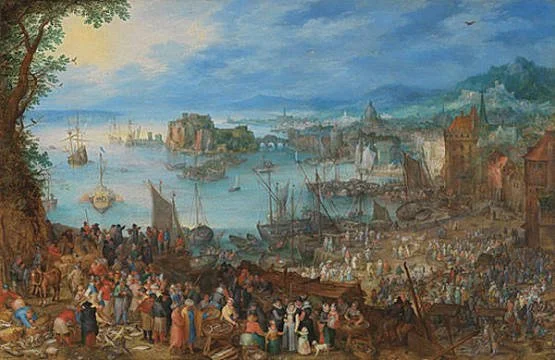
How discarded fish remains, processing installations, and traces of coastal commerce can reveal the everyday economies of medieval maritime communities.
Introduction: Reconstructing a Market That No Longer Exists
Medieval port cities were more than gateways for merchants, pilgrims, sailors, and luxury goods. They were also centers of everyday provisioning, where fish, meat, vegetables, salt, and other necessities moved continually between producers and consumers. Markets supplied ships preparing for long voyages, households living near busy harbors, religious institutions observing dietary restrictions, and workers whose livelihoods depended on maritime trade.
Yet the physical spaces where these exchanges occurred can be difficult to identify archaeologically. Wooden stalls disappear, temporary awnings leave little trace, and crowded marketplaces are frequently rebuilt as cities expand. What survives may be less visually impressive than a harbor wall or merchant's residence: concentrations of fish bones, fragments of storage containers, drainage channels, and shallow pits associated with food processing.
These seemingly ordinary remains can help reconstruct the practical organization of medieval food economies. They may reveal which fish were consumed, how seafood was processed, whether products traveled long distances, and how markets adapted to seasonal changes.
However, identifying a specific excavation as a lost wet market requires caution. Fish bones and salt-related features can also originate from household kitchens, workshops, ship provisions, or waste-disposal areas. The strongest interpretations emerge when several independent lines of evidence converge.
Fish Bones as Evidence of Consumption and Commerce
Fish remains are among the most informative materials recovered from archaeological settlements. Their species, size, anatomical distribution, and condition can help researchers investigate how seafood entered a city and how it was prepared.
Large numbers of bones from a single species might indicate specialized processing, but abundance alone is not enough to establish commercial activity. A household near a productive fishing ground could produce a similar pattern over many years. Archaeologists therefore examine the entire assemblage rather than relying on one striking concentration.
Species identification can distinguish marine fish from freshwater species and sometimes reveal whether particular products came from distant waters. A port supplied by local coastal fisheries might contain abundant remains of nearby species, while a market connected to broader trade networks could include fish associated with different ecological zones.
Fish size is also significant. A collection dominated by large individuals may reflect commercial capture methods or consumer preferences, whereas a mixture of sizes may suggest diverse fishing practices. Researchers must consider the effects of fishing gear, preservation, and the ways bones survive in soil before drawing conclusions.
The Archaeology of Salting Pits and Processing Areas
Salt was essential to many premodern preservation systems. By drawing moisture from fish and inhibiting microbial growth, salting could extend the period during which seafood remained usable. Depending on local techniques, fish might be heavily salted, dried, fermented, or subjected to several stages of processing.
Archaeological features associated with these activities can include shallow pits, lined basins, drains, working surfaces, and concentrations of salt-related residues. Nevertheless, there is no universal archaeological signature for a medieval fish-salting installation. Stone or plaster basins might have served several purposes, and a pit containing mineral deposits does not automatically demonstrate salt production or fish preservation.
Researchers investigate the surrounding sediments, the chemical composition of residues, traces of animal products, and the spatial relationship between installations and other features. Micromorphology—the microscopic study of intact sediment samples—can help distinguish accumulated household waste from deposits formed through repeated industrial or commercial activity.
Where preservation conditions allow, microscopic biological remains and chemical biomarkers may provide additional clues. Such evidence must be interpreted alongside local geology because naturally saline soils and later contamination can imitate some of the chemical patterns associated with food processing.
Market Geography: Connecting the Harbor to the City
A medieval wet market would have occupied a position within a larger system of movement. Fish might arrive by boat, pass through weighing or sorting areas, and then move toward stalls, storage facilities, religious institutions, or urban households.
Archaeologists can investigate this geography by comparing the distribution of fish remains, processing installations, transport containers, and access routes. Concentrations close to waterfront loading areas may indicate unloading or primary processing. More diverse assemblages farther inland could reflect retail consumption or household disposal.
The distinction between wholesale and retail activity is particularly important. A large processing area near a harbor might supply merchants who transported preserved fish elsewhere rather than serve local consumers directly. Conversely, a dense urban concentration of mixed fish remains might represent the cumulative waste of a neighborhood market.
Written records, where available, can clarify these possibilities. Medieval regulations sometimes addressed market supervision, weights and measures, fish sales, taxation, or the quality of food offered to consumers. Such documents rarely describe every practical detail, but they can be compared with the archaeological distribution of processing and waste.
Seasonality, Religious Practice, and Food Security
Fish consumption was shaped by ecology, economics, and cultural expectations. Fishing seasons influenced which species were available, while preservation made some catches useful long after the season ended. Religious fasting calendars could increase demand for fish during particular periods, although the effects differed across regions and communities.
Archaeological evidence may help identify these patterns. Changes in fish species, size, or processing methods across successive deposits can suggest seasonal specialization or shifting supply networks. Yet seasonal conclusions require careful sampling and secure dating because a deposit accumulated over decades may combine many different fishing seasons.
Preserved seafood also had implications for food security. Salted or dried fish could support sailors during voyages, supply communities far from the coast, and provide an alternative when fresh food was scarce. The presence of such products in a port city therefore connects the local market to wider questions of transportation, labor, and survival.
Conclusion: Recovering the Everyday Economy of the Medieval Sea
The archaeology of medieval wet markets demonstrates that ordinary food remains can illuminate complex commercial systems. Fish bones, salt-related features, storage vessels, and drainage structures may reveal how maritime communities fed themselves and supported long-distance travel.
The most convincing reconstruction will not depend on a single pit or an unusually large concentration of bones. It will emerge from the combined study of biological remains, sediment chemistry, architectural features, urban geography, and historical documentation.
A lost market is ultimately more than a place where goods changed hands. It is evidence of the relationships linking fishermen, processors, merchants, consumers, and the coastal environment on which their livelihoods depended.




