
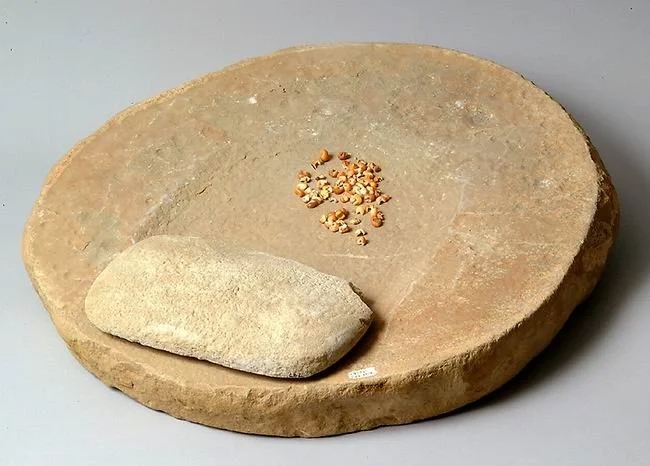
Investigating how grinding technology, household architecture, and labor organization can illuminate the social geography of food processing in ancient communities.
Introduction: The Social World of Food Preparation
Grinding stones are among the most widespread tools in archaeological assemblages. They were used to crush, grind, and process grains, seeds, roots, pigments, minerals, and other materials. Their durability makes them especially valuable for studying everyday work that rarely appears in monumental architecture or elite written records.
Food grinding could require substantial time and physical effort. In societies that depended on cereal agriculture or other starchy plant foods, grinding and related processing activities may have been central to household economies.
The title's emphasis on female economic space raises an important research question: can the archaeological distribution of grinding stones help identify work traditionally performed by women in particular societies?
In some historical and ethnographic contexts, food processing was strongly associated with women. But this pattern cannot automatically be projected onto every ancient community. Gendered divisions of labor varied across cultures and periods, and grinding tools alone do not reveal the gender of the person who used them.
A careful archaeological approach investigates the organization of work without assuming that the same gender roles existed everywhere.
Grinding Technology and the Organization of Labor
Grinding technology includes a range of tools, from handheld grinders to larger stationary grinding installations. Their form depends on the materials being processed, the desired texture, and the physical techniques used.
Researchers examine the size, shape, surface texture, and wear patterns of grinding stones. Microscopic residues may identify plant starches or other materials, while use-wear can help distinguish grinding from pounding or other activities.
The amount of wear and the dimensions of a tool can provide clues about how it was used, but they do not directly reveal the identity of the user. A large grinding stone may have required considerable effort, yet it could have been operated by one person, several people, or individuals taking turns.
Researchers can compare tool distributions across buildings and settlements to investigate whether grinding took place primarily within households or in shared work areas. The results may reveal patterns of labor organization even when the social identities of individual workers remain uncertain.
Household Architecture and Working Spaces
The location of grinding stones can help reconstruct the spatial organization of domestic work. Tools found near hearths, storage areas, courtyards, or food-processing installations may have been used within a household's daily routines.
However, objects are often moved before they are discarded or buried. A grinding stone found in a courtyard may have been used there, stored there, or brought from another location as building material.
Researchers therefore examine the relationship between the artifact and its context. Is the stone associated with plant remains, food-processing debris, or repeated occupation surfaces? Are similar tools found in neighboring houses? Does the architecture suggest a dedicated work area?
Spatial patterns may also reveal differences in access to labor and resources. Some households may have possessed several grinding stones, while others shared equipment or used communal facilities. Such differences require interpretation alongside household size, preservation, and the chronology of occupation.
Gender and the Archaeology of Invisible Labor
The archaeology of gender seeks to understand how societies organized work, authority, identity, and social expectations. It does not assume that biological sex automatically determines a person's activities or social role.
In some societies, women may have been responsible for much of the daily processing of staple foods. In others, food production could be divided differently according to age, status, household structure, season, or the specific task involved.
Grinding stones cannot independently establish who performed the work. Researchers need additional evidence, such as historical descriptions, carefully contextualized burial evidence, skeletal indicators of repetitive activity, or comparisons with well-documented communities.
Even these sources have limitations. Skeletal changes associated with repeated labor are rarely unique to one activity, and grave goods do not provide a straightforward record of occupation. Ethnographic analogy can generate hypotheses, but it cannot prove that an ancient society followed the same division of labor.
The strongest interpretations recognize gender as a question to investigate rather than a conclusion already contained in the artifact.
Grinding, Food Security, and Household Economies
Food processing was essential to transforming many plant resources into usable meals. Grinding could improve digestibility, alter texture, and prepare ingredients for cooking or storage.
The importance of grinding varied with local diets and available technology. Some communities relied heavily on processed grains, while others used a wider range of plant and animal resources. A settlement with many grinding stones may have supported intensive plant processing, but researchers must consider other possible uses.
Tool wear and residue analysis can help identify the materials being processed. If grinding stones contain starch grains consistent with particular plants, the findings can be compared with charred seeds, storage facilities, and environmental evidence.
These data can reveal how households managed food resources. However, they rarely establish the exact quantity of food produced or the social status of the person who processed it.
The labor involved in grinding also has broader economic significance. Time spent preparing food could affect the amount of labor available for farming, craft production, childcare, and other activities. Understanding the organization of this work helps reconstruct the practical foundations of ancient economies.
Beyond the Household: Communal and Specialized Processing
Grinding did not always take place within individual homes. Some communities may have used shared processing areas, particularly when handling large quantities of grain or other materials.
Archaeologists can investigate this possibility by examining the size and concentration of tools, the presence of storage facilities, and the spatial relationship between processing areas and settlements.
A cluster of grinding stones might indicate communal production, but it could also represent accumulated household equipment or a later deposit. Secure stratigraphy and evidence of repeated activity are necessary before assigning a shared function.
Specialized processing may also have involved people whose roles cannot be inferred directly from the tools. The archaeological record can reveal the scale and organization of work more readily than the identities or social status of the workers.
Conclusion: Grinding Stones and the Archaeology of Work
Grinding stones provide a valuable record of food processing, household organization, and the labor required to sustain ancient communities. Their distribution can help identify working areas and investigate how processing activities were organized.
However, grinding stones alone cannot establish that women performed the work. Gendered interpretations require evidence from the relevant society and period, along with careful consideration of alternative explanations.
By combining tool analysis, residue studies, spatial archaeology, and contextual evidence, researchers can investigate the relationship between domestic space and economic activity without imposing modern assumptions on the past. This approach makes everyday labor more visible while acknowledging the limits of what surviving objects can tell us about the people who used them.




