
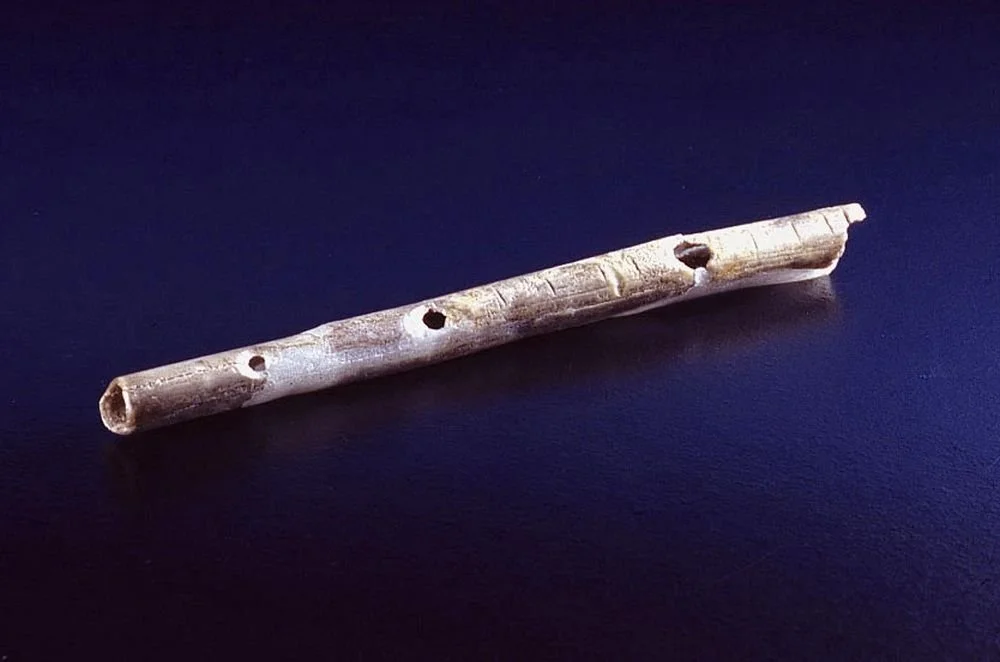
Investigating ancient musical traditions through bone instruments, acoustic experiments, and archaeological evidence from diverse regions of the world.
Introduction: Music Before Written History
Music leaves a different archaeological record from stone tools, buildings, and pottery. Sound disappears almost immediately after it is produced, and the instruments used to create it may decay or break beyond recognition. Yet surviving bone, ivory, wood, and other objects can provide clues about how prehistoric people produced sound.
Bone flutes are especially intriguing because their holes, internal cavities, and carefully shaped surfaces may indicate deliberate sound production. Some prehistoric instruments have been recovered in Europe, where several discoveries have attracted considerable attention. However, the broader history of prehistoric music extends well beyond Europe.
Archaeological research in Africa, Asia, and other regions can contribute to understanding how people experimented with sound, developed instruments, and incorporated music into social life. The evidence is uneven, and not every hollow bone with holes is necessarily a flute.
The challenge is to identify sound-producing objects securely and interpret their possible uses without assuming that all prehistoric societies shared the same musical traditions.
Identifying a Prehistoric Bone Flute
Bone can be shaped into a tube capable of producing sound when air is directed through it. Depending on the instrument's design, holes along the body may allow the player to alter pitch by changing the effective length of the vibrating air column.
Archaeologists examine the number, spacing, shape, and placement of holes, as well as the object's overall geometry. Tool marks may reveal deliberate modification, while wear and residues can provide additional clues about how the object was handled.
However, natural cavities and damage can imitate some features of an instrument. Carnivore activity, water erosion, and accidental breakage may create holes or alter the shape of a bone. A convincing flute identification requires evidence that the features are consistent with deliberate manufacture and sound production.
Researchers also consider the anatomical origin of the bone. Different animal bones have different dimensions and internal structures, which influence their suitability for instrument making. Species identification can therefore help establish whether the raw material was appropriate for the proposed function.
Evidence Beyond Europe
Europe has produced some of the most widely discussed prehistoric bone instruments, but this does not mean that music originated there or that other regions lacked comparable traditions.
In Africa and Asia, researchers have investigated a variety of artifacts that may have produced sound, including modified bones, whistles, and other potential instruments. Their interpretation depends on the archaeological context and the quality of the surviving evidence.
The comparison must be chronological and methodological. An object identified as a musical instrument in one region should not automatically be used to classify a visually similar artifact elsewhere. Different cultures may have modified bones for different purposes, and some instruments may not have survived at all.
Preservation strongly influences the archaeological record. Bone can survive under certain conditions, while wood, reeds, bark, and other organic materials may disappear. A region with few surviving bone instruments may nevertheless have supported extensive musical traditions using perishable materials.
The absence of preserved instruments should therefore not be equated with the absence of music.
Experimental Archaeology and Reconstructing Sound
Once an artifact is identified as a possible flute, researchers can create a replica to investigate how it might have functioned. Experimental instruments can be made from comparable materials and shaped according to the surviving dimensions.
Researchers then test whether the replica can produce stable tones, whether the holes affect pitch as expected, and whether the instrument's design is practical for a human player. Acoustic measurements can record frequency, resonance, and other properties of the sound.
These experiments can establish whether a proposed instrument is physically plausible. They cannot recover its original music, however. The same instrument might produce different melodies depending on technique, musical conventions, and the player's skill.
Modern replicas also may differ from ancient objects in material quality and internal geometry. Experimental results should therefore be interpreted as evidence of possible performance rather than a definitive reconstruction of prehistoric music.
Music, Social Life, and Ritual
Sound-producing instruments can be associated with many aspects of social life. Music may accompany dance, storytelling, work, ceremonies, gatherings, or communication. A flute could have been used for entertainment, personal expression, ritual activity, or several purposes.
Archaeological context helps investigate these possibilities. An instrument found in a burial may have had symbolic significance, but it does not necessarily mean the object was used only in funerary ceremonies. An instrument recovered from a settlement could have been used for music, but it might also have served another function.
Repeated finds in similar contexts can reveal broader patterns. If instruments occur alongside evidence of communal gatherings or structured ceremonial activity, a social or ritual interpretation may become more persuasive.
Nevertheless, music itself is difficult to reconstruct from material evidence. Archaeologists can study instruments and their physical capabilities, but the rhythms, melodies, meanings, and emotional experiences associated with prehistoric performances may remain unknown.
Technology, Skill, and the Development of Musical Traditions
Making a functional bone instrument can require careful selection of raw material, controlled perforation, and knowledge of how its shape affects sound. These skills may have been passed between individuals through demonstration and practice.
The manufacture of an instrument can therefore reveal aspects of technical knowledge beyond its musical function. Researchers examine tool marks, production sequences, unfinished objects, and similarities among instruments to investigate how techniques were learned and shared.
However, similarity between instruments does not automatically prove direct cultural contact. Comparable acoustic requirements can lead to similar designs in different places.
The study of prehistoric music also encourages researchers to reconsider how technology is defined. A sound-producing object may have had little practical value in the narrow economic sense, yet it could have been important for communication, identity, coordination, and collective experience.
Conclusion: Recovering Music from Material Remains
Prehistoric bone flutes provide rare evidence of human experimentation with sound. Their shapes and manufacturing marks can help establish whether an object was designed to function as an instrument, while experimental archaeology can investigate its acoustic possibilities.
The broader record remains uneven because organic materials preserve differently across environments and regions. Archaeologists must distinguish secure instrument identifications from objects whose function remains uncertain, especially when comparing finds across continents.
By examining evidence beyond Europe, researchers can develop a more geographically inclusive understanding of prehistoric sound. Although the original melodies may be lost, the surviving instruments remind us that music and other forms of sound production were part of the human past long before written musical notation existed.




