
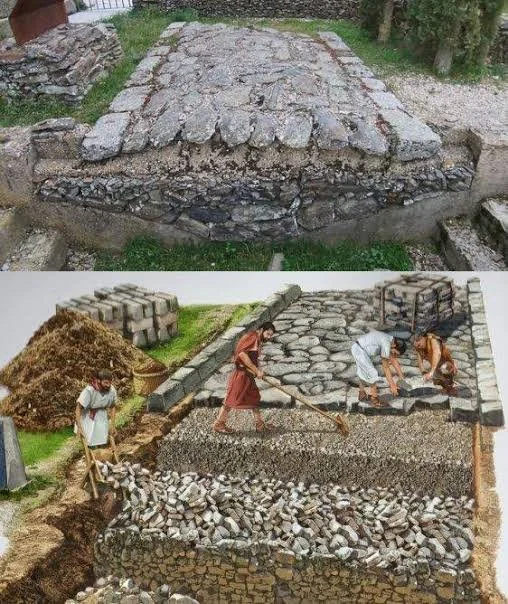
Small sacred spaces, travel rituals, and the archaeological evidence preserved beside Roman highways.
Sacred Places Along the Journey
Roman roads connected cities, military installations, ports, agricultural districts, and settlements across a vast territory. They supported the movement of soldiers, merchants, officials, travelers, and ordinary residents. Yet roads were more than routes for transportation. They also created landscapes of encounters, risks, obligations, and religious activity.
Travel could be dangerous or uncertain. People faced bad weather, difficult terrain, illness, accidents, and the possibility of theft. Religious practices offered ways to express gratitude, seek protection, and mark important moments during a journey.
Small shrines beside roads could provide places for offerings, prayers, or acts of remembrance. Some may have been dedicated to local deities, protective figures, or divine powers associated with travel and boundaries. Others could have developed around springs, unusual rock formations, or locations already regarded as sacred.
The existence of a particular roadside shrine must be established archaeologically or through historical evidence. A small structure beside an ancient road is not automatically religious, and a collection of coins or pottery does not by itself prove that a ritual occurred there.
Roman Roads and Their Surroundings
Roman road systems varied in construction and purpose. Major routes could include carefully engineered surfaces, drainage, bridges, milestones, and infrastructure designed to facilitate movement over long distances. Smaller roads and local tracks might have had simpler construction.
The landscape beside a road could contain tombs, monuments, shops, settlements, water sources, and places where travelers stopped to rest. Roman funerary monuments were often positioned along routes outside settlements, making it especially important to distinguish roadside shrines from burial-related structures.
Roadside activity also changed over time. A location used during the Roman period might have existed before the road was constructed or continued to be occupied after its maintenance declined. Archaeologists must establish the relationship between a structure and the road rather than assuming that proximity proves contemporaneity.
Religion in Everyday Roman Life
Roman religious practice included public ceremonies, household rituals, offerings, festivals, and devotion to a wide range of deities. Religious activity was not confined to monumental temples. Small shrines and household altars could provide settings for repeated acts of devotion.
Travelers might seek divine protection before beginning a journey or express gratitude after reaching a destination. Merchants could make offerings associated with commercial success, while soldiers might participate in religious practices connected with duty, loyalty, and personal safety.
The meaning of a shrine depended on its location, the objects associated with it, and the people who used it. A site beside a crossroads might have had a different significance from one near a bridge, spring, or boundary.
Researchers should avoid assigning a shrine to a particular deity without inscriptions, distinctive imagery, or other supporting evidence.
Why Micro-Excavation Is Useful
Micro-excavation involves carefully investigating small deposits or features in order to preserve fine-grained information. This approach can be especially valuable at roadside shrines, where offerings may have accumulated in thin layers or within small pits.
A broad excavation might expose a structure, but detailed recording can reveal how its deposits formed. Researchers document the position of individual objects, the sequence of layers, soil changes, and relationships between artifacts.
Small finds can be particularly informative when their context is secure. Coins, beads, miniature vessels, animal bones, and fragments of lamps may help researchers reconstruct the activities that took place at a site.
However, no single object necessarily proves a religious function. A coin could have been lost accidentally, a vessel might have been discarded, and animal remains could result from ordinary food preparation. The significance emerges from the pattern of evidence.
Offerings, Deposits, and Ritual Interpretation
A collection of objects deposited in a particular location may indicate deliberate activity, especially when items are arranged in a structured pattern or repeatedly placed in the same feature. Researchers examine whether the objects were broken, burned, selected for particular qualities, or deposited at different times.
Ritual interpretation requires caution because ancient people did not always separate religious and practical behavior in ways that correspond to modern categories. A deposit could combine everyday objects with acts of devotion, while an apparently unusual arrangement might have a nonreligious explanation.
Inscriptions and dedicatory texts can be especially helpful, although many small shrines contain no written evidence. In such cases, comparison with securely identified sites may support an interpretation, but the degree of certainty should remain clear.
Reconstructing the Roadside Environment
A shrine cannot be fully understood without studying the road and surrounding landscape. Researchers can map its distance from settlements, bridges, water sources, cemeteries, and intersections. They can also examine whether the site was visible to travelers or positioned at a place where people naturally stopped.
Environmental evidence may reveal whether the surrounding area was wooded, cultivated, or relatively open during the period of use. Changes in the road's alignment or the development of a nearby settlement could explain why a shrine was abandoned or transformed.
The archaeological record may preserve several phases of activity, showing that the place continued to matter after its original purpose changed.
Preserving Small Sites Along Ancient Roads
Roadside shrines are often less visually impressive than major temples or monumental ruins, but they can provide detailed evidence of everyday religious practice. Their small scale makes careful documentation especially important because later construction, roadwork, erosion, and agricultural activity can destroy their deposits.
The title's emphasis on micro-excavations is therefore significant as a research approach. By recording small deposits and their relationships precisely, archaeologists can reconstruct how travelers used sacred spaces and how religious practices became embedded in the road network.
The existence and function of any specific shrine must still be established through evidence. When that evidence is available, these modest sites can illuminate the personal experiences and beliefs that accompanied movement through the Roman world.




