
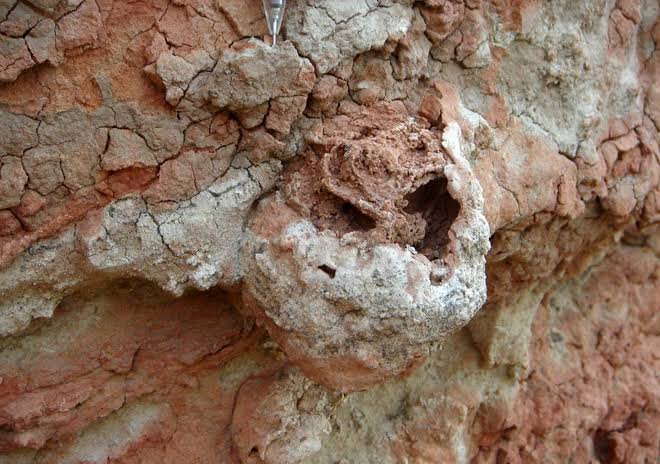
Insect agriculture, fungal symbiosis, and the challenge of identifying ancient relationships between humans and cultivated organisms.
Cultivation Beyond Human Fields
Agriculture is commonly associated with crops such as wheat, rice, maize, and barley. Yet cultivation in the wider natural world takes many forms. Some insects actively manage other organisms as food sources, creating complex relationships that resemble farming in important ways.
Certain termites cultivate fungi within specialized nest structures. Rather than simply collecting plants or consuming dead wood, these termites maintain conditions that support fungal growth and use the resulting material as part of their food system.
This behavior is biologically remarkable, but it must be distinguished from human prehistoric agriculture. Termite fungal cultivation evolved through the history of insect–fungus relationships, independently of human farming. Archaeologists investigating prehistoric human sites should not interpret every fungal trace as evidence that people cultivated fungi.
The broader subject raises important questions about how scientists reconstruct ancient cultivation and how evidence of human activity can be distinguished from natural biological processes.
How Termite Fungus Cultivation Works
In some termite groups, colonies cultivate fungi belonging to specialized lineages. Workers gather plant material, process it, and incorporate it into fungal combs within the nest. The fungi help break down complex plant material and produce substances that the termites can use.
The colony maintains a structured environment in which temperature, moisture, and the movement of organic matter support the relationship. Different castes of termites perform different tasks, and the system depends on cooperation among many individuals.
This is not identical to human agriculture, but it demonstrates how cultivation can emerge through biological relationships that organize the production of food. The termites are not simply passive consumers; their behavior actively supports the growth of the organisms on which they depend.
The details vary among species, and not every termite cultivates fungi. Researchers must identify the organisms and their ecological relationships before interpreting a particular nest or deposit.
What Counts as Fungal Cultivation Archaeologically?
Fungi are difficult to study archaeologically because their visible fruiting bodies may not survive, and much of their growth occurs through microscopic networks. Some fungal structures or chemical traces can persist, but preservation depends heavily on moisture, temperature, soil chemistry, and the surrounding materials.
Evidence of fungal cultivation might include distinctive structures, repeated arrangements of organic matter, residues associated with known cultivation systems, or biological remains found in a clear archaeological context.
However, fungal spores or organic residues alone do not prove deliberate cultivation. Fungi are widespread in natural environments and can grow on decaying wood, plant remains, animal waste, and many other substrates.
Researchers must determine whether the evidence reflects natural decomposition, insect activity, human use, or deliberate management.
Human Uses of Fungi in Prehistory
Humans have interacted with fungi in many ways, including the consumption of edible species, the use of fungi in material processing, and the management of fermentation. Yet the archaeological record does not preserve all these activities equally well.
Some fungi are used in food production because they transform organic materials. Others may be used for medicinal or practical purposes. However, identifying prehistoric use requires evidence that connects the organism to a human activity rather than simply demonstrating that it existed at a site.
Residue analysis, preserved plant and fungal remains, microscopic examination, and comparison with ethnographic evidence can help researchers investigate these relationships. Ethnographic comparisons are useful for generating hypotheses, but practices documented in recent communities cannot automatically be projected into prehistoric times.
Termite Mounds as Archaeological Evidence
Termite mounds can alter the soil around them, concentrate nutrients, and create distinctive structures in the landscape. In some regions, ancient mound remains may be difficult to distinguish from later activity without careful analysis.
A termite mound found near an archaeological site does not automatically indicate that humans used or managed it. The mound could have developed naturally, been abandoned long before human occupation, or continued to be used after the archaeological site was deserted.
Researchers must establish the relationship between the mound and human activity through dating, stratigraphy, biological analysis, and spatial comparison.
If a claim suggests that prehistoric people deliberately managed termite fungal farms, it would require evidence of direct human involvement. The existence of termite agriculture by itself is not evidence of human fungal cultivation.
Environmental Conditions and the Preservation of Fungi
Fungal remains are especially sensitive to environmental conditions. Moisture, oxygen, temperature, acidity, and the activity of other organisms can influence whether traces survive.
In some settings, microscopic remains or chemical signatures may persist even when larger structures disappear. In others, biological evidence can be almost entirely lost.
Researchers must therefore consider preservation bias. The absence of fungal remains does not prove that fungi were never used, while a surviving trace may not indicate deliberate cultivation.
Modern analytical techniques can improve detection, but their results still require contextual interpretation.
The Difference Between Biological Farming and Human Agriculture
The example of termite fungus cultivation demonstrates that agriculture-like systems can arise outside human societies. It also challenges simple definitions of farming by showing that cultivation can involve organisms cooperating with other species.
Nevertheless, the archaeology of human fungal use is a distinct research problem. Researchers need to establish when people collected, cultivated, processed, or consumed fungi and how those activities fit into their wider subsistence systems.
The title's reference to prehistoric fungal cultivation should therefore be treated as a broad research topic rather than evidence of a specific prehistoric practice. A rigorous investigation would separate natural termite agriculture from any independently documented human activity.
What the Study Can Contribute
The archaeology of fungi can expand our understanding of past food systems, ecological knowledge, and human relationships with organisms that are often invisible in the conventional archaeological record.
Termite farming offers an important biological comparison, while archaeological evidence may reveal how humans used fungi in particular contexts. The two subjects are connected by the broader question of cultivation, but they should not be confused.
By combining ecological knowledge, microscopy, chemical analysis, and archaeological context, researchers can investigate fungal activity without overstating what the surviving evidence proves.




