
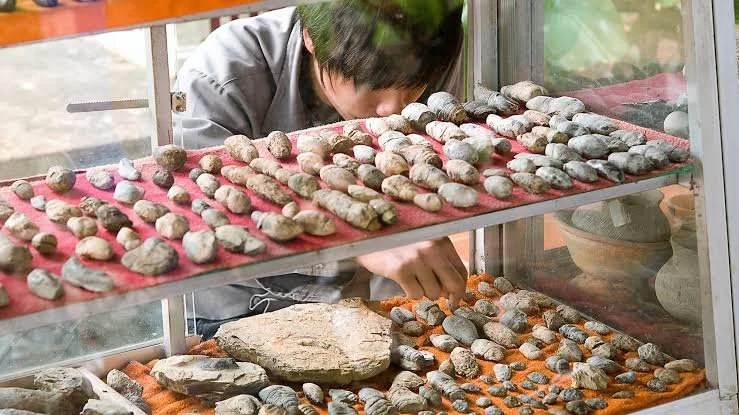
Ancient intestinal parasites, preserved fecal deposits, and the microscopic evidence of everyday life.
What Coprolites Can Reveal
Some of the most informative archaeological discoveries are not monumental objects or elaborate graves. They are the remains of ordinary biological processes that reveal how people ate, lived, and interacted with their environments.
Coprolites are preserved feces from humans or animals. Although the term is sometimes used broadly, researchers must establish whether a sample is human or animal before drawing conclusions about diet, health, or sanitation.
Under favorable conditions, coprolites can preserve plant remains, parasite eggs, microscopic organisms, and other traces of what passed through an individual's digestive system. These materials offer a rare opportunity to study aspects of everyday life that written records and durable artifacts may not capture.
Paleoparasitology is the study of parasites in ancient contexts. By examining preserved parasite remains, researchers can investigate patterns of infection, environmental exposure, sanitation, and contact between humans and animals.
However, a coprolite is not a complete medical record. Its contents represent a particular biological event, and the evidence must be interpreted in relation to preservation, sampling, and archaeological context.
What Paleoparasites Are
Parasites are organisms that live in or on another organism and obtain resources from it. Some parasites infect the digestive system, while others affect different tissues or organs.
Many intestinal parasites produce eggs or other stages that can pass into feces. These microscopic remains may survive in archaeological deposits, especially in environments where moisture, temperature, and soil chemistry favor preservation.
Different parasites have different life cycles. Some require an intermediate host, while others can be transmitted through contaminated food, water, soil, or close contact. Understanding these life cycles helps researchers reconstruct possible routes of infection.
The presence of a parasite egg does not always establish that the individual who produced the feces was suffering from severe illness. Infection can vary in intensity, and the effects depend on the parasite, the host, and the individual's overall health.
How Researchers Identify Ancient Parasites
Laboratory investigation may involve microscopy, sediment processing, chemical analysis, and, in suitable cases, ancient DNA techniques. Researchers look for characteristic shapes, sizes, and structures that help distinguish one parasite from another.
Identification can be challenging because some eggs resemble those of unrelated organisms. Preservation may distort their appearance, while contamination can introduce modern material into an ancient sample.
Reliable studies use appropriate controls and document how samples were collected, stored, and processed. Researchers must also consider whether the sample came from a secure archaeological layer or was exposed to later disturbance.
Ancient DNA can provide additional information in some circumstances, but it is vulnerable to contamination and degradation. A genetic result should be interpreted alongside morphological and archaeological evidence rather than treated as automatically conclusive.
Reconstructing Diet from Coprolites
Coprolites may contain fragments of plants, seeds, pollen, animal tissues, and other material associated with food. These remains can provide clues about what an individual consumed shortly before producing the sample.
Plant remains may indicate the use of particular foods, while other microscopic evidence can reveal components that are difficult to identify from ordinary archaeological deposits. In some cases, chemical analysis can complement visible remains and help investigate the composition of ancient diets.
However, a coprolite represents only a limited snapshot. A food absent from one sample may still have been an important part of the person's diet at other times. Digestion also changes the appearance and survival of different food components.
Researchers therefore compare multiple samples and combine them with evidence from plant remains, animal bones, food-processing areas, and other archaeological materials.
Parasites and Ancient Sanitation
Some intestinal parasites spread when people ingest material contaminated with human or animal waste. Others can be transmitted through soil, water, food, or intermediate hosts.
The presence of certain parasite types may therefore provide clues about sanitation practices, water sources, settlement density, and human–animal relationships. For example, evidence of parasites associated with fecal contamination may prompt researchers to investigate how waste was managed and how drinking water was obtained.
Yet parasite remains do not provide a simple score of a society's cleanliness. Different parasites have different transmission routes, and infections may occur even where people use careful sanitation practices.
A settlement's environmental conditions can also influence infection. Flooding, seasonal water shortages, agricultural practices, and the proximity of livestock may affect exposure.
Human and Animal Parasites in Shared Environments
People and domesticated animals often lived in close proximity in past societies. This could create opportunities for the transmission of some parasites, although the risks varied by species and circumstances.
Comparing parasite remains from human coprolites, animal feces, and surrounding sediments can help investigate these relationships. Researchers may examine whether the same parasite types occurred in several contexts and whether the evidence supports a shared environmental source.
However, detecting the same general parasite group in humans and animals does not automatically establish direct transmission between them. Some parasites have complex life cycles, and their presence may reflect wider ecological conditions.
Sampling, Preservation, and Contamination
Coprolites may survive in dry caves, waterlogged deposits, frozen environments, or other settings that limit decomposition. Different preservation conditions affect which materials remain detectable.
Researchers must also consider the possibility of contamination. Modern fecal material, soil organisms, conservation products, and handling can introduce misleading evidence if samples are not collected and processed carefully.
The context of a coprolite is particularly important. A sample found in a latrine or secure occupation layer may offer stronger evidence than an isolated object recovered from a disturbed deposit.
Reconstructing Ancient Lives Through Microscopic Evidence
Paleoparasitology demonstrates how microscopic remains can illuminate major questions about human history. Parasite evidence can help investigate diet, disease, sanitation, settlement conditions, and the relationships between people and animals.
The strongest interpretations combine parasite identification with environmental data, archaeological context, and other evidence of food and waste management. A single egg or residue rarely establishes a complete picture of health or behavior.
Coprolites are valuable precisely because they preserve traces of ordinary life. Carefully studied, they can reveal aspects of the past that monuments and written records leave largely invisible.




