
Using tree rings and coastal archaeological evidence to reconstruct past environmental conditions without assuming that ancient communities operated formal weather-monitoring systems.
Introduction: Can Trees Reveal the Weather of the Past?
Weather has always influenced human activity. Storms affect navigation, rainfall influences harvests, and temperature shapes the availability of food and building materials. Yet systematic instrumental weather records extend back only a relatively short period compared with human history.
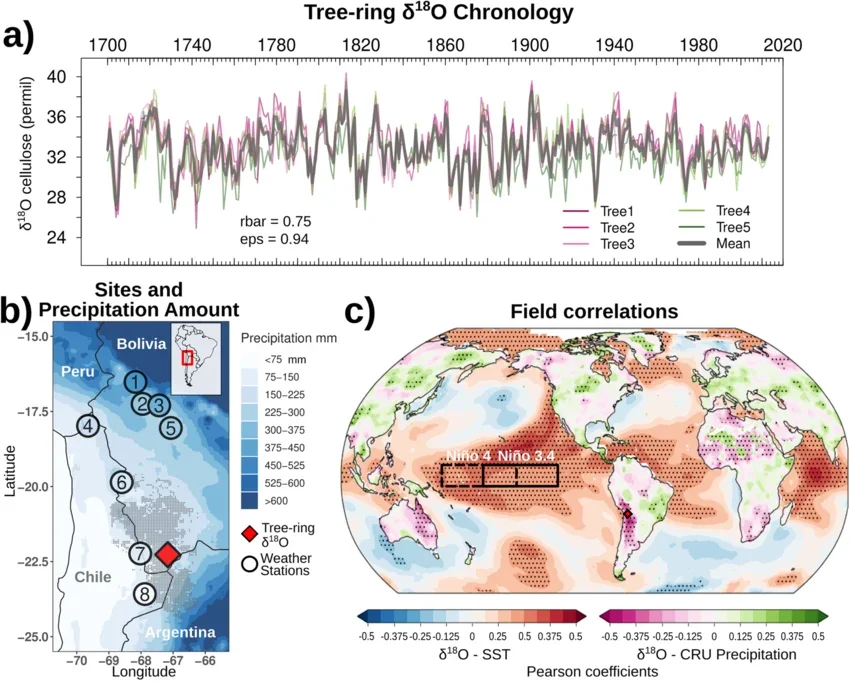
Archaeologists and environmental scientists therefore use natural archives to reconstruct earlier conditions. Tree rings are among the most valuable of these archives because many trees produce annual growth layers whose width, density, and chemical characteristics respond to environmental conditions.
When tree-ring records are compared with archaeological evidence from coastal settlements, researchers can investigate how environmental variability affected maritime communities. Changes in timber supply, harbor maintenance, settlement activity, and patterns of damage may sometimes be examined alongside reconstructed droughts, cold periods, or storms.
The phrase “ancient weather stations,” however, is potentially misleading. Tree-ring records do not demonstrate that ancient people operated formal meteorological stations. Instead, the research concerns the reconstruction of past weather and climate through natural evidence and the investigation of how people responded to it.
The Science of Tree-Ring Dating
Dendrochronology is the study of annual tree rings, especially for establishing the dates of wooden materials. In suitable species and environments, trees form recognizable growth rings each year. Variations in ring width and other properties can reflect changing environmental conditions.
By comparing ring sequences from different trees, researchers construct chronological patterns. A sequence from an archaeological beam may be matched against a regional reference chronology, potentially establishing when the tree was growing and, in favorable circumstances, when it was felled.
The distinction between tree growth and building construction is important. A beam may have been stored, reused, or incorporated into a structure years after the tree was cut. The date of the outermost preserved ring can therefore provide a felling estimate only when the relevant outer wood is present and the sample's history is understood.
Tree rings also provide environmental information. In some regions, growth responds strongly to rainfall; in others, temperature, soil moisture, competition, or other variables may be more influential. A narrow ring does not automatically indicate drought, and the relationship must be calibrated using suitable regional data.
Reconstructing Past Weather and Climate
Tree-ring research can reveal patterns in environmental conditions across decades or centuries. Depending on the species and location, researchers may reconstruct aspects of growing-season temperature, precipitation, drought severity, or other variables.
These reconstructions are not direct measurements of every weather event. A tree's growth integrates several environmental influences, and the signal may be stronger for some conditions than others. Researchers use statistical calibration and comparisons with instrumental records where available to evaluate the reliability of their models.
Climate and weather must also be distinguished. Climate describes longer-term patterns and variability, while weather refers to conditions over shorter periods. Tree rings commonly provide annual or seasonal information rather than a detailed record of individual storms.
Evidence for a specific storm may sometimes be investigated through damaged trees, sediment deposits, coastal erosion, or other geological indicators. Even then, establishing the date and intensity of a particular event can be difficult. Multiple independent records are essential when researchers attempt to connect an environmental episode to an archaeological change.
Coastal Settlements as Environmental Archives
Coastal settlements are particularly sensitive to environmental change because they depend on the relationship between land, sea, and transport. Harbors, landing places, fish-processing areas, and coastal roads can be affected by erosion, sediment accumulation, flooding, and changing shoreline conditions.
Archaeological wood from boats, buildings, harbor structures, and repairs may preserve tree-ring sequences. If the wood can be dated accurately, researchers can establish when timber was harvested and sometimes when construction or repair occurred.
These dates can then be compared with environmental records. For example, a cluster of repairs might coincide with evidence of coastal instability, but coincidence alone cannot establish that a storm or climate shift caused the work. Repairs may also reflect routine maintenance, economic growth, warfare, or changes in harbor use.
Sediment cores from nearby wetlands, estuaries, and lagoons can provide additional evidence. Changes in grain size, salinity, microfossils, and sediment composition may reveal shifts in coastal conditions. Such records can help determine whether a harbor became shallower, a shoreline migrated, or a waterway changed course.
Testing the Relationship Between Environment and Human Activity
A rigorous study begins by establishing independent chronologies for the tree-ring records and archaeological features. Researchers then compare their timelines and investigate whether the proposed environmental relationship is plausible.
The next step is to consider alternative explanations. If a coastal settlement declined during a period of environmental stress, researchers should also examine trade changes, political disruption, population movement, conflict, and shifts in local resources.
The spatial distribution of evidence matters as well. A regional drought may have affected inland agriculture differently from coastal fishing, while a storm could damage one harbor but leave another relatively protected. Local topography and settlement design can influence the severity of environmental effects.
Researchers can also compare several coastal sites rather than relying on one example. If independently dated settlements show similar responses to a well-supported environmental event, the argument for a broader relationship becomes stronger.
Were Ancient Communities Their Own Weather Forecasters?
People who lived close to the sea developed practical knowledge of winds, tides, seasonal patterns, cloud formations, and the behavior of local waters. Such knowledge could be essential for fishing, navigation, agriculture, and travel.
However, this expertise should not be confused with a formal weather station. An ancient community might have recognized seasonal warning signs or developed reliable rules of thumb without recording meteorological measurements in the modern scientific sense.
Archaeologists can investigate environmental knowledge indirectly through maritime technology, seasonal settlement patterns, written observations where available, and evidence of adaptation to recurring hazards. These sources may reveal how communities responded to their surroundings, but they do not necessarily document a standardized forecasting system.
The more defensible interpretation is that ancient people observed and responded to environmental patterns, while modern researchers use natural archives to reconstruct the conditions under which those decisions were made.
Conclusion: Reading Coastal History Through Living Archives
Tree-ring records and coastal archaeological sites can be powerful partners in reconstructing the environmental context of ancient life. Tree rings provide chronological and climatic information, while archaeological structures and sediment deposits reveal how coastal communities used and modified their surroundings.
Their correlation can identify possible relationships between environmental change and human activity, but it cannot establish causation without additional evidence. Tree-ring signals vary by region, archaeological dates have limitations, and coastal settlements change for many reasons.
The real achievement of this research is not the discovery of literal ancient weather stations. It is the creation of a more detailed history of human-environment relationships, one that combines natural archives with material evidence to explore how communities navigated a changing world.




