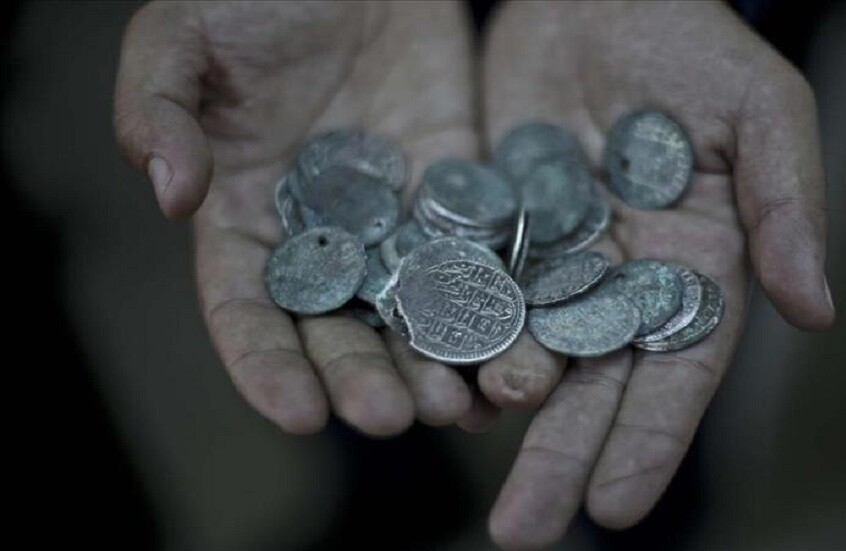
In Stary Ladoga, Russia’s Leningrad region, the City Museum announced the discovery of 23 silver coins dating to the Arab Caliphate period (697–816 CE) along the right bank of the Volkhov River.
The museum highlighted the scientific significance of the find, noting that Arab silver coins were key to international trade between the 8th and 11th centuries. This collection offers material evidence of robust trade activity along the Volga trade route, also known as the “route from the Varangians to the Arabs.”
The coins will become part of the museum’s holdings, contributing to research on monetary circulation, refining understanding of early medieval trade networks, and clarifying Stary Ladoga’s role in broader economic processes.
Stary Ladoga, one of Russia’s oldest settlements, founded no later than the mid-7th century, is historically significant as the first capital of ancient Rus, with around 160 historical monuments, including a fortress, churches, and monasteries.
In a separate Russian discovery, Culture Minister Olga Lyubimova announced the finding of ~20,000 silver coins hidden in a 17th-century merchant’s mansion in Moscow, described as one of the most important recent archaeological finds.
This discovery, alongside the Ladoga coins, underscores the vital role of early medieval trade and coin circulation in Russia.