• MAIN PAGE
  • LATEST NEWS
    • Lost Cities
    • Archaeology's Greatest Finds
    • Underwater Discoveries
    • Greatest Inventions
    • Studies
    • Blog
  • PHILOSOPHY
  • HISTORY
  • RELIGIONS
    • Africa
    • Anatolia
    • Arabian Peninsula
    • Balkan Region
    • China - East Asia
    • Europe
    • Eurasian Steppe
    • Levant
    • Mesopotamia
    • Oceania - SE Asia
    • Pre-Columbian Civilizations of America
    • Iranian Plateau - Central Asia
    • Indus Valley - South Asia
    • Japan
    • The Archaeologist Editor Group
    • Scientific Studies
    • Aegean Prehistory
    • Historical Period
    • Byzantine Middle Ages
    • Predynastic Period
    • Dynastic Period
    • Greco-Roman Egypt
  • Rome
  • PALEONTOLOGY
  • About us
Menu

The Archaeologist

  • MAIN PAGE
  • LATEST NEWS
  • DISCOVERIES
    • Lost Cities
    • Archaeology's Greatest Finds
    • Underwater Discoveries
    • Greatest Inventions
    • Studies
    • Blog
  • PHILOSOPHY
  • HISTORY
  • RELIGIONS
  • World Civilizations
    • Africa
    • Anatolia
    • Arabian Peninsula
    • Balkan Region
    • China - East Asia
    • Europe
    • Eurasian Steppe
    • Levant
    • Mesopotamia
    • Oceania - SE Asia
    • Pre-Columbian Civilizations of America
    • Iranian Plateau - Central Asia
    • Indus Valley - South Asia
    • Japan
    • The Archaeologist Editor Group
    • Scientific Studies
  • GREECE
    • Aegean Prehistory
    • Historical Period
    • Byzantine Middle Ages
  • Egypt
    • Predynastic Period
    • Dynastic Period
    • Greco-Roman Egypt
  • Rome
  • PALEONTOLOGY
  • About us

Rules of mysterious ancient board game decoded by AI, scientists say

February 12, 2026

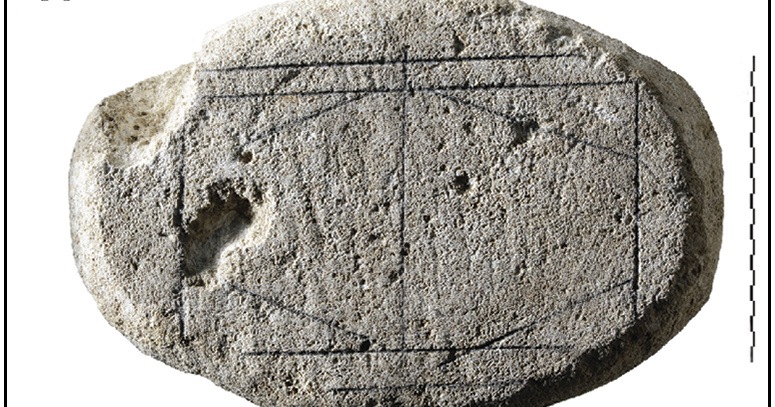
A polished white stone from the Roman period discovered in the Netherlands has puzzled experts for years. Now, researchers believe they have solved the mystery with the help of artificial intelligence: the object appears to be an ancient board game, and they have even proposed how it was played.

The circular limestone slab is marked with both straight and diagonal incised lines. Through 3D scans produced by the restoration studio Restaura, researchers observed that some lines were more deeply worn than others—evidence that pieces were likely slid along certain paths more frequently.

“We can see wear along the grooves exactly where a game piece would have moved,” said Walter Crist, an archaeologist at Leiden University who specializes in ancient games. “Combined with the stone’s overall appearance, this strongly indicates it functioned as a game board.”

To explore how the game may have worked, scholars at Maastricht University turned to an artificial intelligence program called Ludii, designed to reconstruct rules of ancient games. The AI was trained using the rules of around 100 historical games from the same broader region and time frame as the Roman artefact.

The system generated dozens of possible rule combinations and then simulated matches against itself, narrowing the results to versions that were both playable and engaging for humans. Researchers compared these rule sets with the wear patterns on the stone to determine which version best matched the physical evidence.

Still, Dennis Soemers of Maastricht University cautioned that AI results must be interpreted carefully. “If you give Ludii a pattern of lines like this, it will always produce a playable rule set,” he explained. “That doesn’t guarantee the Romans followed those exact rules.”

According to the team, the reconstructed game appears to have been a strategic contest in which players aimed to capture and trap their opponent’s pieces in as few moves as possible. The pieces themselves were likely made of glass, bone, or pottery.

The findings and proposed rules were published in the journal Antiquity, which also shared a video explaining the game. Karen Jeneson, curator of The Roman Museum in Heerlen, noted that researchers considered alternative explanations—such as decorative architectural use—but found none that matched the wear patterns. “The rules we identified align with the marks on the stone and with comparable games from the same cultural period,” she said. “All evidence points to it being a board game.”

In a related discovery, archaeologists in 2015 uncovered gaming pieces, including dice, at a Roman settlement in a German town along the Rhine River, further highlighting the popularity of board games in Roman society.
← Medieval Burial Sites in Denmark Show Illness Didn’t Erase Social StatusArchaeologists make incredible discovery near city of Nis in Serbia →
Featured
image_2026-02-12_195126516.png
Feb 12, 2026
Arab Silver Coins in Russia Highlight Medieval Trade Links
Feb 12, 2026
Read More →
Feb 12, 2026
image_2026-02-12_192509861.png
Feb 12, 2026
Appeal launched to keep Bronze Age treasure in Staffordshire
Feb 12, 2026
Read More →
Feb 12, 2026
image_2026-02-12_191010872.png
Feb 12, 2026
Discover Bucks Museum new exhibition brings Saxons to life
Feb 12, 2026
Read More →
Feb 12, 2026
image_2026-02-12_190843257.png
Feb 12, 2026
The surprising origins of Britain's Bronze Age immigrants revealed
Feb 12, 2026
Read More →
Feb 12, 2026
image_2026-02-12_185159206.png
Feb 12, 2026
Medieval Burial Sites in Denmark Show Illness Didn’t Erase Social Status
Feb 12, 2026
Read More →
Feb 12, 2026
image_2026-02-12_190759498.png
Feb 12, 2026
Rules of mysterious ancient board game decoded by AI, scientists say
Feb 12, 2026
Read More →
Feb 12, 2026
read more

Powered by The archaeologist