Introduction
Stretching across the dense, marshy convergence of the Katonga and Kakinga rivers in south-central Uganda, Bigo bya Mugenyi represents the grandest and most mysterious archaeological earthwork complex in all of sub-Saharan Africa. Translating literally from the local language as "The Forts of the Stranger," this monumental site encompasses a vast, labyrinthine network of interconnected concentric ditches and deep pits that cover an area of more than ten square kilometers. Radiocarbon dating places the primary construction and occupation of this massive complex squarely within the 14th and 15th centuries CE, a turbulent era traditionally associated in oral folklore with the semi-mythical Bachwezi dynasty—a race of divine, short-lived rulers credited with introducing long-horn cattle, iron metallurgy, and centralized kingship to the African Great Lakes region.
For over a century, the sheer scale of the Bigo ditches baffled researchers, leading to intense debates over whether the complex served as a massive military fortress designed to repel northern migrations or as a specialized, ultra-large scale cattle enclosure. The answer required advanced landscape archaeology and targeted micro-stratigraphic excavations of the deep pits.
Labyrinthine Earthworks and Ritual Cattle Economics
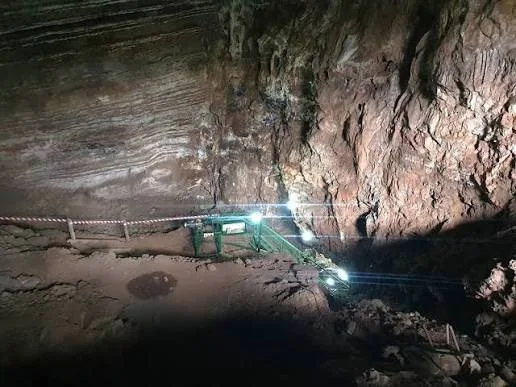
The physical scale of Bigo bya Mugenyi is unmatched in the region, featuring a complex dual-ring layout. The outer ditch network relies heavily on the natural defensive barriers of the surrounding river marshes, while the inner network features high, artificially constructed earth ramparts paired with deep trenches cut directly into the soil and underlying rock, measuring up to five meters deep and four meters wide. The construction required an immense expenditure of labor, pointing to a highly centralized authority capable of organizing thousands of workers across a highly complex, pre-planned landscape design.
The breakthrough in understanding the true function of Bigo came from systematic excavations centered on the inner enclosures, particularly the high artificial mounds known as the "royal courts." Rather than unearthing standard military barracks, archaeologists discovered a material culture heavily centered on pastoral wealth and elite ritual display. The excavations unearhed vast, deep refuse pits packed with tens of thousands of cattle bones, overwhelmingly belonging to the high-status, long-horned Ankole cattle breed.
Stable isotope analysis of these bones revealed that the herds were brought from diverse geographic regions across western and southern Uganda, proving that Bigo functioned as a massive, centralized collection hub for tribute livestock.
The absolute lack of permanent domestic stone architecture within the massive loops of the trenches suggests that the outer zones were designed to corral tens of thousands of cattle during periods of seasonal aggregation or political crisis, protecting the primary wealth of the state from regional raiders. Furthermore, the discovery of highly specialized, decorated roulette-impressed ceramics and ritual iron spearheads on the central mounds indicates that Bigo operated as a sacred, elite-controlled ceremonial center where regional rulers validated their political authority through large-scale feasting and the redistribution of livestock wealth, permanently anchoring the economic and spiritual blueprints of the interlacustrine kingdoms.
Conclusion
The spatial and multidisciplinary unmasking of Bigo bya Mugenyi fundamentally reorders our understanding of the rise of state societies in East Africa. It strips away the colonial myths of foreign origin, proving that the complex was the brilliant creation of an indigenous, highly organized African pastoralist superpower that successfully managed the natural riverine ecology to concentrate unprecedented economic wealth.
The monumental ditch networks and royal cattle pits stand as a permanent material record of the historical reality behind the Bachwezi oral traditions, showing that a highly centralized, prosperous civilization dominated the Ugandan landscape six centuries ago. Ultimately, Bigo bya Mugenyi remains an enduring symbol of early African engineering and political sophistication, proving that the roots of Great Lakes statecraft were forged through the masterful synthesis of landscape engineering and cattle economics.