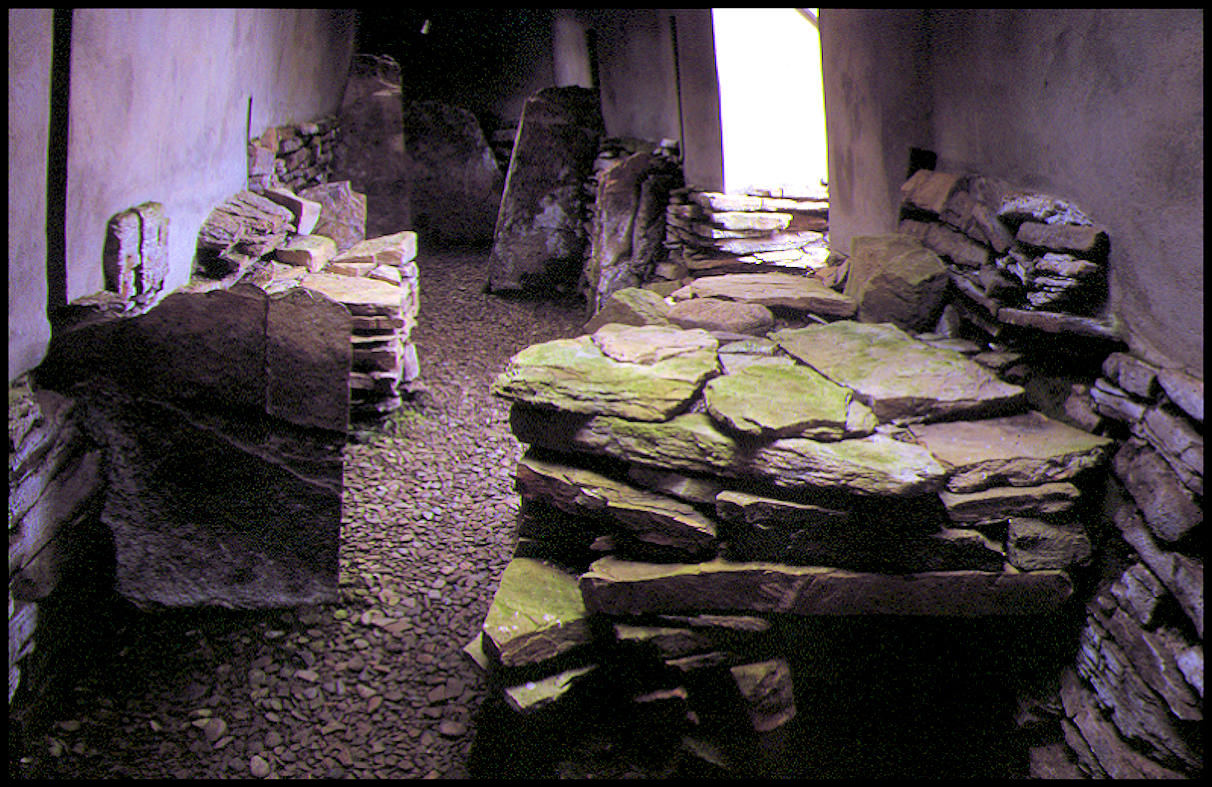
The Blackhammer Chambered Cairn is another remarkable Neolithic monument on Rousay.
It belongs to the rich funerary tradition of Orkney's chambered cairns and provides evidence for the sophisticated architectural techniques used by prehistoric communities to create permanent monuments for collective burial.
Its carefully constructed passage and chamber demonstrate how movement through a tomb could be deliberately controlled.
The Chambered Cairn Tradition
Across Neolithic Orkney, communities constructed different types of chambered tombs.
These included:
stalled cairns;
passage graves;
Maeshowe-type tombs;
and other local variations.
Blackhammer belongs to this diverse architectural tradition.
The Passage
The entrance passage creates a transition between the outside landscape and the enclosed burial chamber.
This arrangement may have had practical and symbolic functions.
Visitors had to move deliberately through the passage before reaching the interior.
The Burial Chamber
The chamber provided a controlled space for human remains.
Multiple individuals could be deposited within the monument over time.
This indicates that the tomb probably served a community rather than one individual.
Collective Ancestry
The use of a shared tomb suggests that the dead remained socially important after death.
Ancestors may have helped communities establish:
identity;
continuity;
lineage;
and connections to territory.
Construction
The monument's stone walls required careful planning.
Builders had to create stable structures capable of supporting the cairn above.
The engineering involved demonstrates considerable knowledge of:
stone weight;
balance;
pressure;
and structural stability.
Light and Darkness
Passage graves create a dramatic contrast between the bright outside world and the darker interior.
Although we cannot know whether this was deliberately symbolic, such architectural transitions may have influenced ritual experiences.
Farming and Settlement
The people who constructed Blackhammer were farmers.
They raised livestock and cultivated crops.
They also continued to exploit wild and marine resources.
Rousay's Prehistoric Population
The number of chambered cairns on Rousay indicates repeated occupation and substantial population during the Neolithic.
The island was clearly part of a wider cultural network.
Relationship With Other Monuments
Blackhammer can be studied alongside:
Midhowe;
Taversoe Tuick;
Knowe of Yarso;
and other Rousay monuments.
Comparing their architecture allows archaeologists to investigate changing funerary traditions.
Why Blackhammer Matters
Blackhammer provides evidence for:
collective burial;
ritual architecture;
stone engineering;
social organization;
and ancestral traditions.
Conclusion
Blackhammer Chambered Cairn demonstrates how Neolithic communities transformed stone and earth into carefully organized funerary spaces.
The passage and chamber created a controlled journey into the monument, while the collective burial tradition connected generations of people to one another.
Its survival helps reveal the complex social and ritual world of prehistoric Rousay.