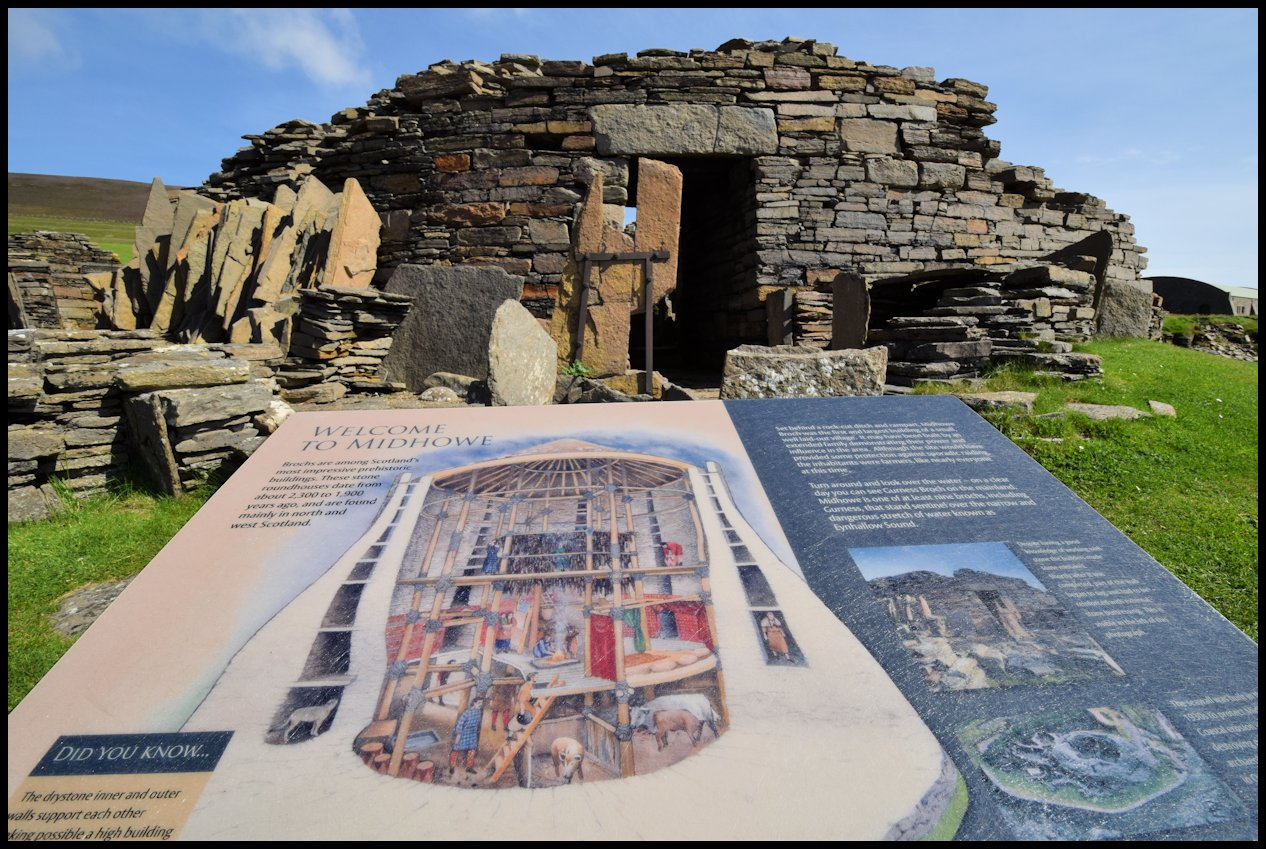
The Midhowe Chambered Cairn on the island of Rousay in Orkney is one of the most impressive prehistoric burial monuments in Scotland. Sometimes described as one of the longest and most elaborate stalled chambered cairns in Orkney, the monument provides exceptional evidence for Neolithic funerary architecture and the ways prehistoric communities organized relationships with their dead.
Located within a landscape containing numerous prehistoric monuments, Midhowe demonstrates that Rousay was an important center of Neolithic activity.
The Architecture of Midhowe
Midhowe is a long, stone-built chambered cairn.
Its internal chamber is divided by upright stone slabs, creating a series of compartments or “stalls.”
This architectural feature gives the monument its classification as a stalled cairn.
The structure originally had a substantial stone covering, creating a large cairn visible across the surrounding landscape.
A Monument Built for the Dead
Midhowe was a funerary monument rather than an ordinary dwelling.
The chamber was used for the deposition of human remains.
Multiple individuals were associated with the monument, demonstrating that it was probably used repeatedly rather than serving as the tomb of a single person.
Collective Burial
The presence of numerous human remains is important because it indicates a collective approach to burial.
Instead of each individual receiving a completely separate grave, members of a community could become part of a shared ancestral monument.
This may have reinforced ideas of:
family;
lineage;
community;
ancestry;
and territorial identity.
The Stalls
The internal upright stones divide the long chamber into separate spaces.
Archaeologists do not know exactly why these divisions were created.
They may have helped organize:
individual burial deposits;
different groups of remains;
ritual activities;
or movement through the monument.
The architecture therefore controlled how people interacted with the dead.
Construction
Building Midhowe required substantial labor.
Workers had to:
locate suitable stone;
quarry or extract it;
transport it;
build the chamber walls;
position the internal stalls;
construct the roof;
and cover the structure with a large cairn.
Such work could only have been accomplished through coordinated community activity.
Farming Communities
The people who built Midhowe lived during the Neolithic period.
They practiced agriculture and animal husbandry.
Their economy included:
cereal cultivation;
cattle keeping;
sheep and goat husbandry;
fishing;
shellfish collection;
and hunting.
The Sea Around Rousay
Rousay's island environment provided access to rich marine resources.
The surrounding waters could provide:
fish;
shellfish;
seabirds;
and marine mammals.
This complemented agricultural production.
A Monumental Landscape
Midhowe was not isolated.
Rousay contains a remarkable concentration of Neolithic chambered tombs.
These include:
Taversoe Tuick;
Knowe of Yarso;
Blackhammer;
and other monuments.
The density of monuments suggests that the island was a significant prehistoric cultural landscape.
Visibility
Large cairns were highly visible.
Their presence could mark important locations and establish connections between communities and the land.
A tomb could therefore function simultaneously as:
a burial place;
a landmark;
a ritual location;
and a symbol of ancestral ownership.
Why Midhowe Matters
Midhowe is particularly important because of its impressive length and internal organization.
It demonstrates that Neolithic builders were capable of creating complex architectural spaces for collective funerary activity.
Conclusion
Midhowe Chambered Cairn is one of Rousay's greatest prehistoric monuments.
Its long chamber, internal stone stalls, human remains, and monumental construction demonstrate that Neolithic communities possessed sophisticated architectural skills and strong traditions surrounding ancestry and death.
The monument is ultimately evidence not only of how people buried their dead, but of how they organized society, memory, and relationships with the landscape