
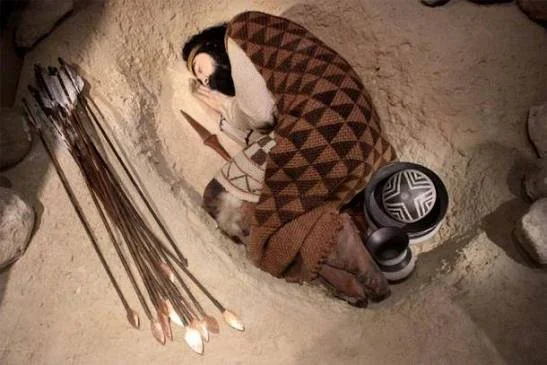
Exploring how burial locations, grave goods, and human remains can reveal movement, identity, and social relationships in Bronze Age landscapes.
Introduction: Burials Along Routes of Movement
The Bronze Age was a period of substantial variation across Europe, Asia, Africa, and other regions. Communities developed distinctive systems of metalworking, agriculture, settlement, exchange, and burial. In many areas, routes connecting settlements, grazing lands, water sources, and trading centers became important parts of everyday life.
Cemeteries located near routes of movement can offer a valuable perspective on these relationships. Their position may reflect practical considerations, territorial boundaries, social visibility, or the long-term use of a landscape. Yet the phrase “roadside cemetery” must be applied cautiously to prehistoric contexts because many modern roads did not exist during the Bronze Age.
A line of graves beside a present-day road might originally have been associated with a river crossing, a ridge route, a seasonal path, or a boundary. It may also have been located there for reasons unrelated to travel.
Archaeologists investigate these possibilities by reconstructing the ancient landscape and examining the burial practices, chronology, and biological histories of the individuals interred there.
Identifying Routes in Bronze Age Landscapes
Roads and paths are not always preserved as clear physical structures. Some may have followed natural corridors, including valleys, riverbanks, passes, and ridgelines. Others may have consisted of repeated tracks formed by people and animals rather than engineered surfaces.
Archaeologists use terrain analysis, remote sensing, excavation, and environmental reconstruction to identify plausible movement corridors. Depressions, worn surfaces, trackways, bridges, and associated settlement patterns can provide evidence of repeated travel.
However, the presence of a route near a cemetery does not prove that the cemetery was established to serve travelers. The graves may have been placed along a boundary, beside a settlement entrance, or near a landmark that was important for other reasons.
A strong interpretation requires chronological compatibility. Researchers must determine whether the route and cemetery were used during overlapping periods. A path visible in the landscape today may have developed after the burials were created.
Mortuary Variation and Social Identity
Bronze Age burials vary widely in form. Some individuals were buried in simple graves, while others received elaborate containers, stone structures, ornaments, weapons, tools, or other objects. Practices differed across regions and changed over time.
Archaeologists examine these differences to investigate social organization and identity. Grave goods may reflect age, gendered social expectations, occupation, status, ritual obligations, or the choices of surviving relatives.
Yet grave goods are not direct inventories of personal wealth. Objects may have been selected for symbolic reasons, and some valuable possessions might have been retained by the living rather than placed in graves. The absence of grave goods does not necessarily indicate poverty or low social status.
Variation within a cemetery can reveal whether people followed shared mortuary conventions or whether distinct burial traditions coexisted. Differences may also reflect changes across generations rather than social divisions among contemporaries.
The relationship between burial variation and mobility becomes particularly interesting when grave practices differ from those typical of nearby settlements. Such differences can suggest connections with other regions, but they must be evaluated against local chronological and cultural evidence.
Isotopes and the Movement of Individuals
Stable isotope analysis can help investigate where individuals spent parts of their lives. Strontium isotopes in tooth enamel reflect aspects of the geological environments from which people obtained food and water during tooth formation. Oxygen isotopes can provide additional information related to drinking water and environmental conditions.
Researchers compare these measurements with regional baselines to assess whether an individual's childhood environment was consistent with the location where they were buried.
The method has important limitations. Similar isotope values can occur in different regions, and geological or environmental variation within one region may be substantial. A result outside the local range can suggest movement without identifying a precise birthplace.
Different tissues record different periods of life. Tooth enamel generally reflects conditions during childhood, while bone can remodel and incorporate information from later years. Comparing them may help investigate whether a person moved during their lifetime, although preservation and individual biology affect interpretation.
Genetic evidence may add information about biological relationships and ancestry. However, ancestry, birthplace, language, and cultural identity are different questions. A person with genetic affinities to another region may have grown up locally or belonged to a family that had moved generations earlier.
Burial Locations and the Social Geography of Travel
Cemeteries beside routes may have occupied visible positions in the landscape. If this pattern is confirmed, researchers can investigate whether visibility served a social function, such as marking territory, maintaining collective memory, or connecting the dead with important movement corridors.
However, visibility alone does not establish intent. A cemetery may occupy a prominent location because the terrain offered suitable ground, because the area was already associated with settlement, or because the route developed around an earlier burial place.
Researchers can use geographic information systems to compare graves with viewsheds, slopes, water sources, settlement locations, and reconstructed routes. Such analysis can identify spatial relationships that are difficult to recognize through excavation alone.
The chronological sequence is essential. If the cemetery predates the route, the relationship may reflect later changes in movement. If the route was already in use, the placement of graves may have been more closely connected with the travel corridor.
Death, Movement, and Community Membership
Mobility did not necessarily weaken a person's relationship with a community. Travelers, craftspeople, pastoralists, traders, and people who moved through marriage or family connections could participate in several social networks during their lives.
Burial practices may reveal how communities incorporated people with different backgrounds. An individual who grew up elsewhere but received a local burial might have been accepted into the community through family ties, residence, or social obligations.
Conversely, distinctive burial treatment could indicate that a person was regarded as different from others in the cemetery. Yet such interpretations are difficult to establish from grave goods alone. Researchers need to consider biological evidence, chronology, and patterns across multiple burials.
The archaeological record is therefore unlikely to provide a simple distinction between local people and outsiders. Mobility was often gradual, repeated, and socially complex.
Conclusion: Cemeteries as Records of Movement and Belonging
Bronze Age cemeteries associated with routes of movement can illuminate the relationship between travel, landscape, and social identity. Burial location, mortuary variation, isotope analysis, and genetics can help researchers investigate where people lived and how communities responded to mobility.
The evidence must be interpreted carefully. A cemetery near a modern road is not automatically a roadside burial ground in the prehistoric sense, and an individual's non-local isotope signature does not by itself establish their social identity.
By reconstructing ancient routes and combining burial analysis with scientific evidence, archaeologists can explore how Bronze Age communities understood belonging, movement, and remembrance. Cemeteries become more than collections of graves: they become records of how people and places were connected across a changing landscape.




