
Introduction
Wood is an extremely valuable archaeological material because it can preserve information about construction, technology, transportation, and environmental change.
Unfortunately, wood usually decomposes rapidly.
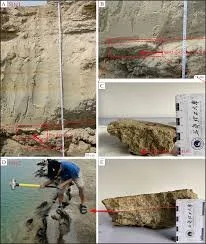
In coastal and mineral-rich environments, however, carbonate deposits can sometimes form on or around buried wood.
These mineral crusts raise an important scientific possibility: can carbonate formation provide chronological information about archaeological wooden structures?
The answer is potentially useful but requires careful geological and archaeological analysis.
What Are Carbonate Crusts?
Carbonates are minerals containing carbonate ions.
Calcium carbonate is especially common in natural deposits.
It can precipitate from groundwater or marine-influenced environments under suitable chemical conditions.
A crust may form on an exposed or buried surface over time.
Coastal Archaeological Wood
Coastal environments can preserve wooden structures under waterlogged conditions.
Examples include:
boats
piers
piles
fish traps
wells
waterfront structures
Waterlogging can slow decomposition by limiting oxygen.
Mineral-rich water can also interact with the wood and surrounding sediment.
Why Dating Is Difficult
A carbonate crust does not automatically provide the age of the wood.
The mineral may have formed long after the wood was deposited.
It may also have formed before the wood was incorporated into an archaeological structure.
Therefore, researchers must distinguish the age of the wood from the age of the carbonate.
Radiocarbon Dating
Radiocarbon dating can sometimes date organic wood directly.
Carbonate materials can also contain carbon, but the source of that carbon must be understood.
Marine and freshwater reservoir effects can produce dates that appear older than the actual formation event.
This is a major concern in coastal archaeology.
Stable Isotopes
Stable carbon and oxygen isotopes can help researchers investigate carbonate formation.
These signatures may provide information about the water from which the mineral precipitated.
If the environmental conditions are understood, the crust may contribute to reconstructing the history of the site.
Layered Mineral Growth
In some circumstances, carbonate crusts may develop sequentially.
Different layers could theoretically record environmental changes.
Microscopic analysis can reveal growth structures.
However, this requires careful calibration.
A crust is not automatically a geological clock.
Coastal Environmental Change
Mineral deposits may also preserve evidence of changing water conditions.
Changes in salinity, temperature, freshwater input, and groundwater movement can influence carbonate formation.
Consequently, carbonate associated with archaeological wood may provide environmental as well as chronological information.
Combining Methods
The strongest approach combines:
radiocarbon dating
dendrochronology where possible
microscopy
stable isotope analysis
sedimentology
mineralogical identification
stratigraphic analysis
Agreement between independent methods greatly strengthens interpretation.
Conservation Challenges
Wood recovered from waterlogged environments can deteriorate rapidly once exposed.
Carbonate deposits may sometimes protect portions of an artifact, but removing them can damage the wood.
Conservation therefore requires careful documentation before treatment.
Conclusion
Carbonate crusts associated with coastal archaeological wood offer an intriguing scientific research avenue.
They should not be treated as direct chronological indicators without environmental and geochemical calibration.
When combined with direct dating and sediment analysis, however, carbonate deposits may help reconstruct the formation history and environmental context of ancient wooden structures.





