
Introduction
The medieval Arctic was not an isolated wilderness.
Indigenous communities developed sophisticated systems for hunting, fishing, transportation, and seasonal settlement long before European expansion.
During the medieval period, Norse communities also occupied parts of the North Atlantic and Arctic world, particularly Greenland and Iceland.
The intersection of Norse and Indigenous economies created complex patterns of interaction.
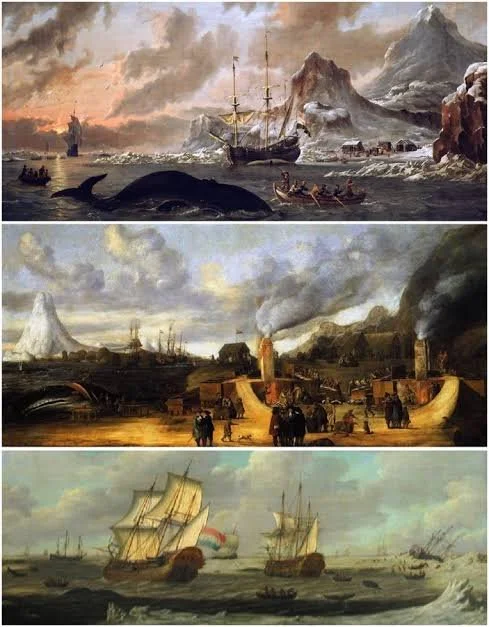
Whaling is especially important because marine mammals were valuable sources of food, oil, bone, and other materials.
Arctic Whaling
Whales provided enormous quantities of biological resources.
Their meat could supplement diets.
Blubber provided oil.
Bones could be used for tools and construction.
Large baleen plates could become valuable raw materials.
Whaling therefore had economic importance far beyond food.
Indigenous Whaling Traditions
Arctic Indigenous peoples developed specialized knowledge of marine environments.
Different communities used different technologies depending on local whale species, sea conditions, boats, weapons, and seasonal patterns.
Whaling required extensive environmental knowledge.
The behavior of whales, sea ice, currents, weather, and coastal geography all influenced hunting success.
Norse Greenland
Norse settlers established communities in Greenland during the medieval period.
Their economy included livestock farming, hunting, fishing, and trade.
Marine resources were increasingly important because agriculture was constrained by the Arctic environment.
Whale products could therefore have been valuable to Norse communities.
Archaeological Evidence
Archaeologists can identify whaling through:
whale bones
cut marks
butchery patterns
hunting equipment
processing areas
settlement refuse
trade objects
Species identification can reveal which whales were exploited.
The spatial distribution of remains can also indicate where carcasses were processed.
Interaction Rather Than Isolation
Norse and Indigenous communities may have interacted through trade, shared landscapes, competition, or indirect exchange.
Archaeological evidence must be interpreted carefully.
An Indigenous artifact at a Norse settlement does not automatically prove direct personal contact.
Likewise, Norse objects in Indigenous contexts may have arrived through several stages of exchange.
Trade in Whale Products
Whale bone and other marine products could travel considerable distances.
Some whale products found in medieval European contexts may have originated far from where the objects were ultimately used.
This creates a large-scale research question: how did Arctic marine resources enter wider European economies?
Genetic and Isotopic Research
Modern scientific methods can identify species and investigate animal movement.
Isotopic analysis may provide clues about marine environments.
Zooarchaeological analysis can distinguish whale species and reconstruct butchery.
These methods allow researchers to move beyond simply counting bones.
Climate and Sea Ice
Medieval Arctic economies were closely connected to climate.
Sea-ice conditions affected transportation and animal migration.
Climate shifts could therefore influence settlement viability and hunting opportunities.
The archaeological record provides a long-term perspective on these environmental relationships.
Conclusion
Medieval Arctic whaling was part of a complex economic world involving Indigenous expertise, Norse settlement, marine resources, and long-distance exchange.
Rather than portraying the Arctic as a remote boundary of European history, archaeology reveals a dynamic region shaped by Indigenous societies and international connections.





