
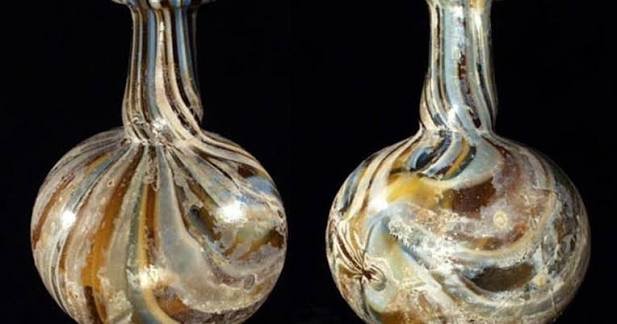
Natural glass, ancient craftsmanship, and the challenge of distinguishing local production from long-distance exchange.
Glass in the Desert Landscape
Natural glass can form when intense heat melts mineral material and the molten substance cools rapidly. In certain desert environments, naturally occurring glass can appear as unusual fragments or larger pieces scattered across the landscape.
Such materials can attract archaeological interest because their appearance may resemble manufactured glass. Yet natural glass and human-made glass have different formation histories, and their distinction is essential when investigating ancient technology.
The title's reference to desert glass workshops connected with Mesopotamian trade raises two separate questions: whether a particular site was used for manufacturing glass objects, and whether its products participated in exchange networks linking desert regions with Mesopotamia.
Neither claim can be established from the presence of glass alone. Researchers must identify the material, determine how it was worked, and establish the archaeological context in which it was found.
Natural Glass and Manufactured Glass
Natural glass forms through geological processes, while manufactured glass results from human-controlled heating and the combination of suitable raw materials. The two can sometimes look similar, especially when fragments are weathered or broken.
Researchers distinguish them by examining composition, structure, inclusions, surface features, and other characteristics. Natural desert glass may preserve features associated with rapid melting and cooling, while manufactured glass can contain chemical signatures related to its ingredients and production methods.
However, no single visual characteristic is always decisive. Weathering can alter surfaces, and fragments may be difficult to classify without laboratory analysis.
A fragment of natural glass could have been collected and used as a tool or decorative material, but that would not make the location where it was found a glassmaking workshop.
What an Ancient Glass Workshop Would Look Like
Glass production can leave a range of archaeological traces, including furnace remains, vitrified materials, crucibles, glass droplets, production waste, and fragments showing evidence of deliberate shaping.
The exact evidence depends on the technology and the scale of production. A workshop producing raw glass would leave different remains from a location where artisans shaped imported glass into vessels or ornaments.
Researchers must also distinguish between primary production and secondary working. A site might have used glass imported from another region without manufacturing the glass itself.
The presence of finished objects alone is insufficient to establish local production. Stronger evidence comes from the combination of production debris, tools, installations, and securely dated occupation layers.
Mesopotamia and Long-Distance Exchange
Mesopotamia was an important center of urban life, craft production, administration, and exchange across different periods of ancient history. Its communities participated in networks through which raw materials, finished objects, and technical knowledge circulated.
Glass objects and related materials moved through parts of the ancient Near East, but the pattern of exchange varied over time. Different political systems and commercial routes shaped which goods were available and how they were distributed.
An object found in Mesopotamia might have been produced locally, imported directly, or passed through several intermediaries. Its presence does not automatically identify the place where the raw material originated.
Researchers examine chemical composition, manufacturing techniques, inscriptions, and archaeological context to investigate these possibilities.
How Glass Provenance Is Studied
Chemical analysis can identify the major and minor elements within a glass sample. Researchers compare these patterns with known production traditions and reference materials to investigate possible origins.
The interpretation is not always straightforward. Different workshops may use similar raw materials, and recycled glass can combine material from multiple sources. A single object may therefore preserve evidence of several stages of production and reuse.
Researchers also examine the object's form and manufacturing traces. These may help establish whether it was cast, molded, drawn, or shaped using another technique.
Provenance studies are strongest when chemical data are combined with archaeological context and comparisons with securely identified workshop remains.
Trade Routes and the Movement of Technology
Trade involved more than the transport of finished goods. Merchants and travelers could also transmit knowledge about materials, techniques, and production methods.
A workshop located far from a major urban center might still participate in a wider network through regional exchange. Raw materials could be carried to artisans, while finished products moved toward settlements with greater demand.
However, the existence of a trade route does not prove that every settlement along it produced or exchanged glass. Researchers must establish the relationship between a particular site and the wider network through material evidence.
The Chronology Problem
The term desert glass can refer to naturally occurring glass, but the historical date of a workshop must be established independently. A natural glass formation may be extremely old, while tools or structures found nearby could belong to much later human activity.
A site may also have been used repeatedly. Glass fragments from different periods can accumulate in the same area, especially where people collected raw material or reused an older settlement.
Archaeologists must therefore separate the geological history of the glass from the chronology of human activity.
What a Confirmed Workshop Could Reveal
A securely identified workshop could illuminate ancient craft specialization, the use of local materials, and the relationship between production and trade. If its products can be connected to objects found in Mesopotamian settlements, researchers could investigate the scale and direction of exchange.
The specific desert glass workshop sites described in the title remain unverified. Their existence and connection with Mesopotamian trade would require documented locations, production evidence, reliable dating, and comparative material analysis.
The broader subject demonstrates why archaeological interpretation must distinguish between a raw material's natural origin, its later human use, and the commercial networks through which finished objects circulated.




