
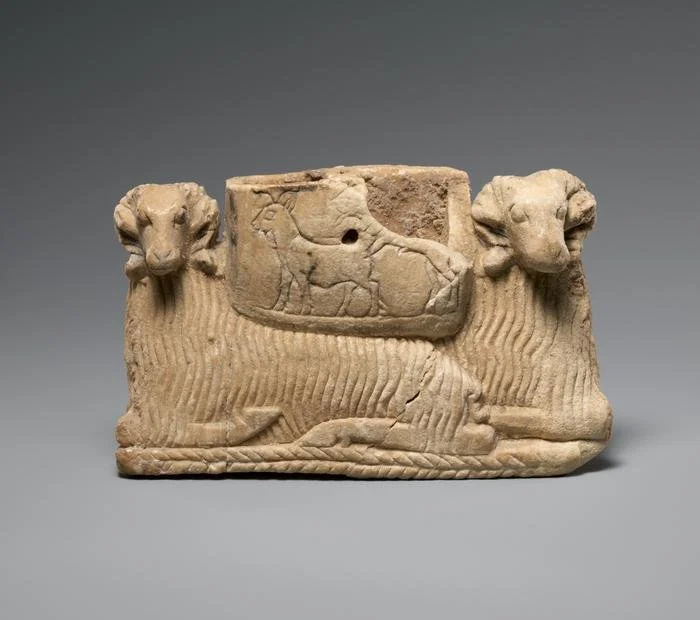
Ancient genomes, livestock movement, and the role of domesticated animals in human migration and commerce.
Animals as Participants in Human History
Sheep and goats have played important roles in human societies for thousands of years. They provided meat, milk, hides, wool, and other resources, while also serving as forms of wealth and valuable assets that could be exchanged between communities.
Unlike many objects traded in antiquity, livestock were living commodities. Moving animals required access to water, grazing, and suitable routes, while their survival depended on climate, disease, and the availability of food. Herds could travel with migrating communities, be driven to markets, or be transferred between owners as gifts, tribute, or commercial goods.
These movements connected animal populations across wide geographical areas. Genetic evidence can help researchers investigate how livestock lineages changed as animals moved between regions and how human activity shaped their distribution.
However, the DNA of an ancient sheep or goat does not automatically reveal a specific trade route. Researchers must combine genetic results with archaeological context, chronology, and evidence about the movement of people and goods.
Domestication and the Expansion of Herding
Sheep and goats were domesticated in parts of southwestern Asia during the early development of agriculture, although the precise histories of the two species differ. Their domestication was a gradual process involving changes in animal behavior, breeding, and the relationship between herds and human communities.
As agricultural societies expanded, livestock became important in new regions. Animals could be moved alongside migrating farmers, exchanged between neighboring communities, or introduced through trade and political relationships.
The spread of livestock did not necessarily occur through a single migration. Different populations could contribute animals to local herds over time, producing complex patterns of ancestry and adaptation.
Archaeological evidence such as animal bones, herd age profiles, and settlement remains can help reconstruct livestock management. Genetic evidence adds another layer by revealing relationships among animal populations that may not be obvious from their physical remains.
What Ancient DNA Can Reveal
Ancient DNA is genetic material recovered from archaeological remains. When preservation is suitable, researchers can analyze fragments of DNA from bones, teeth, and other biological materials.
The resulting data can help identify relationships among animals, estimate genetic diversity, and compare ancient populations with one another and with modern livestock. Researchers may investigate whether a particular population was closely related to animals from another region or whether its genetic composition changed over time.
Ancient DNA can also reveal that animals once thought to belong to a single continuous population had more complicated histories involving migration, interbreeding, or replacement.
Yet genetic relationships are not the same as direct evidence of trade. Two animal populations may share ancestry because they descended from an earlier population rather than because animals moved directly between the two regions during the period under study.
Sheep, Goats, and the Archaeology of Herd Management
Animal bones provide important evidence about how people raised and used livestock. Researchers examine the species represented, the ages at which animals were slaughtered, and patterns of bone damage associated with butchery.
These patterns can suggest whether a herd was managed primarily for meat, milk, wool, breeding, or a combination of purposes. For example, keeping animals alive into adulthood may be consistent with obtaining products over a longer period, although the interpretation depends on species and local practice.
The distribution of bones across settlements can also reveal differences between household consumption, specialized production, and commercial activity.
Genetic data can complement these findings. If a settlement contains animals with ancestry associated with a distant region, researchers can investigate whether the pattern reflects trade, migration, breeding practices, or another process.
How Livestock Moved Across Continents
The phrase across continents captures the broad reach of animal movement, but livestock did not travel through a single continuous network. Different regions were connected through migration, pastoral routes, markets, imperial administration, and maritime exchange.
Sheep and goats could be moved overland with herders, transported by ship, or transferred through a series of local exchanges. The routes depended on terrain, political boundaries, water supplies, and the needs of the animals.
The same animal population could also change through interbreeding with local herds. Over generations, this process might create a genetic pattern that reflects multiple movements rather than a single introduction.
Researchers therefore reconstruct livestock movement as a dynamic process involving both geography and biology.
The Science of Ancient DNA Analysis
Ancient DNA is often highly fragmented and can be contaminated by modern biological material. Researchers work in specialized facilities and use laboratory procedures designed to reduce contamination and identify patterns consistent with ancient DNA preservation.
The analysis may focus on mitochondrial DNA, which is inherited through the maternal line, or on nuclear DNA, which contains information from both parental lineages. Each type of data answers different questions.
Mitochondrial DNA can help trace maternal ancestry, but it provides only one part of an animal's genetic history. Nuclear DNA offers a broader view of ancestry and relationships, although it often requires more genetic material and more extensive analysis.
The interpretation also depends on the quality and size of the sample. A single animal may provide valuable information, but broad conclusions about a regional trade network generally require multiple specimens from well-dated sites.
Genetic Evidence and the Problem of Trade Routes
If ancient sheep from two distant sites share a close genetic relationship, researchers may investigate whether their movement was connected to trade. However, other explanations must be considered.
Both populations could descend from an earlier shared source. Animals may have moved through migration rather than commercial exchange, or their genes may have spread through breeding without the entire herd moving over long distances.
Archaeological context helps distinguish these possibilities. Researchers compare genetic patterns with the dates of the sites, animal remains, settlement histories, and evidence of contact between communities.
A genetic result is most informative when it can be connected to a specific historical process rather than simply mapped onto a modern geography.
Climate, Adaptation, and Changing Herds
Livestock movement was influenced by climate and ecology. Different breeds and populations developed traits suited to local environments, although the relationship between genetic variation and adaptation is complex.
As animals entered new regions, they could interbreed with existing herds or undergo selection for traits favored by local conditions. Changes in livestock genetics may therefore reflect both human choices and environmental pressures.
Researchers can investigate these changes by comparing ancient genomes across time. Such studies may reveal when particular lineages appeared, how genetic diversity changed, and whether later populations descended from earlier local herds or included substantial contributions from newcomers.
Reconstructing the History of Animal Exchange
Ancient DNA provides a powerful way to investigate the movement of sheep and goats, but it cannot independently reconstruct every transaction or route. Genetic data must be interpreted alongside animal bones, archaeological chronology, environmental evidence, and the broader history of human settlement.
The specific trade routes implied by the title would need to be established through research on identifiable animal remains and securely dated sites. No single genetic pattern should be presented as proof of a particular trade journey without supporting evidence.
The wider significance is clear: livestock were not merely resources consumed by ancient societies. They were living connections between communities, environments, and economies. Studying their genetic histories can help reconstruct how people moved animals, exchanged knowledge, adapted herds, and built relationships across vast distances.




