
Introduction
The Arabian Peninsula occupies a strategic position between the eastern Mediterranean, Mesopotamia, the Persian Gulf, the Red Sea, and the Indian Ocean. Throughout antiquity, its landscapes supported diverse communities engaged in trade, pastoralism, agriculture, mining, craft production, and transportation.
The study of desert glass workshops and Bronze Age trade routes offers an opportunity to investigate the relationship between unusual geological materials, craft production, technological experimentation, and long-distance exchange.
The specific workshops described in this title are not verified as archaeological discoveries. The article explores the possible archaeological significance of glass-related materials and manufacturing activity in Arabia while distinguishing natural desert glass from intentionally produced glass.
Desert Glass and Its Geological Origins
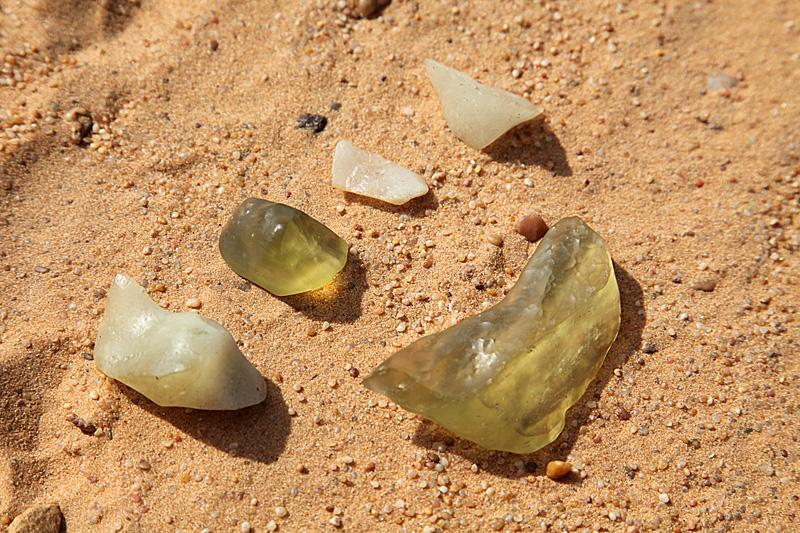
Natural desert glass is a glass-like material formed through geological processes. One well-known example is Libyan Desert Glass, found in parts of the eastern Sahara. Its origin has been associated with an extremely high-temperature event, although the precise formation mechanisms and details have been subjects of scientific investigation.
Natural glass can also occur in volcanic environments, where molten material cools rapidly and forms glassy structures.
These materials differ from manufactured glass, which is produced through controlled technological processes involving raw materials, heating, and chemical composition.
The distinction is important because the presence of natural glass in an archaeological landscape does not necessarily indicate a glass workshop.
Glass Technology during the Bronze Age
Glass production and glassworking developed within complex technological traditions in the ancient Near East and eastern Mediterranean.
Early glass was often used to create beads, small decorative objects, inlays, vessels, and other products.
The production of glass required specialized knowledge of raw materials, heating conditions, and manufacturing techniques.
Ancient glassmakers worked with combinations of silica-rich materials, fluxes, and other ingredients. Fluxes lowered the temperature required to produce a workable glass. The composition of glass could vary according to the materials used and the technological tradition.
Glassworking could involve melting raw glass, shaping it, forming beads, applying decorative elements, and reheating objects.
The archaeological evidence for glass production may include furnaces, crucibles, glass waste, unfinished objects, raw glass fragments, and manufacturing tools.
Natural Glass and Craft Experimentation
Natural glass may have attracted ancient communities because of its distinctive appearance, texture, and physical properties.
Depending on the type of glass, it could be used for cutting, decorative purposes, or other forms of material exploitation.
Researchers may investigate whether natural glass was collected, transported, modified, or incorporated into objects.
However, identifying a workshop requires evidence of deliberate production or processing. A concentration of natural glass fragments alone does not establish that a glassmaking workshop existed.
Archaeologists would need to examine the material's composition, surface modifications, manufacturing traces, spatial distribution, and association with other artifacts.
Arabian Trade Routes during the Bronze Age
Arabia was connected to broader trade and transportation systems through land routes, coastal navigation, and maritime exchange.
Trade networks linked communities across the Arabian Peninsula with neighboring regions, including Mesopotamia, the Gulf, the Levant, and areas farther east.
The movement of commodities depended on environmental conditions, transportation technology, political relationships, and access to resources.
Trade goods could include metals, textiles, agricultural products, incense-related materials, stones, ceramics, and other commodities.
The archaeological study of exchange often relies on identifying materials that originated in different regions.
Chemical and mineralogical analyses may help determine the source of raw materials, although provenance studies require appropriate reference samples and reliable analytical methods.
Workshop Archaeology and Production Evidence
A hypothetical desert glass workshop could be investigated through the spatial distribution of materials and production remains.
Researchers might examine:
Raw glass or naturally occurring glass.
Glass fragments.
Unfinished objects.
Furnace remains.
Crucibles.
Heating residues.
Tools.
Waste materials.
Associated ceramics.
Evidence of repeated production.
The presence of heating structures and glass residues could support an interpretation of glassworking activity, but researchers would still need to distinguish primary glass production from secondary glassworking.
Primary production involves manufacturing glass from raw ingredients, while secondary glassworking involves shaping or processing already manufactured glass.
These activities can leave different archaeological signatures.
Chemical Analysis and Material Provenance
Chemical analysis can help investigate the composition and origin of glass.
Researchers may use techniques such as X-ray fluorescence, electron microscopy, or other analytical methods to identify elements and compare glass samples.
The composition may provide clues about the materials used and possible production traditions.
Comparisons between glass objects from Arabian archaeological sites and materials from neighboring regions could contribute to research on trade and technological exchange.
However, chemical similarity does not automatically prove direct trade between two locations. Materials may have moved through multiple intermediaries, and similar recipes could be used in different workshops.
Trade, Technology, and Cultural Exchange
The study of glass-related materials in Arabia could help investigate how technological knowledge moved across regions.
Trade did not only involve the movement of finished goods. It could also involve the exchange of raw materials, skills, production techniques, ideas, and cultural practices.
Craft technologies may spread through migration, apprenticeship, commercial interaction, political relationships, or the movement of specialist workers.
A workshop associated with imported materials might reveal connections to broader exchange networks, while locally produced objects could demonstrate adaptation of foreign technologies to regional traditions.
Archaeological research must distinguish between the movement of objects and the movement of technological knowledge, as these processes do not necessarily occur together.
Environmental Conditions and Desert Archaeology
Desert environments may preserve archaeological materials under certain conditions, but they can also expose sites to erosion, wind deflation, shifting dunes, extreme temperatures, and disturbance.
Workshop remains may be partially buried or scattered across broad landscapes.
Survey methods may include remote sensing, surface collection, geophysical investigation, and targeted excavation.
The archaeological study of desert production sites requires careful documentation because spatial relationships between materials may be essential to understanding activity areas.
Conclusion
Desert glass workshops and Bronze Age trade routes in Arabia represent an important research theme connecting geology, technology, archaeology, and economic history.
The investigation of natural glass, manufactured glass, workshop remains, and regional trade could help explain how communities exploited unusual materials and participated in wider exchange networks.
By combining archaeological fieldwork, chemical analysis, geological research, and comparative studies, researchers could examine the development of craft technologies and the movement of materials across ancient Arabia.





