
Introduction
Rock art represents one of the most enduring forms of visual communication in human history. Across different regions of the world, prehistoric communities created engravings and paintings on rock surfaces, depicting animals, human figures, geometric forms, tracks, and abstract symbols. These images may have served ritual, social, educational, territorial, or symbolic purposes, although their meanings are often difficult to determine.
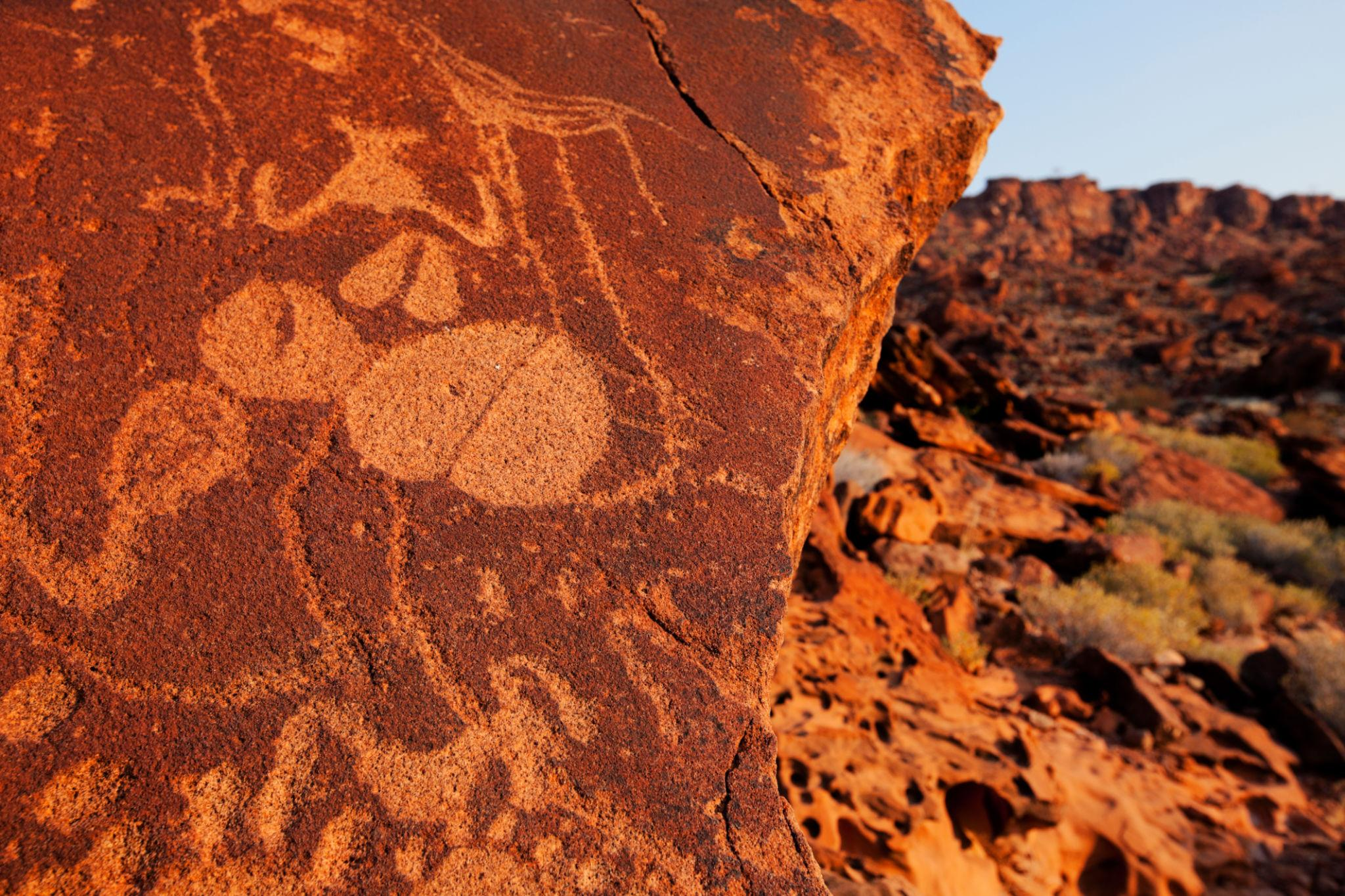
Namibia contains important rock-art landscapes, including the engravings of Twyfelfontein, a UNESCO World Heritage Site known for its extensive collection of prehistoric rock engravings. The study of petroglyph portfolios, particularly when images occur in sequences across neighboring panels, offers an opportunity to examine whether rock art may have conveyed narratives, organized information, or relationships between visual elements.
The term portfolio in this context refers to a collection of rock-art panels studied together rather than as isolated images. The specific sequential panels discussed here are not identified as a verified archaeological discovery.
Namibia's Rock-Art Landscape
Namibia's archaeological landscape includes engravings and paintings associated with prehistoric hunter-gatherer communities and other cultural traditions.
Rock engravings may depict animals such as giraffes, elephants, antelope, rhinoceroses, and other species associated with the surrounding environment. Some images include tracks, human figures, or abstract markings.
The production of petroglyphs involved selecting suitable rock surfaces, preparing or modifying them, and creating images through repeated striking, scraping, or other engraving techniques.
The location of rock art may also be significant. Panels can occur near water sources, routes through the landscape, shelters, or distinctive geological formations.
The relationship between image, location, and environment is therefore an important part of archaeological interpretation.
Sequential Panels and Visual Organization
Rock-art panels are often studied individually, but their arrangement across a landscape may provide additional information.
A group of images located along a rock face, across several boulders, or within a confined shelter may have been created as part of a broader visual arrangement.
Researchers could examine whether the images share stylistic characteristics, orientations, subject matter, or relationships that suggest they were intended to be viewed together.
Sequential organization might involve repeated animal figures, changes in image size, movement across surfaces, or visual relationships between neighboring engravings.
However, spatial arrangement alone does not prove that the panels were designed as a narrative.
The images may have been created at different times by different people. Some panels may represent independent activities, while others may have been modified or reused over generations.
Rock Art as Narrative
Narrative in rock art does not necessarily resemble written storytelling.
Visual sequences may communicate ideas through repeated imagery, spatial relationships, symbolic associations, or culturally understood conventions.
For example, a group of animal images might represent species associated with particular ecological or ritual meanings. Repeated tracks may relate to movement, hunting, or symbolic representation. Human and animal figures appearing together could reflect social, ritual, or mythological associations.
Researchers must avoid assigning a specific narrative without evidence.
The interpretation of rock art often relies on contextual analysis, ethnographic comparison, archaeological evidence, and careful consideration of alternative explanations.
Digital Documentation of Petroglyph Portfolios
Modern recording methods can improve the documentation of rock-art panels.
Photogrammetry, three-dimensional scanning, high-resolution photography, digital tracing, and GIS mapping may be used to record individual images and their relationships.
Digital models allow researchers to examine engravings under different lighting conditions and compare panels without repeatedly visiting fragile surfaces.
A portfolio-based recording system could include:
Panel location and orientation.
Rock surface characteristics.
Image dimensions.
Engraving techniques.
Subject identification.
Overlapping images.
Possible chronological relationships.
Spatial relationships between panels.
Condition and preservation status.
This approach may help researchers investigate whether visual sequences were created intentionally or developed gradually through repeated visits.
Dating and Cultural Interpretation
Dating rock engravings is often challenging because the images may lack associated organic materials suitable for radiocarbon dating.
Researchers may investigate weathering, patination, superimposition, archaeological context, stylistic comparison, and other evidence.
The relative sequence of engravings may be established where one image clearly overlaps another, although the chronology may remain incomplete.
Ethnographic research may provide insight into the possible significance of animal imagery and ritual landscapes. However, contemporary cultural traditions cannot automatically be used to explain prehistoric images without establishing historical relationships.
Conservation and Cultural Heritage
Rock-art panels are vulnerable to weathering, erosion, vandalism, tourism pressure, and environmental changes.
Digital documentation can support monitoring and conservation planning.
Researchers may record cracks, surface loss, changes in patination, biological growth, and damage caused by visitors.
The preservation of rock art also requires respect for local communities and cultural heritage authorities. Some sites may hold cultural or spiritual significance beyond their archaeological value.
Conclusion
The study of sequential petroglyph panels in Namibia offers a promising way to investigate visual organization, cultural expression, landscape use, and possible narrative structures in prehistoric rock art.
By examining groups of panels rather than isolated images, researchers may identify patterns that contribute to a broader understanding of how prehistoric communities used imagery to communicate, remember, and interact with their environments.





