
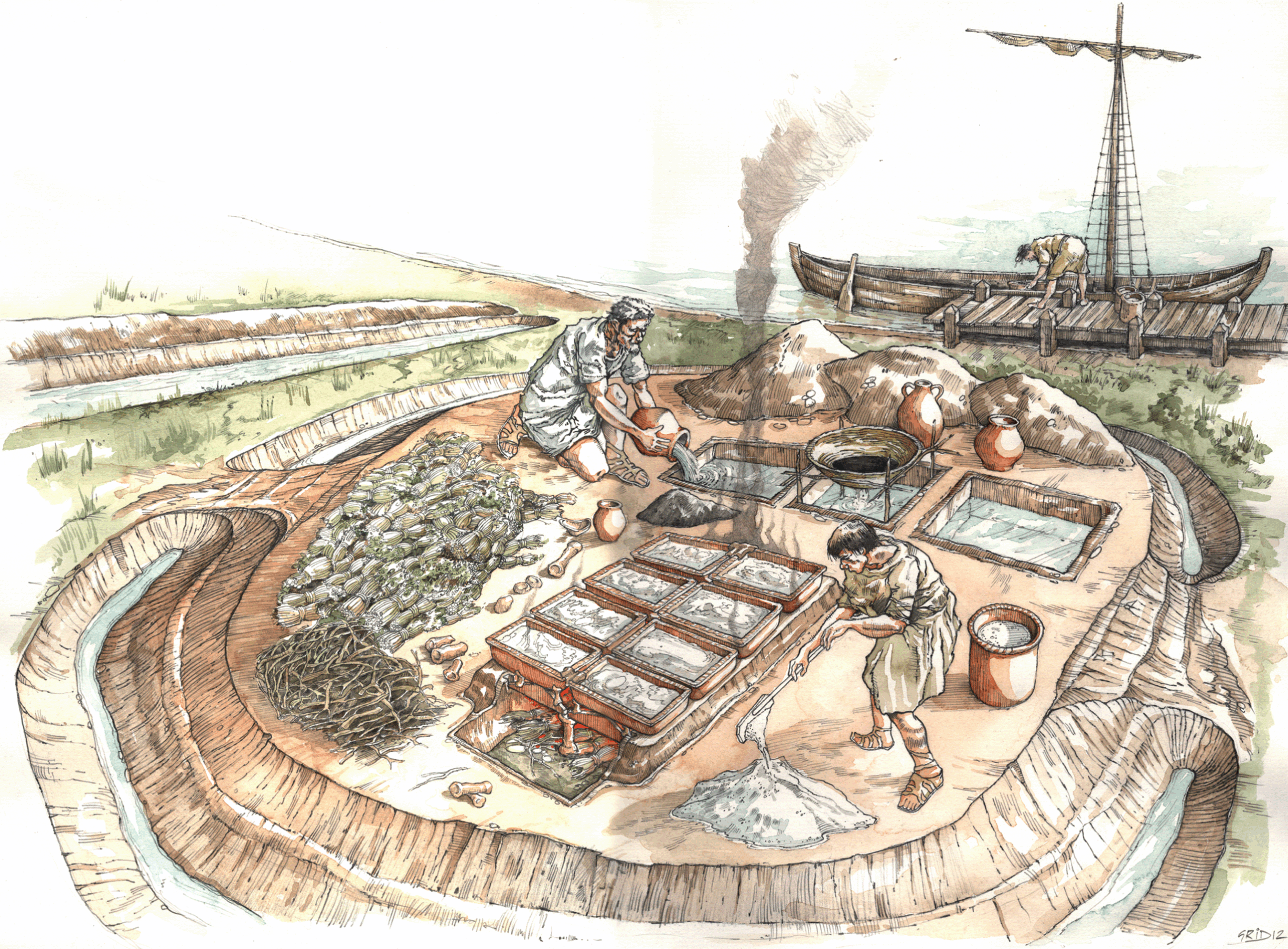
Investigating how salt production in elevated landscapes may have connected local communities with pastoral economies, regional exchange, and long-distance transport.
Introduction: Salt Above the Lowlands
High plateaus present distinctive challenges and opportunities for salt production. Some contain saline springs, mineral deposits, or salt-bearing soils, while others have limited natural sources of usable salt. Communities living in these landscapes may have developed different ways to obtain, process, and distribute this essential resource.
Salt could be produced by evaporating saline water, collecting naturally occurring deposits, or processing salt-rich soils and sediments. The method depended on local geology, climate, available fuel, and the quantity of salt required.
The archaeological study of high-plateau salt production connects technology with economic geography. A production site may reveal how people exploited local resources, while nearby routes and settlements may provide clues about where the salt went.
However, salt production is not always easy to identify archaeologically. Salt dissolves readily, and some methods leave few durable remains. Researchers must distinguish deliberate production from natural mineral accumulation and avoid assuming that every saline deposit was exploited by ancient communities.
Sources of Salt in Elevated Landscapes
Salt occurs in several geological and environmental settings. It may be present in saline springs, evaporative basins, mineral deposits, or soils affected by the movement of dissolved salts.
On high plateaus, evaporation can concentrate salts where saline water collects and subsequently loses moisture. In some locations, communities may have harvested natural deposits directly; elsewhere, they may have processed brine to obtain usable crystals.
Researchers investigate the geology and hydrology of a site to determine whether a proposed salt source was available during the relevant period. Modern springs and saline soils can provide useful comparisons, but their chemistry and accessibility may have changed through time.
Evidence of ancient exploitation may include modified basins, heating installations, specialized vessels, production waste, or repeated activity surfaces. No single feature is universally diagnostic, so interpretation depends on the combination of archaeological and environmental evidence.
Techniques for Extracting Salt
Salt production techniques differ according to the concentration of the brine and the climate. In dry environments, solar evaporation may be sufficient to concentrate saline water. Where evaporation is less effective, heating may accelerate the process.
Some communities could have collected salt directly from naturally formed deposits. Others may have used vessels or shallow basins to concentrate brine before collecting the crystals.
Archaeologists examine residues, ceramic fragments, hearths, fuel remains, and the layout of production areas to reconstruct these processes. Specialized vessels may show signs of repeated heating, but pottery exposed to fire can also be associated with cooking and other crafts.
Experimental archaeology can test proposed production methods. Researchers may reproduce plausible techniques using local materials and compare the resulting deposits with archaeological evidence. The experiments can demonstrate feasibility but cannot prove that a particular method was used without supporting context.
Salt, Pastoralism, and Subsistence
Salt has biological importance for humans and many animals. In pastoral economies, access to mineral resources can influence herd management, especially where natural sources are unevenly distributed.
Salt may also be used in food processing and preservation, although the importance of these functions varies across environments and historical periods. In high-plateau communities, its role could have included household consumption, livestock management, or exchange with neighboring settlements.
Researchers can investigate these possibilities by comparing salt-production sites with grazing areas, seasonal settlements, and routes used by people and animals. However, proximity alone does not establish a direct economic relationship.
Animal remains, settlement patterns, and environmental evidence can help reconstruct the wider subsistence system. Where historical records survive, they may clarify how salt was obtained or distributed, but their relevance must be assessed for the specific region and period.
Reconstructing Ancient Salt Routes
Salt can be transported in relatively compact quantities, but the cost and difficulty of moving it depend on distance, terrain, and available transport. High plateaus may be connected to lowland settlements through passes, valleys, rivers, and established travel corridors.
Archaeologists use geographic analysis to identify plausible routes between production areas and settlements. Evidence of roads, caravan stops, storage facilities, and associated trade goods can help reconstruct movement.
The distribution of salt itself is often difficult to trace because it leaves limited durable evidence. Researchers may therefore investigate indirect indicators, including distinctive containers, changes in settlement organization, and written references to salt exchange.
However, the movement of other goods along the same route does not prove that salt was transported there. A convincing reconstruction requires evidence linking the production site to the communities that may have consumed or exchanged its output.
Labor, Political Authority, and Control of Resources
Salt production can require specialized knowledge, organized labor, and access to water, fuel, and suitable terrain. Where production was intensive, these demands may have encouraged cooperation or competition over resources.
Some historical states regulated salt production or distribution, but such arrangements cannot be assumed for early high-plateau societies. Production might have been organized by households, communities, merchants, or local authorities.
Archaeologists investigate control through the layout of installations, storage areas, administrative evidence, and changes in production over time. Standardized facilities may suggest shared technical conventions, but they do not automatically demonstrate centralized management.
The relationship between salt production and political power must therefore be established chronologically. Salt may have contributed to the development of exchange networks or administrative systems without being the sole cause of political centralization.
Conclusion: Salt as a Link Between Highlands and Lowlands
Early salt production on high plateaus offers a way to investigate how communities exploited mineral resources and connected them with broader economic networks. Production techniques, geological settings, settlement patterns, and transport routes can help reconstruct the movement of salt across varied landscapes.
The principal challenge is distinguishing ancient exploitation from natural salt accumulation and demonstrating that particular routes carried salt rather than other goods.
By combining environmental analysis, archaeological excavation, experimental research, and landscape modeling, researchers can explore how salt supported subsistence and exchange in elevated regions. These investigations show how a relatively ordinary mineral could connect remote production sites with the wider social and economic systems of ancient communities.




